
Hawks, Eagles and Kites · Accipitridae
Red-tailed Hawk
Buteo jamaicensis
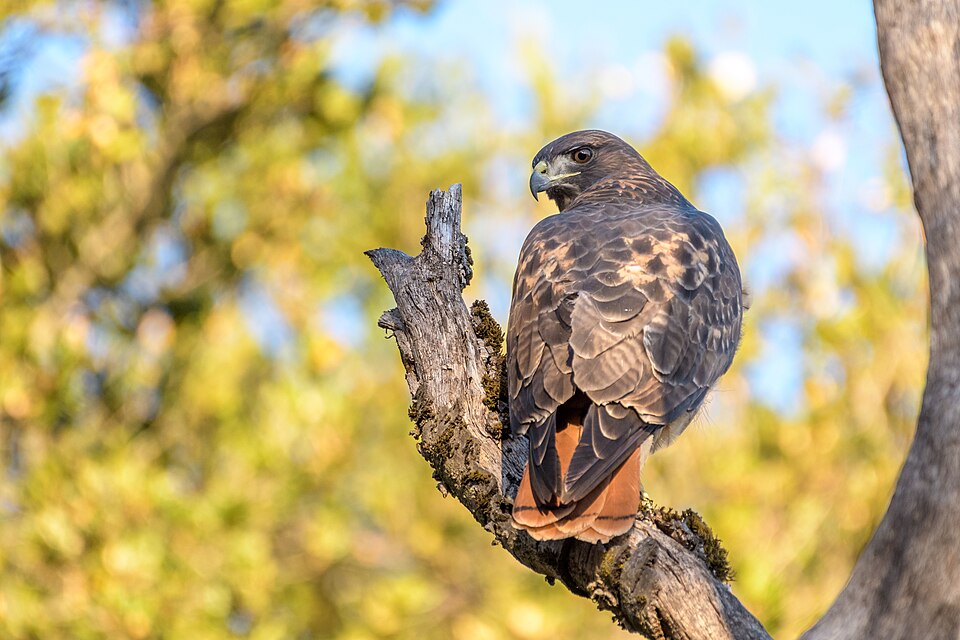
The most common large hawk in North America, often seen soaring over fields or perched on roadside poles, with a brick-red tail as an adult.
Presence varies. Bird presence and timing change with location, weather, habitat and migration. Treat this page as a starting point, then check recent local sightings (for example on eBird) before you go.
Identification features
- Big, broad-winged hawk with a short, wide tail; the tail of an adult is rusty red above.
- Dark band of streaks across the belly on many birds, especially in the East.
- Dark patch on the front edge of the inner wing seen from below in flight.
- Whitish chest and a dark head on most eastern birds, but western birds vary from pale to nearly black.
- A hoarse, descending scream that is often used in movies to stand in for other raptors.
Size and appearance
The Red-tailed Hawk is a bulky, broad-winged raptor, about the size of a heron or a large crow-sized hawk, with females larger than males. Adults typically have a reddish tail above and pale below, while juveniles have a brown, finely barred tail. East of the Mississippi River most birds have a pale chest and a band of dark streaks across the belly. West of the river, plumage varies a lot, from pale to rusty to nearly black. Harlan’s Hawk is a dark, blackish form with a mottled, whitish tail. Most birds show pale patches on the back and a dark front edge on the underwing.
Bill: A short, strongly hooked bill that tears prey.
Habitat
Red-tailed Hawks are found wherever there is open ground to hunt and a high perch to scan from. Typical places are fields, pastures, prairie groves, roadsides, and farmland with scattered trees. They also live in woodlands, deserts, mountains, and tundra edges, and a growing number nest in cities and suburbs. They place a bulky stick nest in a tall tree, on a cliff ledge, on towers or on buildings. Pairs often hold the same territory year after year and add to the nest.
Grasslands & fields Forests & woodlands Cities & parks Deserts & arid scrub Backyards & feeders
Geographic range
This is the most widespread and familiar large hawk in North America, found across the lower 48 states and Alaska, and in Canada, Mexico and Central America. Several regional forms exist: for example, the eastern form, the western form, Harlan’s Hawk (winters on the central and southern Plains and nests mainly in Alaska and northwestern Canada), and the pale Krider’s form. Hawaii is outside the range covered here. Coastal birds in the Pacific Northwest and southern Alaska usually stay put, but most birds that breed in the far north leave for winter.
Northeast Southeast Midwest Southwest Pacific West Alaska & Hawaii
Seasonal presence
In much of the country, you can see Red-tailed Hawks all year. Birds that nest in the north and in interior Alaska and Canada usually move south for winter, and so winter brings extra hawks to the central and southern states, including northern forms like Harlan’s. Migration peaks in late fall and again in early spring, with birds traveling alone on days with favorable winds. In summer, adults hold nesting territories and are conspicuous when soaring. Timing varies with weather, food and local birds, so do not count on a bird at a given date.
| Region | Spring | Summer | Fall | Winter |
|---|---|---|---|---|
| Northeast | Present | Present | Present | Present |
| Southeast | Present | Present | Present | Present |
| Midwest | Present | Present | Present | Present |
| Southwest | Present | Present | Present | Present |
| Pacific West | Present | Present | Present | Present |
| Alaska & Hawaii | Present | Present | Present | Not typical |
A dot means the species is regularly present in that region in that season. Dates shift with latitude, elevation, weather and migration, and some regions are only partly covered by the species’ range.
Diet
Small mammals such as voles, rats, rabbits and ground squirrels are the staple food. Red-tails also take birds, up to the size of a pheasant, along with reptiles such as snakes, frogs, bats, insects and carrion. The mix changes with place and season. A hawk typically watches from a high perch and swoops to the ground, or hunts by flying low over a field. Hawks should never be fed. Rodent poison can harm hawks that eat poisoned prey, so avoid using it near your yard.
Behavior
Red-tails spend long stretches perched on poles, trees and fences, then launch into a soar on rising air. In courtship, pairs circle high together, and males perform steep dives and may pass food to the female in the air. The pair builds a large stick nest, which they often reuse, and both incubate the two to three eggs. Young leave the nest after about six to seven weeks but need more time before they can fly well. Red-tails can be defensive near nests, so keep your distance and use binoculars.
Vocalizations
The classic call is a harsh, drawn-out, descending scream, often written as “kee-eeeer,” that lasts two or three seconds. It is given in flight, especially in territorial displays or when pairs soar together. Because it is so distinctive and carries so far, filmmakers often use it for other raptors, including eagles. Young birds make a begging call when they want food. Avoid using recordings to draw hawks in, especially near nests.
Recordings are not hosted on this site. For audio, see the sources below. Please avoid playing recordings to attract birds in the field. See Learning Bird Songs and Calls.
Similar species
- Swainson’s Hawk. Slimmer, with a dark chest bib and longer wings held in a slight V; a summer visitor to the Plains and West.
- Rough-legged Hawk. A winter visitor with a white tail ending in a dark band and dark patches at the wrist, often hovering.
- Red-shouldered Hawk. Smaller, with a banded black-and-white tail, reddish barred chest and a loud, repeated “kee-ah” call, in eastern woods.
Observation tips
- Scan fence posts, utility poles and treetops along highways and open fields.
- Look for a hawk soaring in circles on warm days, when rising air carries it up.
- Check the belly band and tail: pale chest, dark band, and a red tail on an adult.
- Expect more variation in plumage in the West and in winter, when northern forms arrive.
- Keep a long distance from nests, which can be on buildings and towers as well as trees.
Always keep your distance, stay on trails and leave nests alone. See How to Observe Birds Responsibly.
Conservation status
IUCN Red List: Least Concern. Audubon lists the Red-tailed Hawk as Least Concern on the IUCN list and describes it as widespread and common, with numbers that have increased in some areas since the 1960s and now appear stable or rising. Birds and their parts are protected under the Migratory Bird Treaty Act, per a secondary source. Status and trends change, so check the linked sources.
Status last checked 2026-11-03. Status and trends change, so check the linked sources for the latest. Search the IUCN Red List.
Questions and answers
Why do some Red-tailed Hawks have no red tail?
Young birds have brown, barred tails and only develop the red tail as they mature. Some adult forms, especially in the West, are dark or pale and the tail color can look different. Look at the body shape, belly band and the dark patch on the wing.
Are Red-tailed Hawks a danger to pets?
A Red-tailed Hawk mostly hunts rodents, rabbits and other small prey, but small pets left outside can occasionally attract attention. Supervising small pets outdoors is a sensible precaution. We did not verify specific numbers for this, so treat it as general advice.
Related entries
Related birds
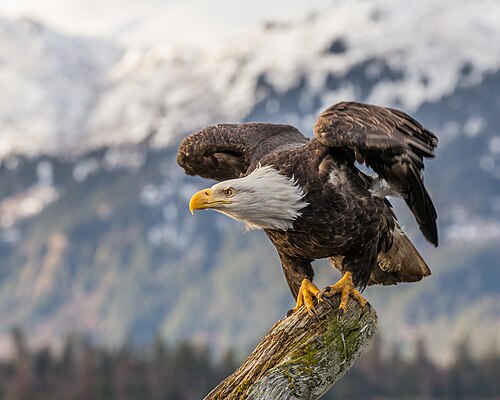
Bald Eagle
Haliaeetus leucocephalus
America’s national bird, a huge dark-brown raptor with a white head and tail that fishes along coasts, rivers and large lakes.
- Very large
- Wetlands
- Coastlines
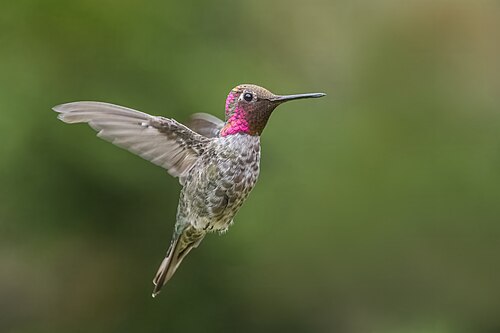
Anna’s Hummingbird
Calypte anna
A stocky Pacific Coast hummingbird with a rose-red head, now a year-round presence in many western yards and feeders.
- Tiny
- Backyards
- Cities
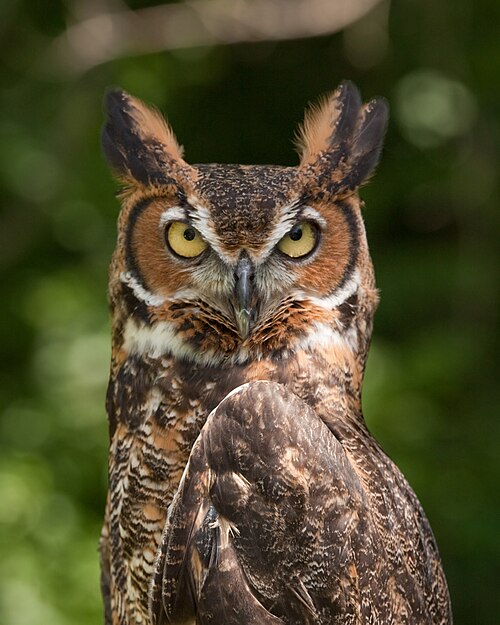
Great Horned Owl
Bubo virginianus
A big, heavy-bodied owl with feather tufts like horns and a deep, steady hoot. It lives in almost every kind of wooded or semi-open country.
- Large
- Forests
- Deserts
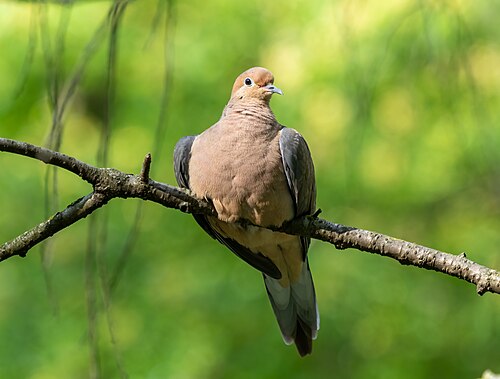
Mourning Dove
Zenaida macroura
A slim, soft gray-tan dove with a long pointed tail and a low, owl-like coo, common on wires, lawns and under feeders.
- Medium
- Backyards
- Grasslands
Related guides
Sources
Sources are the pages consulted when this entry was written. How we choose and use sources: sources and identification criteria.
Further reading (not used as a source for this entry): All About Birds, Cornell Lab of Ornithology.