
Hummingbirds · Trochilidae
Anna’s Hummingbird
Calypte anna
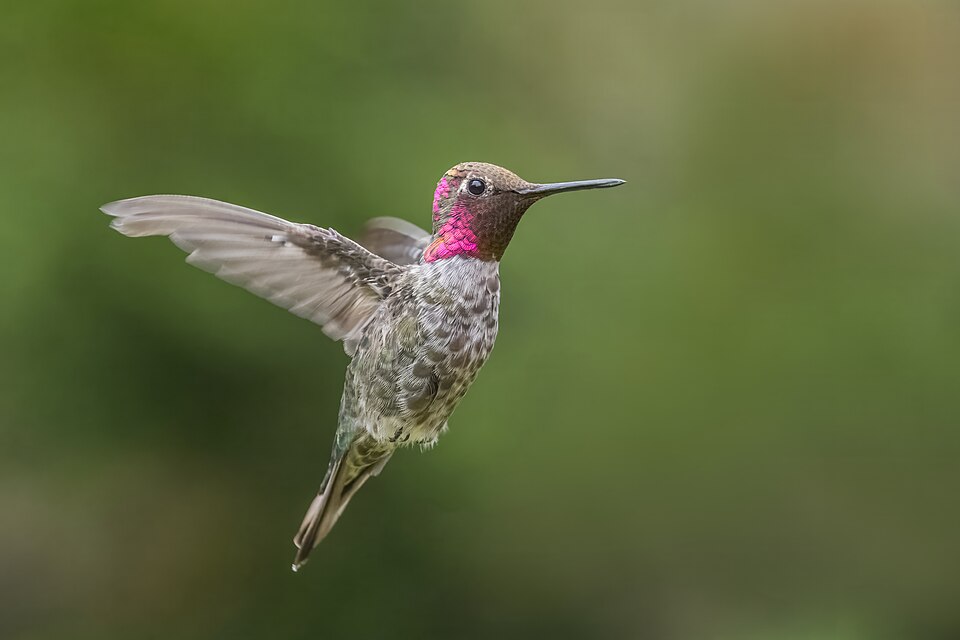
A stocky Pacific Coast hummingbird with a rose-red head, now a year-round presence in many western yards and feeders.
Presence varies. Bird presence and timing change with location, weather, habitat and migration. Treat this page as a starting point, then check recent local sightings (for example on eBird) before you go.
Identification features
- An adult male has a glittering rose-red crown and throat that can look black or gold when the light is wrong.
- Females are green above and gray below, usually with a few red spots on the throat.
- Compared with Black-chinned and Costa’s Hummingbirds, it looks stockier and holds its tail steady while hovering.
- In spring the male climbs high in a courtship display, then dives steeply and makes a sharp popping sound at the bottom.
- Males often sing a buzzy, scratchy song from a perch, which is unusual for a hummingbird.
Size and appearance
Anna’s is a small, compact hummingbird, about four inches long and weighing only a few grams. Both sexes are green on the back and gray on the underparts. The adult male’s rose-red crown and throat set him apart from nearly every other US hummingbird, and the color changes with the light, so at some angles the head looks dark. Females and young birds are plainer, but many show a patch of red spots on the throat. The wings are short and narrow, and the tail is squared or notched and stays still when the bird hovers. Next to a Black-chinned or Costa’s Hummingbird, Anna’s often looks a bit thicker-bodied.
Bill: A long, straight, slender black bill suited to reaching into tubular flowers and feeder ports.
Habitat
Anna’s Hummingbirds are at home in gardens, city parks, chaparral, and open woods, including streamside groves, open oak woodland, and coastal sage scrub. The species is most common in lowlands and on lower mountain slopes, though some birds move to high mountain meadows in late summer. It adapts very well to suburban areas, where flowering plants and feeders offer a steady supply of food. That adaptability is a big reason it is now common in places that were not part of its range a few decades ago.
Backyards & feeders Cities & parks Deserts & arid scrub Forests & woodlands
Geographic range
The core range is the Pacific Coast, from Baja California north through California and into Oregon and Washington. Since the 1950s the breeding range has grown north and east, and it now reaches British Columbia and Arizona. A 17-year study using Project FeederWatch data found that the winter range moved more than 400 miles north over about two decades, with birds settling in colder places and in areas with more housing and more feeders. Garden flowers and feeders are widely thought to have helped, but the exact causes are still being studied. Rare birds can turn up outside the usual range, so a surprise sighting should be reported carefully.
Seasonal presence
Along the Pacific Coast Anna’s Hummingbirds are year-round residents, and they stay through winter in places where no other hummingbird species does. Nesting can begin as early as December in mild areas, so spring in California can mean fledglings in February. In the Southwest, some birds move west to California after nesting in spring and return in late summer, while others stay put. At the northern edge, in places such as the Pacific Northwest, birds near winter feeders are most visible. Timing varies with location, weather, and food supply, so a bird seen one winter may not return the next.
| Region | Spring | Summer | Fall | Winter |
|---|---|---|---|---|
| Southwest | Present | Present | Present | Present |
| Pacific West | Present | Present | Present | Present |
A dot means the species is regularly present in that region in that season. Dates shift with latitude, elevation, weather and migration, and some regions are only partly covered by the species’ range.
Diet
Anna’s feeds on nectar from many flowers and on small insects, which it catches in the air or picks from leaves. Insects are especially important for growing young, which are fed small insects. At feeders it will drink sugar water. If you put one out, make the nectar by dissolving one part plain white table sugar in four parts water; tap water is fine and boiling is not required. Never add red dye, and never use honey, brown sugar, or other sweeteners, which can spoil quickly or harm the birds. Change the nectar and clean the feeder often: the Smithsonian’s National Zoo suggests every other day, at least twice a week in summer, and at least weekly in cooler weather.
Behavior
At flowers the bird usually hovers while it slips its bill and long tongue into the bloom, but at a feeder it may hover or perch. Males are strongly territorial in the breeding season and chase rivals from good flower patches or feeders. The courtship display is dramatic: the male hovers and sings, climbs much higher, then dives straight down toward the female, producing a loud pop at the bottom. Only the female builds the nest, a tiny cup of plant fibers and spider silk lined with soft down and covered with lichen, usually a few feet to about 25 feet above the ground. She incubates and feeds the young alone. If you spot a nest, enjoy it from a distance and avoid trimming the plant around it.
Vocalizations
Anna’s is one of the more vocal hummingbirds. Males sing a buzzy, scratchy, rambling song from a perch, often the same exposed twig, and the song can go on for long stretches. The usual calls are a sharp "chip" and a quick run of "chee" notes, often given when chasing a rival. The popping sound at the bottom of the courtship dive is made by the bird itself and is not a call. Because hummingbird sounds are so high and quick, listening first and looking second often leads you to the bird.
Recordings are not hosted on this site. For audio, see the sources below. Please avoid playing recordings to attract birds in the field. See Learning Bird Songs and Calls.
Similar species
- Costa’s Hummingbird. A male Costa’s has a violet crown and throat and looks slimmer. Anna’s is stockier, with a rose-red head.
- Black-chinned Hummingbird. A male Black-chinned has a black chin with a thin violet band. Anna’s has red on the head and holds its tail more steadily when hovering.
- Ruby-throated Hummingbird. Ruby-throated is the common hummingbird of the East. Only the male’s throat is red, not the crown, and the two species are not normally found together. Compare side by side
Observation tips
- Look and listen from a safe distance at flowering shrubs and feeders, especially early and late in the day.
- Use plain white sugar at a 1:4 ratio with water, no red dye, no honey. Clean the feeder each time you refill it, and replace nectar sooner in hot weather.
- Plant native nectar flowers so birds have food that does not depend on a feeder you may forget to refill.
- Do not hold a hummingbird feeder in your hand to get close. Let the bird come to a spot where it feels safe.
- If you are in the northern part of its range in winter, keep a feeder from freezing only if you can stay on top of it, since the birds rely on it on cold days.
Always keep your distance, stay on trails and leave nests alone. See How to Observe Birds Responsibly.
Conservation status
IUCN Red List: Least Concern. The IUCN lists Anna’s Hummingbird as Least Concern. Audubon calls it very common in much of its range and gives an estimated population of about 9.6 million. The breeding range has grown north and east since the 1950s. Status and trends change over time, so check the IUCN Red List and Cornell Lab pages for current information.
Status last checked 2026-11-03. Status and trends change, so check the linked sources for the latest. Search the IUCN Red List.
Questions and answers
Is it okay to keep a hummingbird feeder up in winter?
In areas where Anna’s Hummingbirds stay for the winter, birds may use feeders on cold days. If you put one out, you need to keep the sugar water fresh and fully clean the feeder each time. If you cannot commit to that, plant flowers instead.
Do I need red dye in the nectar?
No. The Smithsonian’s National Zoo says red dye is not needed to attract hummingbirds and could be harmful. Use only plain white table sugar and water, mixed one part sugar to four parts water.
Related entries
Related birds
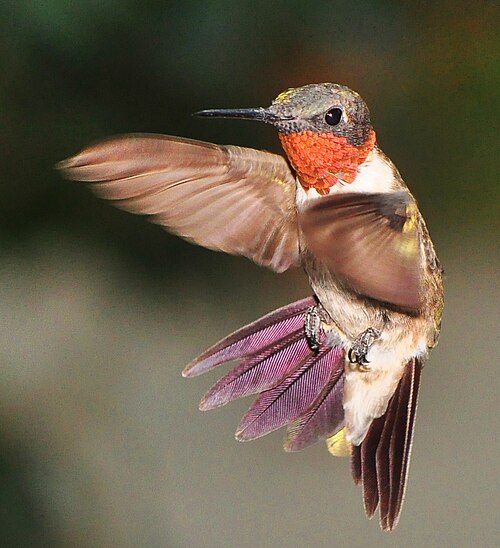
Ruby-throated Hummingbird
Archilochus colubris
The only hummingbird that breeds across eastern North America, a tiny summer visitor that migrates to Mexico and Central America.
- Tiny
- Backyards
- Forests
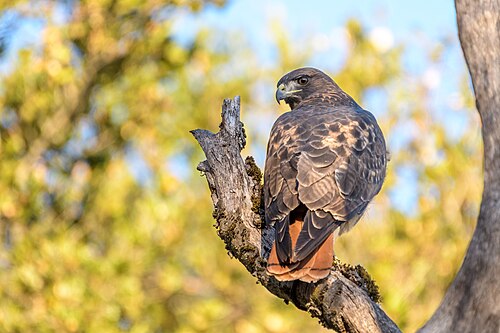
Red-tailed Hawk
Buteo jamaicensis
The most common large hawk in North America, often seen soaring over fields or perched on roadside poles, with a brick-red tail as an adult.
- Large
- Grasslands
- Forests
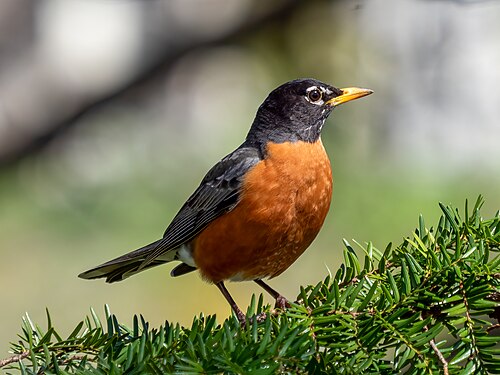
American Robin
Turdus migratorius
A gray-brown thrush with a rusty-orange breast, often seen sprinting and pausing across lawns while hunting worms.
- Medium
- Backyards
- Cities
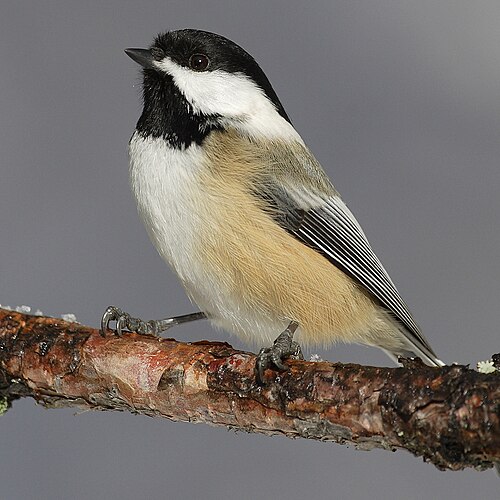
Black-capped Chickadee
Poecile atricapillus
A tiny, curious songbird with a black cap and bib, white cheeks and a clear fee-bee song. A resident across the northern states.
- Small
- Forests
- Backyards
Related guides
Sources
- Audubon Field Guide — Anna’s Hummingbird
- Project FeederWatch — Winter range expansion of a hummingbird is associated with urbanization and supplementary feeding
- Smithsonian’s National Zoo — Hummingbird Nectar Recipe
Sources are the pages consulted when this entry was written. How we choose and use sources: sources and identification criteria.
Further reading (not used as a source for this entry): All About Birds, Cornell Lab of Ornithology.