
Songs & Calls · 8 min read
Learning Bird Songs and Calls
Most birds are heard long before they are seen, and in thick leaves or low light, sound may be the only clue you get. Learning even a handful of voices makes every walk richer, and you can do it with patience and no special gear.
Songs versus calls
Birders separate bird sounds into two broad groups. Songs are the longer, more structured vocalizations, and in many songbirds they are given mostly by males during the breeding season to claim territory and attract a mate. Calls are shorter and serve everyday purposes: keeping a flock together, signaling alarm, begging for food, or announcing flight.
The line is not perfectly clean. Some species sing nearly year-round, some females sing, and some birds that are not songbirds, like doves, owls, and woodpeckers, have vocalizations or drumming that serve song-like purposes. For a beginner, the useful rule is simple: if you hear something long and musical coming from a perch, it is probably song, and if it is short, sharp, and repeated, it is probably a call.
Both matter for identification. In fall and winter, when song is rare in many regions, calls become the main way to detect and name birds.
The dawn chorus
In spring and early summer, many areas fill with song in the hour or so around sunrise. The overlapping voices can feel overwhelming at first, but that is also the best time to practice, because birds are most vocal and often sing the same phrase over and over.
Why birds sing so much at dawn is still debated. Territory defense after a quiet night and mate attraction are among the better-supported ideas, and a 2025 study of dozens of species did not find support for the old explanation that sound simply carries farther at that hour. Researchers say there is probably no single cause.
A practical approach: go out at first light, find a spot with a mix of trees and open space, and sit. Do not try to name everything. Pick the loudest or most repeated voice and track it down, then add a second voice on your next visit. Timing varies by region and season, and in much of the country the chorus fades by midsummer.
Mnemonics that actually help
A mnemonic turns a sound into words you can remember. They work because they capture rhythm and pitch pattern, which is what your ear remembers first. Treat them as memory hooks and not exact transcriptions, and feel free to make your own if the common version does not fit what you hear.
Here are a few widely used examples. The Northern Cardinal often gives clear, whistled phrases that people hear as cheer, cheer, cheer or birdy, birdy, birdy. The American Robin sings a rolling series of rising and falling phrases often described as cheerily, cheer-up. The Black-capped Chickadee says its own name in a harsh chick-a-dee-dee-dee call, and in many places also gives a clear two-note whistle, often written as fee-bee. The Blue Jay gives a loud, ringing jay-jay, and can also produce softer sounds that surprise people who know only the harsh call. The Mourning Dove has a slow, mournful cooo-OO-oo, cooo, cooo.
Test any mnemonic against a real recording, since regional dialects and individual birds vary.
Learn by families and by a few backyard birds
Trying to memorize a hundred songs at once is the quickest way to give up. Instead, learn the character of each family first. Thrushes, like the robin and bluebird, tend to sound flute-like or liquid. Sparrows often sing a repeated pattern with a clear introduction and a trill. Wrens are usually bubbly and surprisingly loud for their size. Woodpeckers rely on sharp calls and drumming. Doves coo. Chickadees and nuthatches give the nasal or buzzy calls typical of woodland flocks.
Then anchor each family with one bird you can hear every day. For many people that is a mix of the Northern Cardinal, the American Robin, the Black-capped Chickadee, and the Mourning Dove. Which of these you can hear depends on where you live; in the West, for example, you may swap in the Song Sparrow or Steller’s Jay. Once you know a few voices well, unfamiliar ones stand out, and that contrast is how learning accelerates.
The Northern Mockingbird is worth knowing as a warning. It imitates other birds and repeats each phrase several times, which can confuse beginners. If every phrase from one bird comes in a group of three or more, think mockingbird before you assume a yard full of different species.
Quiet listening practice
Good listening is a skill, and it improves with short, regular sessions. Try these steps for ten to fifteen minutes at a time.
- Stand or sit still and let your ears adjust before you move.
- Count how many different voices you can separate, without naming them.
- Pick one voice and describe it: fast or slow, high or low, a trill or a whistle, repeated or varied.
- Locate the singer with binoculars and match what you see to what you hear.
- Write down your description, then check it against a reference later.
- Note the place, time, and weather, because those details change which birds are active.
Apps and recordings, used responsibly
Phone apps can speed up learning. Merlin Bird ID, from the Cornell Lab of Ornithology, includes a Sound ID feature that listens through your phone’s microphone and shows a running list of birds it detects. It is free, and it turns recordings into spectrograms for analysis. Merlin also uses eBird records to estimate which birds are likely at your place and time of year. Coverage and the number of supported species have changed over time, so check the app for current details.
Treat the result as a lead and not an answer. Confirm by finding the bird, or at least listening again. Background noise, distant birds, and mimics can produce wrong suggestions.
Recordings are excellent for study at home. Play them on your own time, or use earbuds in the field, so only you hear them. The Cornell Lab’s Macaulay Library and similar archives hold thousands of recordings for comparison. What you should not do is play them outdoors to draw a bird closer.
A brief look at sonograms
A sonogram, also called a spectrogram, is a picture of sound. Time runs left to right, pitch runs bottom to top, and darker or brighter marks show louder sound. A flat horizontal line is a steady whistle. A vertical stack is a sharp click or noise. A zigzag is a trill.
You do not need to read sonograms to bird by ear, but watching one while a recording plays helps your brain connect what you hear with its shape. Merlin shows these as you record, and it is a good way to see why two similar songs differ.
A simple plan for your first season
Choose five birds that live near you. Check which are regional with the seasonal calendar and the songs and calls hub. Listen to each on a recording at home, then listen for them outdoors. Add one new bird every week or two. By the end of a season you will know a core group by ear, and every new voice will be easier to place.
Remember that voices vary with region and season, and many birds are silent for long stretches in fall and winter. That is normal, and calls will carry you through. For ideas on a full year of listening, see birdwatching through the seasons.
Frequently asked questions
Is it okay to play bird songs to attract birds?
Ethics guidance, including the American Birding Association’s code, advises restraint and says to avoid it around nests, rare birds, and busy birding spots. A recording can stress a territorial bird and distract it from feeding or defending young. Wait quietly instead, or use earbuds to study sounds.
When is the best time of day to learn bird songs?
Early morning in spring and early summer, around sunrise, when many birds sing most. Timing varies by region and species, and the chorus often thins as summer goes on. In fall and winter, learn calls instead, since most songbirds sing less.
Can I trust the Merlin app to name every bird I hear?
Treat it as a helpful lead and not a final answer. It can be thrown off by noise, distant birds, or mimics like the Northern Mockingbird. Try to confirm by seeing the bird or hearing it again, and compare with a reference recording.
Birds mentioned in this guide
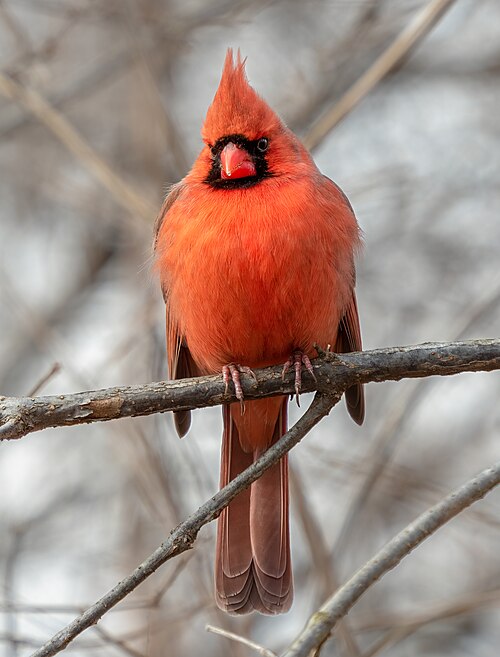
Northern Cardinal
Cardinalis cardinalis
A crested, year-round songbird. The male is brilliant red with a black face; the female is warm tan with red accents.
- Medium
- Backyards
- Forests
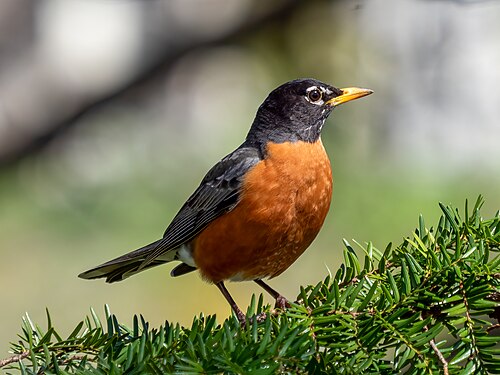
American Robin
Turdus migratorius
A gray-brown thrush with a rusty-orange breast, often seen sprinting and pausing across lawns while hunting worms.
- Medium
- Backyards
- Cities
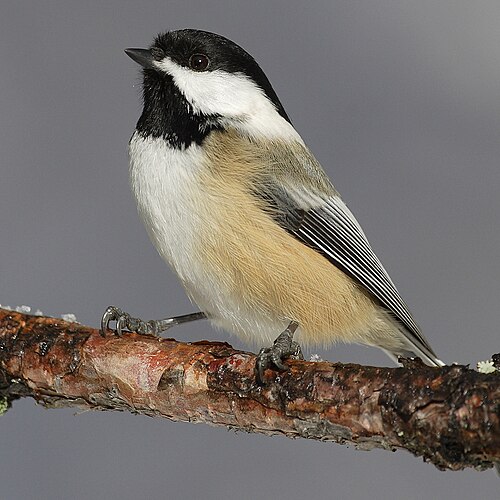
Black-capped Chickadee
Poecile atricapillus
A tiny, curious songbird with a black cap and bib, white cheeks and a clear fee-bee song. A resident across the northern states.
- Small
- Forests
- Backyards
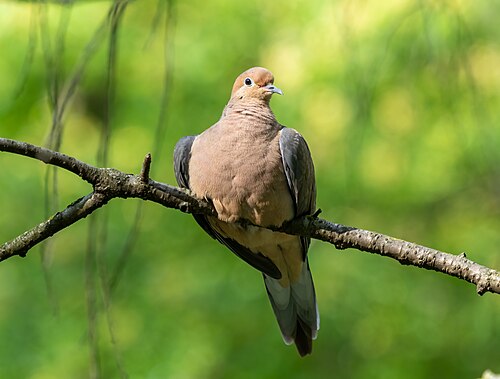
Mourning Dove
Zenaida macroura
A slim, soft gray-tan dove with a long pointed tail and a low, owl-like coo, common on wires, lawns and under feeders.
- Medium
- Backyards
- Grasslands
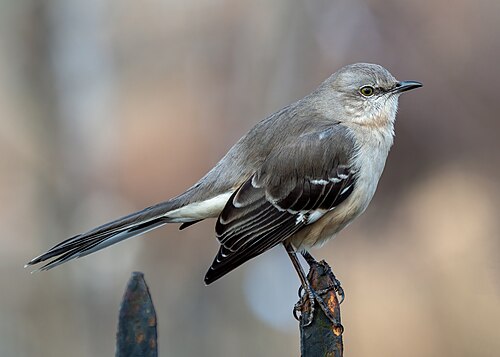
Northern Mockingbird
Mimus polyglottos
A slim gray songbird that sings from rooftops and wires, repeats borrowed phrases, and flashes white wing patches when it hops across a lawn.
- Medium
- Backyards
- Cities
Keep reading
Sources
- Cornell Chronicle — Merlin Sound ID
- Birds Outside My Window — Don’t Play It Again, Sam
- NYC Bird Alliance — Birding Law & Ethics
Sources are the pages consulted when this entry was written. How we choose and use sources: sources and identification criteria.