
Pigeons and Doves · Columbidae
Mourning Dove
Zenaida macroura
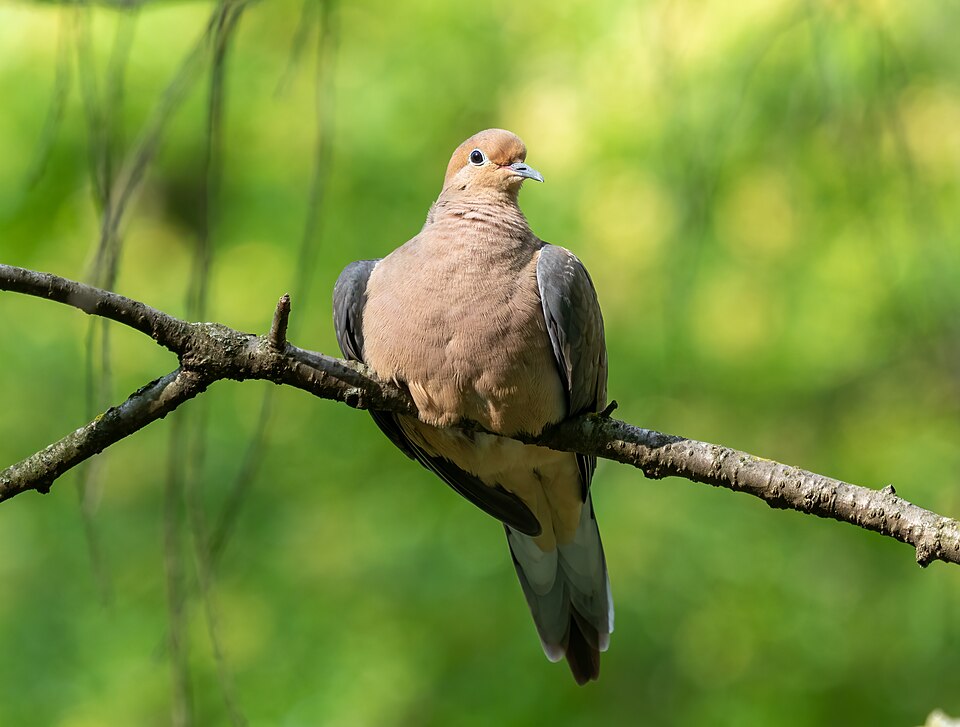
A slim, soft gray-tan dove with a long pointed tail and a low, owl-like coo, common on wires, lawns and under feeders.
Presence varies. Bird presence and timing change with location, weather, habitat and migration. Treat this page as a starting point, then check recent local sightings (for example on eBird) before you go.
Identification features
- Plain, soft gray-brown body with a small head and a few black spots on the folded wing.
- Long, pointed, wedge-shaped tail that shows white edges when the bird flies or lands.
- Small round head with a dark eye and a thin dark bill, giving a gentle, wide-eyed look.
- Adult males have a blue-gray crown and a pinkish wash on the chest; females are plainer brown.
- Takes off with a whistling flutter of the wings that is easy to hear before you see the bird.
Size and appearance
The Mourning Dove is about the length of an American Robin but looks slimmer because of its long, tapered tail. The body is a smooth gray-tan, with black spots scattered across the wings and a single dark smudge on the cheek. Males carry a pink tint on the breast and a bluish-gray cap; females are duller and browner, though the two sexes are hard to separate at a glance. In flight, the tail spreads to show a row of white spots along the edge. Young birds look scaly because of pale feather edges, and beginners sometimes mistake them for small ground-doves, which live mainly in the southern states.
Bill: A small, slim dark bill with a soft base, built for picking seeds off the ground.
Habitat
This is a bird of open and half-open places. It does well where scattered trees meet bare or short ground, such as farm fields, roadsides, suburbs, parks, prairies and desert scrub. It tends to avoid dense, unbroken forest. Nests are usually placed in a tree or shrub, but doves also use building ledges, gutters, and sometimes the ground. Because it thrives around people, you can find it in a quiet backyard, a city park or a gravel lot. A source of seed, bare ground for feeding and a nearby perch are the main things it needs.
Backyards & feeders Grasslands & fields Cities & parks Deserts & arid scrub
Geographic range
Mourning Doves are found across most of the lower 48 states and well into southern Canada, and they range south through Mexico. They are among the most widespread birds in North America. Birds in the north generally move south for winter, while many in the middle and southern states stay put. They are uncommon to rare in Alaska, so this page treats Alaska as outside the usual range. Hawaii has other dove species, which are introduced and not covered here. Numbers appear lower in parts of the West than in the East, but the species is regularly seen in every region we cover.
Seasonal presence
In much of the country you can see Mourning Doves in every season, but what you see depends on where you stand. In the northern states and Great Lakes area, many leave in fall, and the ones that remain in winter often cluster near feeders and farm fields. Spring migration moves north over roughly March to May, and fall movement runs from about September to November, usually by day and in loose flocks. In the Southeast, Southwest and southern Pacific states, doves are typically around all year. Weather, food supply and local habitat all shift these dates, so treat them as a general pattern and not a promise.
| Region | Spring | Summer | Fall | Winter |
|---|---|---|---|---|
| Northeast | Present | Present | Present | Present |
| Southeast | Present | Present | Present | Present |
| Midwest | Present | Present | Present | Present |
| Southwest | Present | Present | Present | Present |
| Pacific West | Present | Present | Present | Present |
A dot means the species is regularly present in that region in that season. Dates shift with latitude, elevation, weather and migration, and some regions are only partly covered by the species’ range.
Diet
Almost everything a Mourning Dove eats is seed. It favors waste grain and the seeds of grasses and weeds, and it picks them off the ground instead of scratching for them. Snails and a few insects are eaten now and then, but they make up a tiny share. Doves swallow small bits of grit to help grind hard seeds. At home feeders they come for millet, cracked corn, safflower and sunflower seed, and they often clean up spilled seed under a tube feeder or on a platform tray. Skip bread and processed foods, and keep the ground under feeders clean and dry so old seed does not build up.
Behavior
Mourning Doves spend most of their feeding time walking on the ground with a bobbing head and a quick, careful gait. Outside the breeding season they gather in flocks that roost together in trees or on wires. Courting males launch into the air with loud wingbeats and glide down in a wide circle, then strut with puffed chests and coo to the female. The nest is a thin platform of twigs, and the pair usually raises two young that are fed a rich milk made in the parents’ crops. A pair can raise several broods in a season, especially in warm southern areas. Nests are fragile, so do not approach them; watch from a distance with binoculars.
Vocalizations
The song is a soft, slow coo that gives the bird its name, often written as “coo-OO, coo, coo, coo.” It carries across a yard on still mornings and is sometimes mistaken for an owl, though it is higher and gentler. Males sing from a perch to attract a mate. A short, low “roo-oo” can also be heard when a bird is startled. The most noticeable sound in flight is the whistling clap of the wings at takeoff and landing. Avoid playing recordings to draw doves in, especially near nesting areas, since it can disturb breeding birds.
Recordings are not hosted on this site. For audio, see the sources below. Please avoid playing recordings to attract birds in the field. See Learning Bird Songs and Calls.
Similar species
- Eurasian Collared-Dove. Larger and stockier with a pale gray body, a black half-collar on the neck, and a squared, white-tipped tail instead of a long pointed one.
- White-winged Dove. Bulkier with a bold white stripe along the folded wing and a rounded tail, mainly in the Southwest and Texas.
- Rock Pigeon. Heavier and darker with an iridescent neck, a short square tail, and a flock-and-street habit.
Observation tips
- Scan power lines and fence posts at dawn and dusk, when doves often perch and call.
- Look under feeders and along gravel roads where doves pick seeds off the ground.
- Listen for the whistling flutter at takeoff; it helps you find a bird before you see it.
- Keep a respectful distance from nests, which are flimsy and easy to abandon if approached.
- Offer millet or cracked corn on a tray or the ground, and clean the area regularly to keep seed fresh.
Always keep your distance, stay on trails and leave nests alone. See How to Observe Birds Responsibly.
Conservation status
IUCN Red List: Least Concern. Audubon lists the Mourning Dove as Least Concern on the IUCN list and describes it as one of the most abundant birds in North America. It benefits from farmland and towns, and it is also a legal game bird in many states under federal and state rules. Status and trends change over time, so check the linked sources for current information.
Status last checked 2026-11-03. Status and trends change, so check the linked sources for the latest. Search the IUCN Red List.
Questions and answers
Why is it called the Mourning Dove?
The name comes from its low, drawn-out coo, which sounds sad or mournful to many listeners. Only the male sings it, usually from a perch. The sound is soft, so it is easy to miss unless you stop and listen on a quiet morning.
Do Mourning Doves leave in winter?
It depends on where you live. Many birds in the far north move south in fall, but doves stay through winter across much of the country. Birds seen at feeders in cold months may be local residents or visitors from farther north.
Related entries
Related birds
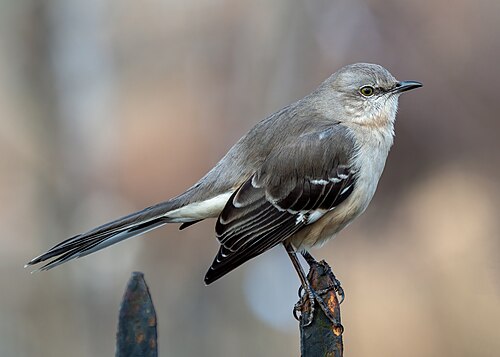
Northern Mockingbird
Mimus polyglottos
A slim gray songbird that sings from rooftops and wires, repeats borrowed phrases, and flashes white wing patches when it hops across a lawn.
- Medium
- Backyards
- Cities
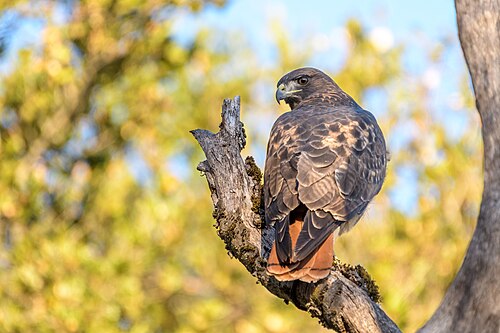
Red-tailed Hawk
Buteo jamaicensis
The most common large hawk in North America, often seen soaring over fields or perched on roadside poles, with a brick-red tail as an adult.
- Large
- Grasslands
- Forests
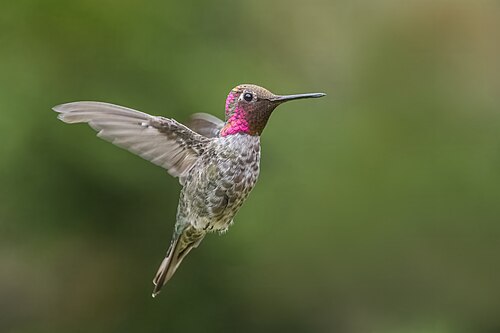
Anna’s Hummingbird
Calypte anna
A stocky Pacific Coast hummingbird with a rose-red head, now a year-round presence in many western yards and feeders.
- Tiny
- Backyards
- Cities
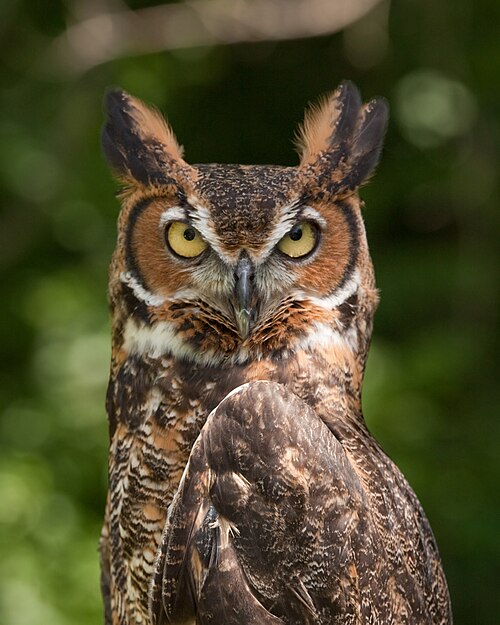
Great Horned Owl
Bubo virginianus
A big, heavy-bodied owl with feather tufts like horns and a deep, steady hoot. It lives in almost every kind of wooded or semi-open country.
- Large
- Forests
- Deserts
Related guides
Sources
Sources are the pages consulted when this entry was written. How we choose and use sources: sources and identification criteria.
Further reading (not used as a source for this entry): All About Birds, Cornell Lab of Ornithology.