
Migration · 8 min read
Understanding Migration
Twice a year, billions of birds shift between breeding and wintering areas, and many of them do it in the dark. Knowing why they go, which routes they use and how to follow the movement turns spring and fall into the most exciting seasons for a birder.
Why birds migrate
The main reason is food. Many birds breed in northern areas where long summer days and a burst of insects make it a good place to raise young. When winter cuts off that food, birds that depend on insects, nectar or open water move to places where supplies last. The trip is costly and risky, so it pays off only for species that gain a lot from both ends of the journey.
Not every bird migrates. Some, like the Northern Cardinal, mostly stay put. Others shift only partway, such as the American Robin, which many people think of as a sign of spring but which winters in large numbers across much of the U.S. Some birds are long-distance travelers, such as the Ruby-throated Hummingbird and the Barn Swallow.
Because patterns vary, treat any statement about migration as a general pattern. The same species can act differently in different parts of its range.
Even within one species, individuals differ. Some birds in the northern part of a range leave completely, while birds farther south may stay all winter. Food supply matters too: in a year with a poor seed or berry crop, some birds travel farther or show up in places they rarely visit. That is why a bird that was common last winter may be scarce this one, and why local reports are worth more than a fixed calendar.
How birds know when and where to go
Changing day length is the main trigger for the urge to migrate, working through hormones. Temperature and food supply can adjust the details. Birds kept in cages still become restless at about the usual migration time, which suggests an internal yearly rhythm.
Navigation uses several cues at once. Research summarized on Wikipedia describes the sun, star patterns, the Earth’s magnetic field, landmarks and possibly smell. Young birds on a first trip appear to have an inborn sense of direction, and they refine their skills with experience.
Scientists are still working out the details, and the answers differ among species, so you will see these ideas described with a lot of hedging.
The four flyways
North American flyways are broad routes that many birds follow between breeding and wintering areas. The U.S. Fish and Wildlife Service uses four administrative flyways to organize management: the Atlantic, Mississippi, Central and Pacific. Each has a council of state wildlife agencies. They were first drawn up with waterfowl in mind, and they are best seen as general guides rather than walls.
In simple terms, the Atlantic Flyway runs along the East Coast, the Mississippi Flyway follows the river valley and the Great Lakes region, the Central Flyway crosses the Great Plains, and the Pacific Flyway runs along the West Coast and mountains. The FWS lists Florida through Maine in the Atlantic Flyway, for example, and Alaska, California, Oregon and Washington in the Pacific Flyway.
American Bird Conservancy points out that flyways are not fixed lanes. Waterfowl often keep to particular paths, while songbird routes overlap a lot. Some species even use a different route in spring than in fall; the Blackpoll Warbler is one example, flying a long overwater leg in fall and traveling inland in spring.
Timing depends on species, weather and year
Early arrivals and late departures are normal. In many areas, spring movement builds from late winter and peaks in April and May, and fall movement runs from late summer into November, with the earliest shorebirds and swifts leaving in July or August. Those windows are rough. Timing shifts from north to south, from coast to mountains and from one year to the next.
Weather has an immediate effect. Favorable tailwinds, usually from the south in spring and from the north in fall, often trigger large movements, while storms, strong headwinds and cold snaps can stall birds or push them off course. A warm spring can bring birds early, and a cold one can hold them back.
Climate change is also shifting timing for some species, which can leave birds out of step with their food. Because of all this, never promise yourself a particular bird on a particular date. Use the seasonal calendar as a rough guide and check recent local reports.
Stopover habitat matters
Migrants do not fly nonstop. They rest and refuel at stopover sites, and many spend more of the trip time on the ground than in the air. A patch of woods, a wetland edge, a coastal dune or even a city park can be a lifeline for a tired bird.
Some shorebirds depend on a handful of key sites such as Delaware Bay, so losing one can affect an entire population. This is why wetlands, forest edges and protected coastal land matter far beyond where birds breed. Our habitat pages describe the places migrants rely on.
In your own yard, native shrubs and trees, a clean water source and fewer pesticides all help. If you see an exhausted bird, keep your distance and let it rest. Disturbing birds at a stopover costs them energy they need.
Night flights, light pollution and collisions
A large share of songbirds migrate at night, which helps them avoid predators and heat and leaves daylight for feeding. BirdCast states that more than 80 percent of migratory species in North America migrate at night. Weather radar picks up these flights as waves of echoes after dusk.
Artificial light can pull these birds off course. Bright lights and lit buildings can draw them into cities, where they circle, tire and then collide with glass in the morning. American Bird Conservancy states that more than a billion birds die each year in the U.S. from glass collisions, and it notes that low buildings and homes are also a risk, not only skyscrapers.
Lights Out programs ask building owners and residents to turn off or dim unneeded lights at night during migration seasons. Audubon runs a national Lights Out effort, and many cities have local programs. Indoors, you can switch off decorative lights, close blinds, shield outdoor fixtures so they point down and use motion sensors. Check your own city or state program for dates, since they vary.
Following migration with BirdCast
BirdCast uses weather radar to detect and predict bird movement. According to its website, it offers live migration maps, migration forecast maps, local dashboards for counties and states, and email alerts for intense migration in many U.S. cities. The live maps run during the spring and fall migration seasons, and the tools cover the contiguous United States.
The forecast shows expected bird density, not direction or species, so it tells you when a big night is likely rather than what will land. A heavy night of migration is often followed by a morning with new birds in local parks and yards, especially after a night with favorable winds and a front passing through.
Check BirdCast in the evening. Then go out early the next day, listen for calls, and look at the edges of woods and water.
Using eBird to see what has arrived
eBird, run by the Cornell Lab of Ornithology, collects sightings submitted by birders. Its maps and bar charts show when species usually appear in your county, and recent sightings show what other people are seeing near you. We could not open eBird pages while preparing this guide, so check its current features on the site itself.
Combine the two tools. BirdCast tells you if migration is likely, and eBird tells you what was seen where. Local bird clubs and regional reports add detail that national tools cannot.
When you go out, give birds room. Do not use recorded calls to draw them in, stay clear of nests, and avoid crowding a rare bird, which can drive it away from vital feeding. See our responsible birding guide and the seasonal birdwatching hub for more.
Frequently asked questions
Are the four flyways strict highways?
No. They are broad, general routes used for management and for teaching. Waterfowl tend to follow them more closely, while songbird routes overlap. Some species use a different path in spring than in fall.
When is the best time to see migrating birds?
In many areas, spring peaks around April and May and fall runs from late summer into November, but timing varies by location, species, weather and year. Check recent local reports and a migration forecast before you go.
What can I do at home to help migrating birds?
Turn off unneeded outdoor and decorative lights at night during migration, make glass more visible, keep cats indoors, grow native plants and offer clean water. Check local Lights Out programs for specific dates.
Birds mentioned in this guide
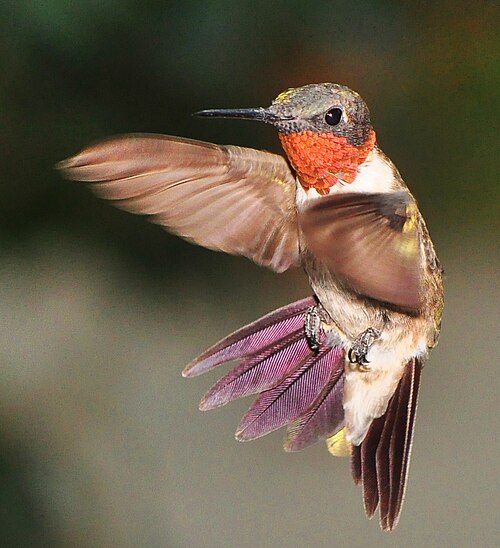
Ruby-throated Hummingbird
Archilochus colubris
The only hummingbird that breeds across eastern North America, a tiny summer visitor that migrates to Mexico and Central America.
- Tiny
- Backyards
- Forests
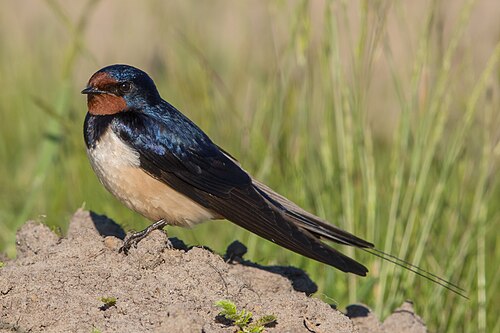
Barn Swallow
Hirundo rustica
A graceful, blue-backed swallow with a rusty throat and a deeply forked tail, often seen skimming over fields and nesting under bridges.
- Small
- Grasslands
- Wetlands
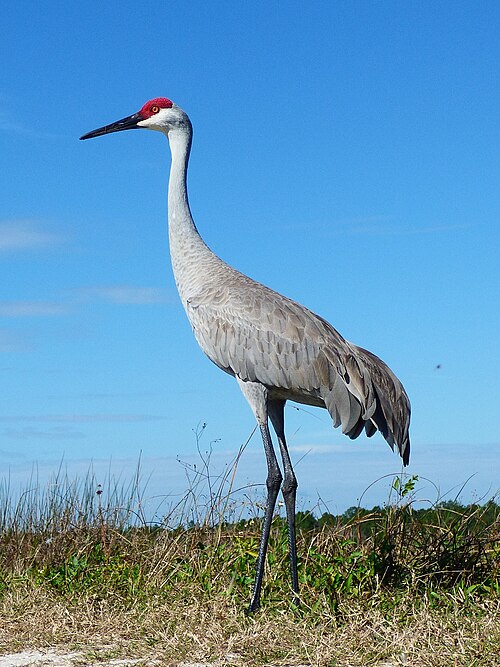
Sandhill Crane
Antigone canadensis
A tall gray crane with a red forehead, a bugling rattle, and migrations that fill Great Plains skies with hundreds of thousands of birds.
- Very large
- Wetlands
- Grasslands
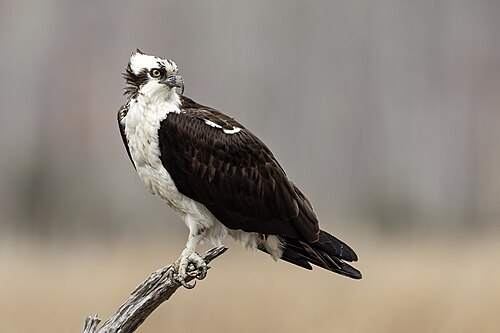
Osprey
Pandion haliaetus
A large fish-eating raptor that hovers over water and plunges feet-first for its catch. Look for its stick nests on poles and platforms.
- Large
- Wetlands
- Coastlines
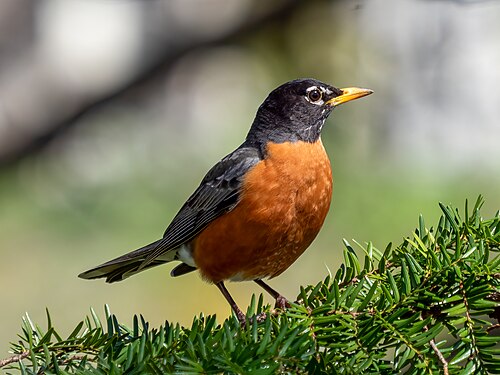
American Robin
Turdus migratorius
A gray-brown thrush with a rusty-orange breast, often seen sprinting and pausing across lawns while hunting worms.
- Medium
- Backyards
- Cities
Keep reading
Sources
- U.S. Fish and Wildlife Service: Migratory Bird Program Administrative Flyways
- American Bird Conservancy: The Four Flyways of North America
- BirdCast (Cornell Lab of Ornithology and partners)
- Bird migration (Wikipedia, secondary cross-check)
- American Bird Conservancy: Preventing Glass Collisions
Sources are the pages consulted when this entry was written. How we choose and use sources: sources and identification criteria.