
Hawks, Eagles and Kites · Accipitridae
Bald Eagle
Haliaeetus leucocephalus
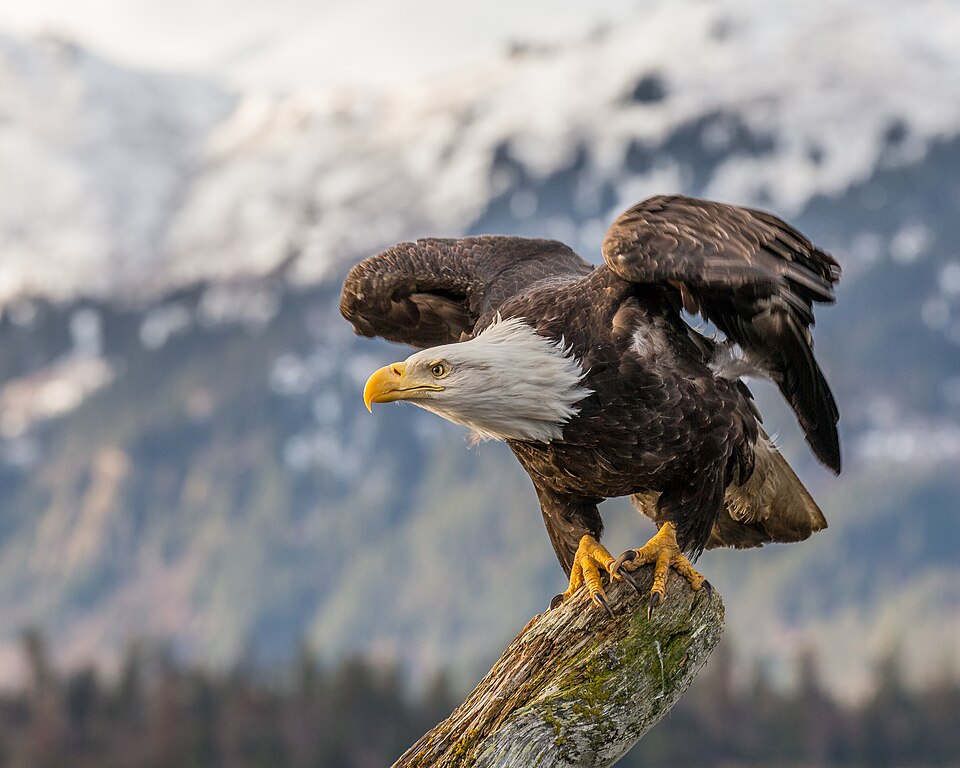
America’s national bird, a huge dark-brown raptor with a white head and tail that fishes along coasts, rivers and large lakes.
Presence varies. Bird presence and timing change with location, weather, habitat and migration. Treat this page as a starting point, then check recent local sightings (for example on eBird) before you go.
Identification features
- Very large raptor with broad, flat wings held level when soaring.
- Adults have a white head and white tail against a dark brown body, with a heavy yellow bill.
- Young birds are dark brown with white mottling and take about five years to reach adult plumage.
- The head projects far forward in flight, unlike the shorter head of a Golden Eagle.
- Usually found near water, perched high in a tree or soaring above a river or shoreline.
Size and appearance
The Bald Eagle is one of the largest birds of prey in North America, with a wingspan of about 6 feet 8 inches. The adult has a white head and tail, a dark brown body and wings, and a heavy yellow bill and eyes. Females are larger than males. Young birds look very different: they are mostly dark brown with irregular white patches and a dark bill, and they become whiter on the body over the first few years. Full adult plumage arrives at about 5 years old, so many eagles you see are not yet white-headed.
Bill: A large, hooked bill that is yellow on adults and dark on young birds.
Habitat
Bald Eagles are found near open water with fish: coasts, large rivers, lakes and reservoirs, wetlands and estuaries. They nest in tall trees near water, and in treeless areas they may use cliffs, rocky ridges or sea stacks. In winter, they gather at open rivers, below dams and wherever food is available, including dry valleys in the West that have open water. Eagles are also found at landfills and farm fields for carrion. They can nest near cities if there are large trees and a fish source nearby.
Geographic range
Bald Eagles breed throughout most of the United States and Canada, including Alaska, and they nest in every one of the lower 48 states. They also range into northern Mexico. Birds nesting in the north and interior usually migrate south, while many in the south stay all year. Juveniles disperse widely. Hawaii is outside the regular range. Southern birds and northern birds are sometimes treated as two subspecies, but you do not need that to identify them in the field.
Northeast Southeast Midwest Southwest Pacific West Alaska & Hawaii
Seasonal presence
Where you see Bald Eagles in each season depends on whether they are residents or migrants. In the south, adults often stay near their nests all year. In the north, many eagles leave between August and January, with juveniles moving earlier and farther than adults, and return to breeding areas from about January to March. Winter is a prime time for viewing in places with open water, since eagles gather along rivers, below dams and at coastal salmon streams. Timing shifts with weather and food, so check local reports. Eagles migrate singly, not in flocks.
| Region | Spring | Summer | Fall | Winter |
|---|---|---|---|---|
| Northeast | Present | Present | Present | Present |
| Southeast | Present | Present | Present | Present |
| Midwest | Present | Present | Present | Present |
| Southwest | Present | Not typical | Present | Present |
| Pacific West | Present | Present | Present | Present |
| Alaska & Hawaii | Present | Present | Present | Present |
A dot means the species is regularly present in that region in that season. Dates shift with latitude, elevation, weather and migration, and some regions are only partly covered by the species’ range.
Diet
Fish are the main food when they are available, such as salmon, herring, catfish and carp. Eagles take them by swooping from a perch, flying low over the water or wading in the shallows. When fish are scarce they eat ducks and other waterbirds, small mammals like rabbits and muskrats, turtles and crabs. They readily eat carrion, and they sometimes steal food from other eagles or Ospreys. Eagles are wild birds and should never be fed by people. Do not leave out meat or fish scraps to attract them.
Behavior
Bald Eagles pair for life unless one mate dies and usually first breed at about four to five years of age. Their stick nests are among the largest of any bird and get bigger when pairs add to them over the years. In courtship, pairs may lock talons and tumble through the air. Both parents incubate and feed the young for several months. Eagles soar on thermals and glide along coasts and rivers, and they often perch for long periods. They are sensitive to disturbance near nests, so keep well back and use binoculars or a spotting scope.
Vocalizations
The Bald Eagle’s voice surprises many people because it is weak and thin for such a large bird. The typical call is a high, squeaky, cackling chatter, with thin squeals and gull-like whistles. Movie soundtracks often substitute the powerful scream of a Red-tailed Hawk for the eagle’s real voice. Listen near nests and perches, where adults call to each other and to young. Do not play recordings to draw eagles in, especially near nests.
Recordings are not hosted on this site. For audio, see the sources below. Please avoid playing recordings to attract birds in the field. See Learning Bird Songs and Calls.
Similar species
- Golden Eagle. Adult is all dark with a golden wash on the nape, a smaller head, and feathered legs; found mostly in open and mountainous country.
- Osprey. Smaller, with white underparts, a dark eye stripe and wings that crook at the wrist in flight. Compare side by side
- Turkey Vulture. Holds its wings in a V and rocks as it soars, and the adult has a small red head.
Observation tips
- Look along rivers, lakes and coasts, especially in winter below dams or near open water.
- Scan the tops of tall trees; eagles spend a lot of time perched in plain view.
- Study young birds carefully; mottled brown birds are often first or second-year eagles.
- Stay well back from nests and roosts, and let the bird’s behavior tell you when you are too close.
- Never feed eagles or leave out carcasses to attract them.
Always keep your distance, stay on trails and leave nests alone. See How to Observe Birds Responsibly.
Conservation status
IUCN Red List: Least Concern. The Bald Eagle recovered after serious declines in the 1900s linked to hunting, DDT and habitat loss, and the US Fish and Wildlife Service removed it from the federal endangered species list in 2007. It is still protected by the Bald and Golden Eagle Protection Act and the Migratory Bird Treaty Act, which prohibit harming eagles, nests or eggs. The FWS estimated about 316,700 eagles in the lower 48 in 2018 to 2019. Status and trends change, so check the linked sources.
Status last checked 2026-11-03. Status and trends change, so check the linked sources for the latest. Search the IUCN Red List.
Questions and answers
Is the Bald Eagle still protected?
Yes. It came off the Endangered Species list in 2007, but the Fish and Wildlife Service says the Bald and Golden Eagle Protection Act and the Migratory Bird Treaty Act still apply. They prohibit killing, selling or harming eagles, nests and eggs. Check current rules with the agency.
Why do some eagles have no white head?
Young eagles are mostly dark brown with white patches and only get the white head and tail at about five years old. A brown eagle near water is often a young Bald Eagle. A Golden Eagle is also brown but is usually found in more open or mountainous areas.
Related entries
Related birds
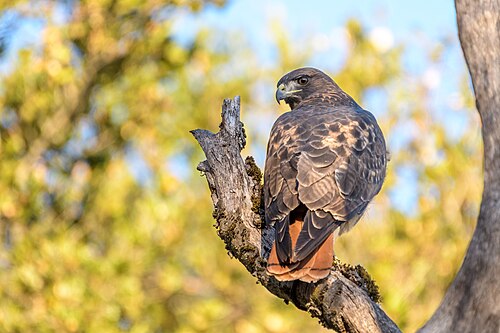
Red-tailed Hawk
Buteo jamaicensis
The most common large hawk in North America, often seen soaring over fields or perched on roadside poles, with a brick-red tail as an adult.
- Large
- Grasslands
- Forests
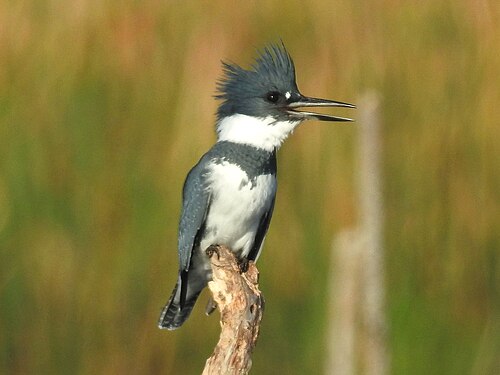
Belted Kingfisher
Megaceryle alcyon
A shaggy-crested, blue-gray waterside bird that rattles along rivers and plunges headfirst for fish.
- Medium
- Wetlands
- Coastlines
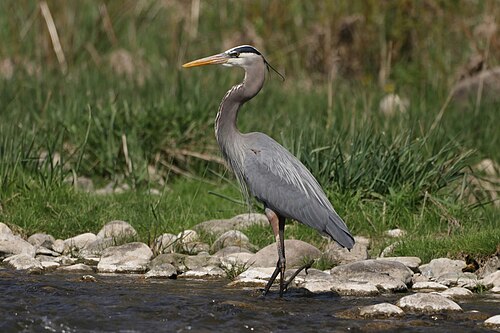
Great Blue Heron
Ardea herodias
North America’s largest heron, a tall gray-blue wader that stands motionless in shallows and strikes with a spear-like bill.
- Very large
- Wetlands
- Coastlines
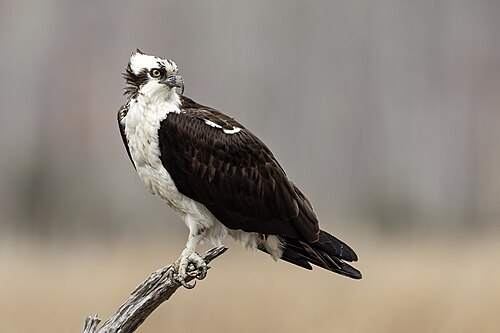
Osprey
Pandion haliaetus
A large fish-eating raptor that hovers over water and plunges feet-first for its catch. Look for its stick nests on poles and platforms.
- Large
- Wetlands
- Coastlines
Related guides
Sources
- Audubon Field Guide — Bald Eagle
- US Fish and Wildlife Service — Bald Eagle
- Wikipedia — Bald eagle (secondary cross-check)
Sources are the pages consulted when this entry was written. How we choose and use sources: sources and identification criteria.
Further reading (not used as a source for this entry): All About Birds, Cornell Lab of Ornithology.