
Bird Identification · 8 min read
Bird Identification Basics
Identifying a bird is rarely about one dramatic feature. It is about collecting several small clues and seeing which species fit all of them. This guide walks through a five-clue method, the traps that fool experienced birders, and the honest option of leaving a bird unnamed.
Start with the whole bird, not the details
Most beginners look straight for color, then flip through a field guide hoping for a match. That works for a male Northern Cardinal and fails for almost everything else. Color changes with light, season and age, while the overall build of a bird stays the same from minute to minute.
A better habit is to take a two-second mental snapshot before you reach for anything: how big, what shape, what is it doing, and where is it? Birders often use the word gestalt for this overall impression. It is just pattern recognition, and it gets sharper the more birds you look at.
The method below uses five clues. Each one narrows the list of possibilities, and no single clue has to be perfect.
Clue 1: Size and shape
Size is hard to judge in an empty sky, so compare the bird to something you know. A sparrow-sized bird is small and compact, a robin-sized bird is medium, and a crow-sized bird is large. The American Robin, Blue Jay and Mallard make handy mental yardsticks because most people have seen them.
Then look at proportions. Is the bill thick and cone-shaped for cracking seeds, thin and pointed for picking insects, long and straight for spearing fish, or hooked for tearing meat? Is the tail long, short, notched or fanned? Are the legs long enough for wading? Is the body slim and upright or round and hunched?
Bill shape alone can place a bird in a family. The Explore tool lets you filter the library by bill type, which is a quick way to practice.
Clue 2: Color pattern, not just color
Notice where the colors sit. A pale belly with a dark necklace, a wing with two white bars, a stripe through the eye, a bright patch near the tail: these patterns, often called field marks, separate look-alike species far better than a single color word.
Work from the head down. Check for an eye-ring, an eyebrow stripe, a crown stripe, a dark cap or a mask. Then look at the throat and breast, whether the underparts are streaked or plain, the wing bars, and the tail edges. Birds that look like a plain brown blur at first glance often turn out to have two or three clear marks once you slow down.
If you are not sure of a color, say so in your notes. A bird described as dull gray-brown with a pale eye-ring is more useful than a bird forced into a color you were not sure about.
- Head: eyebrow, eye-line, eye-ring, crown stripes, cap, throat patch
- Wings: bars, patches, edges of the feathers, wing tips at rest
- Underparts: streaks, spots, plain, or a contrasting breast band
- Tail: length, shape, pale or dark edges, color of the underside
Clue 3: Behavior
What a bird does often settles a close call. A small bird creeping headfirst down a trunk is a nuthatch, not a chickadee. A bird that bobs its tail constantly is behaving very differently from one that sits still and flicks its wings. See the Reading Bird Behavior guide for more on this.
Pay attention to how it moves (hopping or walking), where it feeds (ground, branches, trunk, air, water), how it flies (steady flapping, undulating, soaring, hovering) and whether it is alone or in a group. A flock of small birds feeding on the ground is a different set of candidates than a single bird perched at the top of a dead tree.
Voice is behavior too. Even a single call note can settle an identification when the view is poor. The Learning Bird Songs and Calls guide is a good companion to this one.
Clue 4: Habitat
Birds are picky about where they live. Marsh edges, mature forest, open grassland, rocky coast, desert scrub and suburban yards each hold a different cast of species. Seeing a bird in the right habitat for a candidate species is a point in favor; seeing it somewhere odd should make you slow down and double-check.
Think about layers inside a habitat as well. Some birds stay in the canopy, some in the understory, some on the ground. Our habitat pages describe what each setting looks like and which birds tend to use it.
Clue 5: Range and season
This clue removes more wrong answers than any other. Many species are only present in some regions, and many are only present part of the year. A bird that is common in the Southeast in winter may be absent from the same yard in July, and the reverse is true for summer migrants.
Range maps in field guides show where a species is usually found, often with separate colors for breeding, wintering and year-round presence. Treat them as a guide, not a guarantee. Edges shift, weather moves birds around, and every spring and fall brings a few birds outside their usual area.
Our seasonal calendar and regional guides can help you narrow the list for your location and month. For the bigger picture of why birds appear and disappear, read Understanding Migration.
Lighting, distance and other tricks of the eye
Light is the biggest source of mistakes. A bird against a bright sky becomes a dark silhouette, and every species looks black or gray. Strong sun can wash out subtle colors or make glossy feathers flash blue or green. Shade, on the other hand, can make a bright bird look dull. Moving a few steps to change your angle, when you can do it without disturbing the bird, often fixes the problem.
Silhouettes are still useful. Shape, size, wing form and flight style survive poor light, which is why experienced birders often name a bird before they see a single color.
Distance matters as well. Heat shimmer, wet feathers and puffed-up winter plumage all change how a bird looks. Binoculars help, and patience helps more. Keep your distance, move slowly and let the bird settle rather than walking toward it.
Juveniles, molt and other confusing plumages
Many birds do not look like their field-guide picture. Young birds are often streaked, spotted or duller than adults, and some resemble a different species altogether. The young American Robin has a spotted breast that surprises people who only know the adult. Males and females can also look very different, as with the Northern Cardinal.
Seasonal changes add another layer. Some birds change color between breeding and nonbreeding seasons. Molt, the replacement of worn feathers, can leave a bird with patchy, ragged or missing feathers, and a molting bird may look odd for a few weeks. Late summer and early fall are especially tricky for this reason.
When a bird does not match any picture, check whether a juvenile, female or nonbreeding plumage in the field guide fits better. Good guides and the species pages in our bird library show these variations.
Using range maps, guides and apps wisely
Field guides, range maps and identification apps are tools, not authorities. Merlin Bird ID, eBird, iNaturalist and the Audubon app are all widely used, and sound or photo suggestions can be a great starting point. Check any suggestion against what you actually saw: does the size, shape and behavior match, and is the bird plausible for your region and date?
Apps can be wrong, especially with a distant or blurry subject or a noisy recording. Treat a suggestion as a hypothesis to test, not an answer to accept.
Responsible birding applies here too. Do not play recorded songs to pull a bird into view. It can stress the bird, interrupt feeding or nesting, and pull it away from its territory, and it is especially harmful for nesting, rare or stressed birds. Our responsible birdwatching guide covers this in more detail.
When to say unknown
Some birds never give you enough. The view was too short, the light was bad, or the bird belongs to a group that even experts separate only with sound or detailed feather study. Saying it was one of the small brown birds and leaving it there is honest, and it is better than a confident guess that ends up in a record and misleads someone else.
A useful unknown note records what you did see: size compared with a familiar bird, bill shape, the two or three clearest marks, behavior, habitat, date and place. Come back later, compare with a guide, and ask a local birder or club. A narrowed answer such as probably a sparrow of some kind is a perfectly good result for the day.
Over time, the unknowns shrink. Each one you work through teaches you what to look at next time. If you want a faster way to narrow candidates, try the Bird Finder tool or compare two look-alikes side by side.
Frequently asked questions
What is the first thing I should look at when identifying a bird?
Overall size and shape, followed by what the bird is doing. These stay the same in poor light and at a distance, while color often does not. Add color pattern, habitat, and your location and date to narrow the list.
Can I rely on an app to identify birds for me?
Apps are useful starting points, but they can be wrong, especially with blurry photos or noisy recordings. Check the suggestion against the size, shape, behavior, habitat and range you actually observed before accepting it.
Is it okay to play bird songs to see a bird better?
It is best avoided. Playback can stress birds and pull them from feeding or nesting, and that matters most for nesting, rare or stressed birds. Wait quietly, use binoculars and let the bird come into view on its own.
Birds mentioned in this guide
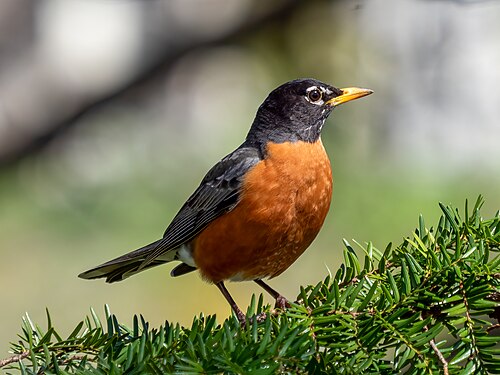
American Robin
Turdus migratorius
A gray-brown thrush with a rusty-orange breast, often seen sprinting and pausing across lawns while hunting worms.
- Medium
- Backyards
- Cities
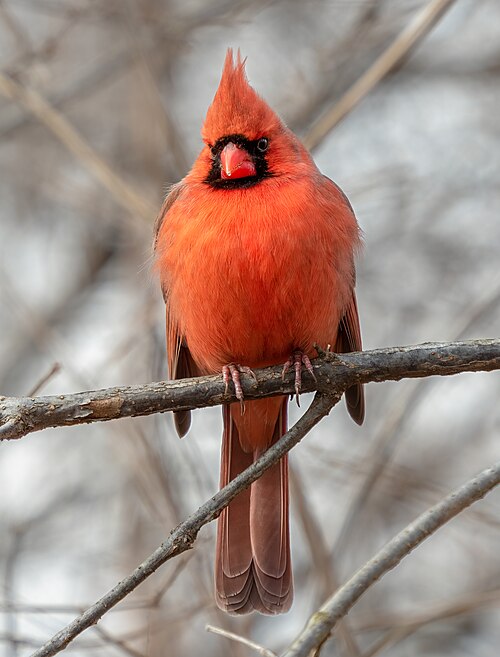
Northern Cardinal
Cardinalis cardinalis
A crested, year-round songbird. The male is brilliant red with a black face; the female is warm tan with red accents.
- Medium
- Backyards
- Forests
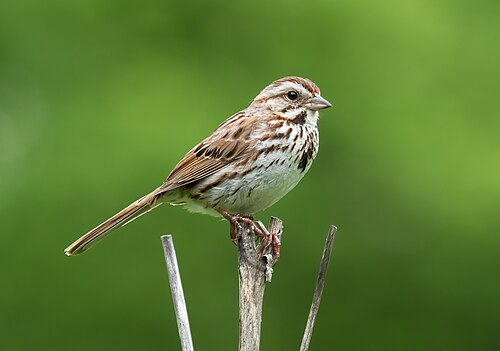
Song Sparrow
Melospiza melodia
A streaky, medium-sized sparrow with a central breast spot and a loud, varied song. It turns up in thickets, marsh edges and yards across the continent.
- Small
- Wetlands
- Backyards
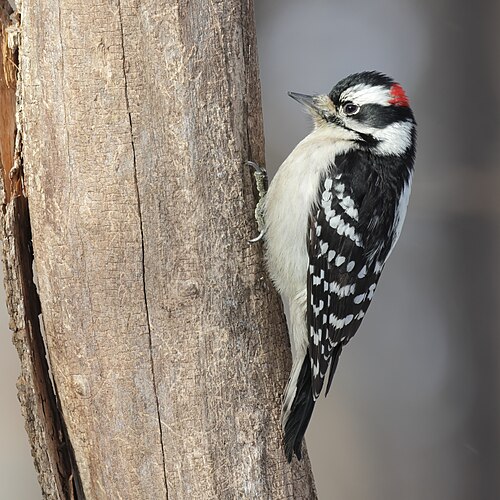
Downy Woodpecker
Dryobates pubescens
The smallest woodpecker in North America, a black-and-white bird with a short bill that visits suet feeders and tiny branches.
- Small
- Forests
- Backyards
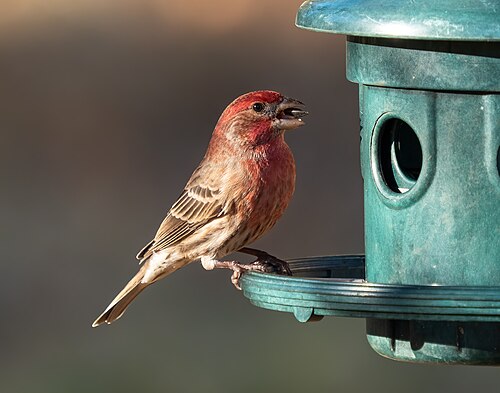
House Finch
Haemorhous mexicanus
A streaky brown finch. Males have a red head and chest. Native to the Southwest and now widespread in cities across the US.
- Small
- Cities
- Backyards
Keep reading
Sources
- Birdwatching (Wikipedia, secondary cross-check)
- Bird migration (Wikipedia, secondary cross-check)
- American Bird Conservancy: The Four Flyways of North America
Sources are the pages consulted when this entry was written. How we choose and use sources: sources and identification criteria.