
Typical Owls · Strigidae
Great Horned Owl
Bubo virginianus
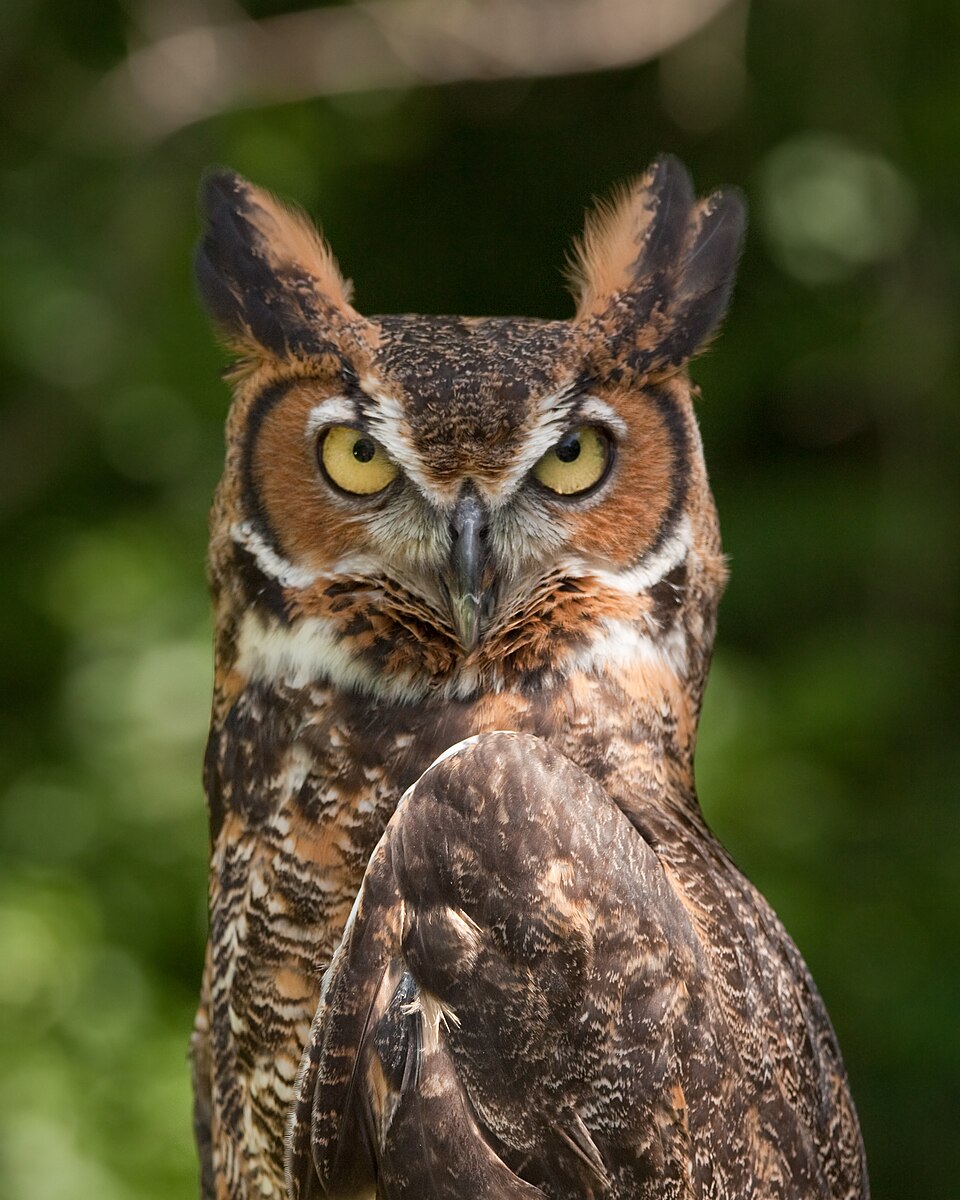
A big, heavy-bodied owl with feather tufts like horns and a deep, steady hoot. It lives in almost every kind of wooded or semi-open country.
Presence varies. Bird presence and timing change with location, weather, habitat and migration. Treat this page as a starting point, then check recent local sightings (for example on eBird) before you go.
Identification features
- Look for a large, bulky owl with two prominent feather tufts rising from the top of the head.
- A white patch on the throat shows clearly against the mottled brown and gray body.
- The belly and chest carry fine horizontal bars rather than vertical streaks.
- The face is a rounded disk, often rusty or buff, with big yellow eyes.
- In flight the wings look broad and rounded, and the tail is fairly short and rounded.
- A low series of hoots, usually heard at dusk or at night, is often the first sign it is there.
Size and appearance
This is one of the largest and heaviest owls across much of North America, with a thick body and a big head. Its plumage is a blend of mottled brown, gray and buff that matches bark very well, set off by a white throat and a barred belly. The two ear tufts are feathers, not ears, and they can be raised or flattened with the bird’s mood. Eyes are yellow. Females are larger than males, though the difference is hard to judge on a single bird. Facial color varies with region, from rusty to pale gray. Young birds look fluffier and often have a downy gray-buff look before they take on adult feather patterns.
Bill: A short, dark, sharply hooked bill that is partly hidden by facial feathers.
Habitat
Few North American birds use as many habitat types. It occurs in forests, woodlots, wooded stream corridors, farm country, deserts, swamps, parks and the edges of towns, and in the north it reaches conifer forest near treeline. For nesting it needs some trees, cliffs or heavy brush, so it generally avoids open tundra and large unbroken grassland during the breeding season. Daytime roosts are usually in dense trees, thick conifers or on shaded ledges, where the plumage disappears into the background. Hunting takes place over adjacent open ground such as fields, clearings and marsh edges.
Forests & woodlands Deserts & arid scrub Cities & parks Grasslands & fields
Geographic range
The Great Horned Owl lives across most of North America, from the northern forests south through every region of the lower 48 and on into Mexico and much of South America. In the US it is found in every region covered by this guide, though Alaska is not included in the season grid here because the sources opened did not spell out its status there. It is generally a permanent resident rather than a migrant. A few individuals wander long distances in fall and winter, and some of those move south, so a bird can show up outside its usual range. Subspecies differ in tone across the continent.
Seasonal presence
Because most Great Horned Owls stay on their territories all year, there is no real arrival date to wait for. Late fall and winter are good times to listen, since pairs are vocal as they prepare to nest, and in northern areas nesting can begin in late winter. Leafless trees make daytime roosts easier to notice then. Spring and summer bring fledglings that sit on branches near the nest site and beg with raspy calls. Fall can bring some wandering birds. Exact timing varies with latitude, elevation and weather, so a pattern that holds in Georgia may be weeks off in Minnesota.
| Region | Spring | Summer | Fall | Winter |
|---|---|---|---|---|
| Northeast | Present | Present | Present | Present |
| Southeast | Present | Present | Present | Present |
| Midwest | Present | Present | Present | Present |
| Southwest | Present | Present | Present | Present |
| Pacific West | Present | Present | Present | Present |
A dot means the species is regularly present in that region in that season. Dates shift with latitude, elevation, weather and migration, and some regions are only partly covered by the species’ range.
Diet
Great Horned Owls are powerful, flexible predators. Most of what they take is mammals, including mice, rats, rabbits, ground squirrels, opossums and even skunks. They also catch birds, from small songbirds to ducks and hawks, and now and then smaller owls. Reptiles, frogs, large insects, scorpions and rarely fish fill in the gaps. In cold northern winters they may cache extra prey and later thaw frozen items by sitting on them. They do not visit feeders, though they may hunt animals that gather around them. Prey choice depends heavily on what is common locally.
Behavior
This owl is mostly nocturnal, with some activity at dusk. It usually watches from a high perch and then drops silently onto prey, using sharp hearing and strong vision in dim light. Pairs hold territories year-round. In the north, courtship starts early, with the male giving display flights and bringing food to the female. Rather than building from scratch, Great Horned Owls typically take over an old nest made by another large bird, such as a hawk, heron or crow, or use a cavity or ledge, and add little to it. The female does the incubating while the male hunts. Young leave the nest at roughly five weeks, often clambering about on nearby branches before they can fly, and parents keep feeding them for months. A fledgling on the ground is usually still being cared for by adults, so leave it alone.
Vocalizations
The classic call is a series of low, soft hoots with a rhythm of roughly five notes, where the second and third are shorter than the rest, often written as hoo, hoo-hoo, hoo, hoo. Pairs may call back and forth, with the female’s voice higher in pitch than the male’s. Other sounds include barks, shrieks, hisses and bill snaps, which are more common near nests or when the owl feels threatened. Young birds give harsh, raspy begging screeches. Hooting is most frequent from late fall through winter. Recordings should not be used to draw an owl in, since that stresses the bird.
Recordings are not hosted on this site. For audio, see the sources below. Please avoid playing recordings to attract birds in the field. See Learning Bird Songs and Calls.
Similar species
- Long-eared Owl. Long-eared Owls are much smaller and slimmer, with longer, closer-set tufts and vertical streaks on the belly rather than horizontal bars.
- Barred Owl. Barred Owls have no ear tufts, dark eyes and a rounded head, and they give a rhythmic hoo-hoo call, often written as who-cooks-for-you.
- Short-eared Owl. Short-eared Owls hunt over open fields in daylight or dusk, have tiny tufts that rarely show and are paler and longer-winged in flight.
Observation tips
- Never approach a roost or nest. Owls that are flushed from daytime roosts lose rest, and nests can be abandoned or exposed to predators when people crowd in. Scan with binoculars from a long distance instead.
- Avoid playing owl recordings to draw one out. It disrupts hunting and nesting and stresses territorial birds, and in many parks and refuges it is not allowed.
- Listen at dusk from late fall through winter. Stand quietly at a field edge or wooded border and let the hooting come to you.
- Look for clues rather than the bird: whitewash on branches and trunks, regurgitated pellets under a roost tree, and crows or jays mobbing something in a conifer.
- If you find a young owl on the ground or low on a branch, keep your distance. Parents are usually close by, and leaving the area is the best help you can give.
Always keep your distance, stay on trails and leave nests alone. See How to Observe Birds Responsibly.
Conservation status
IUCN Red List: Least Concern. The IUCN lists the Great Horned Owl as Least Concern, and Audubon describes it as widespread and common with numbers that appear stable in most areas. Status and trends change over time, so check the IUCN Red List for the current assessment. This guide did not verify specific US legal protections.
Status last checked 2026-11-03. Status and trends change, so check the linked sources for the latest. Search the IUCN Red List.
Questions and answers
Are the horns on a Great Horned Owl actually ears?
No. The tufts are just feathers that the owl can raise or lower, probably to help with camouflage and signaling. The real ear openings are on the sides of the head, hidden under facial feathers, and they are quite sensitive.
Do Great Horned Owls migrate?
Mostly not. Adults generally stay put year-round, though some individuals wander long distances in fall and winter and a number of them head south. That is why one occasionally appears well away from its normal range.
Related entries
Related birds
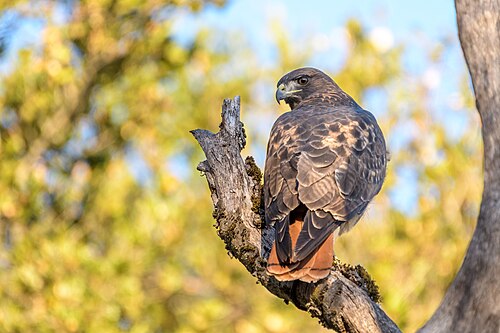
Red-tailed Hawk
Buteo jamaicensis
The most common large hawk in North America, often seen soaring over fields or perched on roadside poles, with a brick-red tail as an adult.
- Large
- Grasslands
- Forests
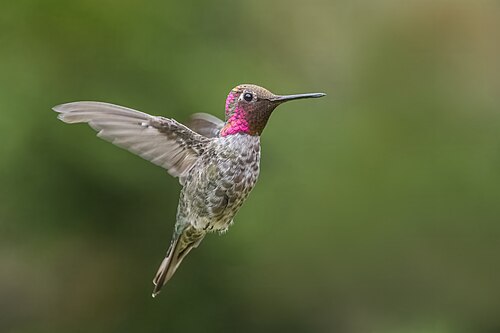
Anna’s Hummingbird
Calypte anna
A stocky Pacific Coast hummingbird with a rose-red head, now a year-round presence in many western yards and feeders.
- Tiny
- Backyards
- Cities
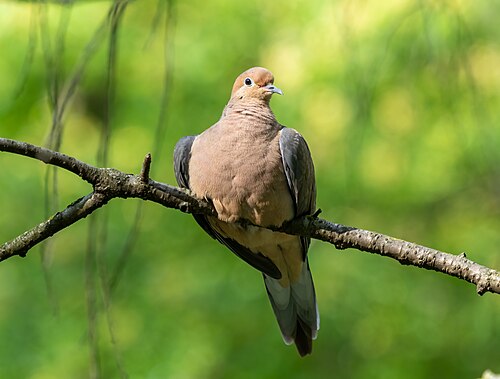
Mourning Dove
Zenaida macroura
A slim, soft gray-tan dove with a long pointed tail and a low, owl-like coo, common on wires, lawns and under feeders.
- Medium
- Backyards
- Grasslands
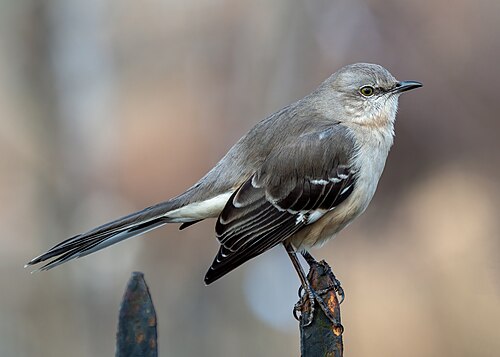
Northern Mockingbird
Mimus polyglottos
A slim gray songbird that sings from rooftops and wires, repeats borrowed phrases, and flashes white wing patches when it hops across a lawn.
- Medium
- Backyards
- Cities
Related guides
Sources
- Audubon Field Guide — Great Horned Owl
- Wikipedia: Great horned owl (secondary cross-check of the IUCN category)
Sources are the pages consulted when this entry was written. How we choose and use sources: sources and identification criteria.
Further reading (not used as a source for this entry): All About Birds, Cornell Lab of Ornithology.