
New World Sparrows · Passerellidae
Song Sparrow
Melospiza melodia
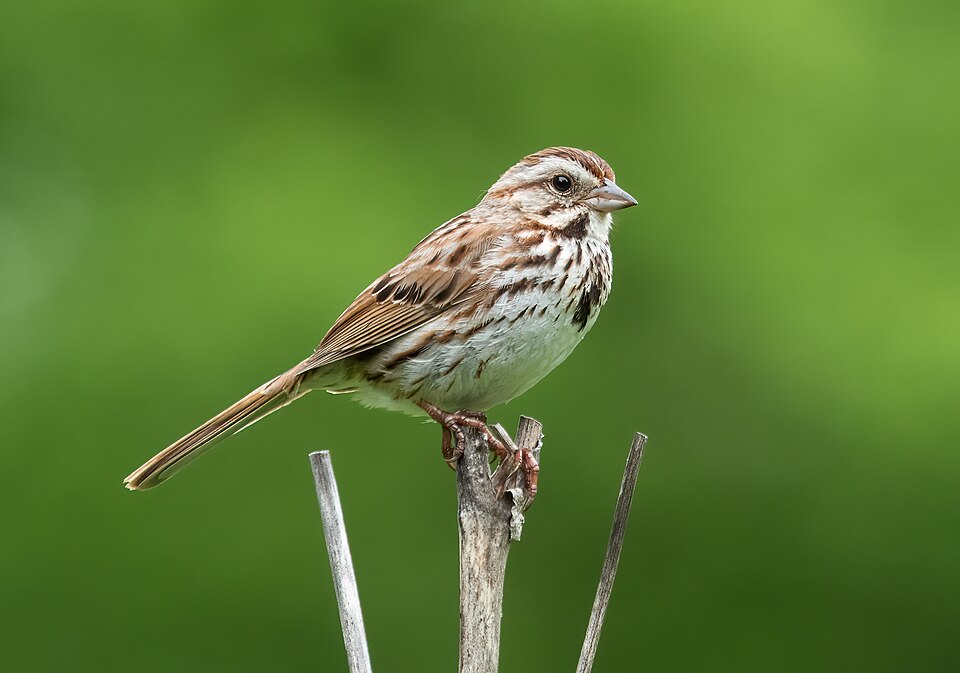
A streaky, medium-sized sparrow with a central breast spot and a loud, varied song. It turns up in thickets, marsh edges and yards across the continent.
Presence varies. Bird presence and timing change with location, weather, habitat and migration. Treat this page as a starting point, then check recent local sightings (for example on eBird) before you go.
Identification features
- Look for heavy brown streaks on the breast that often merge into a dark central spot.
- The face is boldly marked, with a gray eyebrow and a dark stripe behind the eye and whisker marks beside the throat.
- The tail is fairly long and often pumps in flight, as the bird flies from bush to bush.
- Plumage differs by region, from large dark birds in the Aleutians to small pale birds in the desert Southwest.
- The song often begins with a few clear repeated notes before a jumbled trill.
- It is usually seen low, in or near thick vegetation, and frequently near water.
Size and appearance
A Song Sparrow is a medium-sized, round-headed sparrow with a rather long, rounded tail. The back is brown with darker streaks, the face is gray and brown with a striped pattern, and the breast carries thick brown streaks that often come together in a dark central spot. Males and females look alike. Appearance changes a great deal across the huge range. Birds from the Pacific Northwest and Alaska are dark and rich, while desert birds are pale and gray. Eastern birds sit somewhere in between. A bird that doesn’t seem to match a field guide picture may just be a regional form. Juveniles are paler and streakier overall.
Bill: A short, brownish, seed-cracking bill, slightly pointed.
Habitat
Song Sparrows favor tangled, low vegetation, especially near water. Typical places include brushy fields, streamsides, shrubby marsh edges, woodland edges, hedgerows, roadside thickets and well-planted gardens. In some coastal areas, local populations live in salt marshes. They need cover to hide in but open ground to forage on, so the border between thick brush and an open edge is ideal. In winter the same sorts of habitat are used, often with more birds from the north. Feeders placed next to dense shrubs may attract them.
Wetlands & water edges Backyards & feeders Grasslands & fields Forests & woodlands
Geographic range
Song Sparrows occur across most of North America, from the Aleutian Islands and southern Alaska across Canada to the Atlantic coast, and south through the US into northern Mexico and the Mexican Plateau. Many subspecies exist, and they vary in size and color. Birds in the southern half of the range and along the Pacific coast are generally resident, while those breeding in the northern interior and the East move south in winter, reaching the southern US. In Alaska, some populations migrate and others stay. Exact movements differ a lot by subspecies and location.
Northeast Southeast Midwest Southwest Pacific West Alaska & Hawaii
Seasonal presence
In the Pacific states, the Southwest and much of the Midwest and Northeast, Song Sparrows can often be seen in every season, though winter populations include birds that bred farther north. Across the Southeast, they mostly appear as migrants and winter visitors, usually from fall through spring. In Alaska, many leave in autumn and return in spring, while some island and coastal birds stay. Song begins to sound in late winter and peaks in spring. Timing varies with weather and location, so a bird in your yard in January may be local or a winter arrival from far north.
| Region | Spring | Summer | Fall | Winter |
|---|---|---|---|---|
| Northeast | Present | Present | Present | Present |
| Southeast | Present | Not typical | Present | Present |
| Midwest | Present | Present | Present | Present |
| Southwest | Present | Present | Present | Present |
| Pacific West | Present | Present | Present | Present |
| Alaska & Hawaii | Present | Present | Present | Not typical |
A dot means the species is regularly present in that region in that season. Dates shift with latitude, elevation, weather and migration, and some regions are only partly covered by the species’ range.
Diet
Song Sparrows eat mostly insects and seeds. In summer they take many insects such as beetles, caterpillars and grasshoppers, which also feed their young, and in fall and winter they rely heavily on grass and weed seeds. Coastal and island birds also pick up small crustaceans and snails. They forage mostly on the ground, scratching in leaf litter and sometimes wading in very shallow water, and they also work through shrubs and low trees. At feeders they will take millet, cracked corn and black oil sunflower seed, usually from the ground or a low tray, and they stay close to cover.
Behavior
Song Sparrows can be secretive, dropping into thickets when disturbed, but they are often easy to see because they are common. They fly low from bush to bush with a pumping tail. Males sing from a prominent perch such as a shrub top, fence or reed stem to defend a nesting territory, and territories are often small, so many pairs may live close together in good habitat. Nests are built low in dense vegetation, either on the ground or in a low shrub, and females incubate the eggs. Pairs can raise more than one brood in a season. In winter they may join loose mixed flocks with other sparrows, though they usually remain within dense cover. Staying out of thickets in spring helps protect hidden nests.
Vocalizations
The song is a musical, varied phrase that typically begins with three or four short, clear notes, often written as sweet sweet sweet, and then slides into a buzzy trill or a jumble. Each male has several song versions, and songs differ between regions, so no two sound exactly alike. The usual call is a sharp, flat chip or chimp, and birds also give buzzes, trills and thin whistles. Song is heard most in spring but may start on warm days in late winter. Recordings should not be used to attract birds, particularly on nesting territories.
Recordings are not hosted on this site. For audio, see the sources below. Please avoid playing recordings to attract birds in the field. See Learning Bird Songs and Calls.
Similar species
- Lincoln’s Sparrow. Lincoln’s Sparrows are smaller and neater, with fine, delicate streaking on a buff wash across the chest and no strong central spot.
- Savannah Sparrow. Savannah Sparrows have a shorter tail, usually a yellow tinge in front of the eye, and live in open fields rather than shrubby edges.
- Fox Sparrow. Fox Sparrows are larger and chunkier, often with a rusty or gray-brown color and heavy, blotchy spots rather than the Song Sparrow’s streaks.
Observation tips
- Check shrub tops and fence posts at dawn in spring, when males sing from open perches.
- Set a feeder or a seed tray near dense brush. Song Sparrows prefer to eat close to cover and will dart back into it.
- Stay on paths in marshes and thickets during the nesting season, since nests are low and hard to see.
- Do not play song recordings to bring one into view. Territorial males waste energy answering and may neglect their nest.
- Learn the song’s opening notes first, and then compare birds from different regions, because plumage and song both vary widely.
Always keep your distance, stay on trails and leave nests alone. See How to Observe Birds Responsibly.
Conservation status
IUCN Red List: Least Concern. The IUCN lists the Song Sparrow as Least Concern, and Audubon describes it as widespread and abundant, though some local populations, especially in coastal marshes, are vulnerable to habitat loss. Status and trends change over time, so check the IUCN Red List for the current assessment. This guide did not verify specific US legal protections.
Status last checked 2026-11-03. Status and trends change, so check the linked sources for the latest. Search the IUCN Red List.
Questions and answers
Do Song Sparrows migrate?
It depends on where they live. Birds in the southern half of the range and along much of the Pacific coast stay all year. Many from the northern interior and the East head south in winter, so winter birds in a yard may have come from farther north.
Why do Song Sparrows look so different in different places?
The species has many regional forms. Birds in wet Pacific Northwest and Alaska habitats are large and dark, desert birds are small and pale, and eastern birds fall in between. They are all the same species, though.
Related entries
Related birds
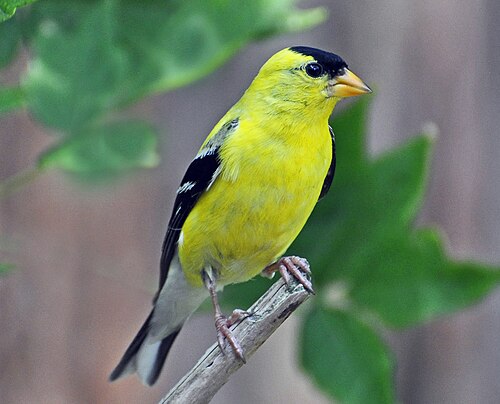
American Goldfinch
Spinus tristis
A small seed-eating finch. Breeding males are bright yellow with a black cap; winter birds turn a muted tan-olive.
- Tiny
- Grasslands
- Backyards
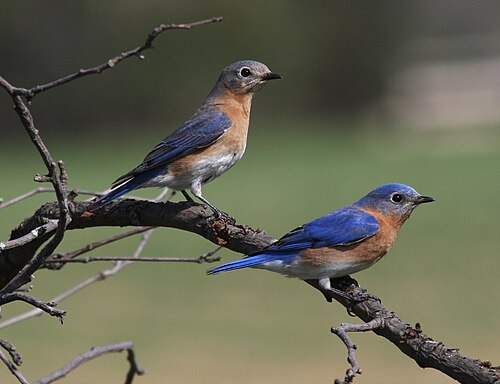
Eastern Bluebird
Sialia sialis
A small thrush of open country: the male is bright blue above with a rusty throat and chest, and a white belly.
- Small
- Grasslands
- Backyards
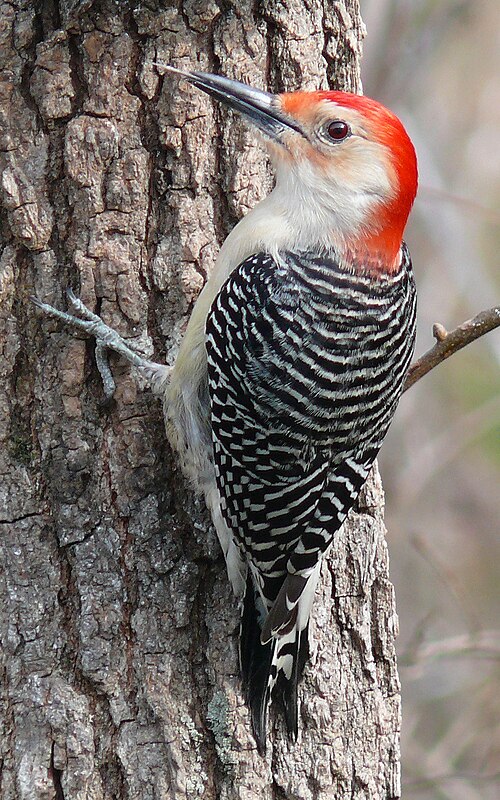
Red-bellied Woodpecker
Melanerpes carolinus
A medium woodpecker with a zebra-striped back and a red cap, familiar in eastern woods, suburbs and at suet feeders.
- Medium
- Forests
- Backyards
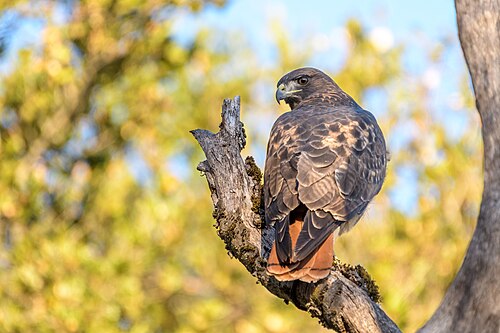
Red-tailed Hawk
Buteo jamaicensis
The most common large hawk in North America, often seen soaring over fields or perched on roadside poles, with a brick-red tail as an adult.
- Large
- Grasslands
- Forests
Related guides
Sources
Sources are the pages consulted when this entry was written. How we choose and use sources: sources and identification criteria.
Further reading (not used as a source for this entry): All About Birds, Cornell Lab of Ornithology.