
Thrushes · Turdidae
Eastern Bluebird
Sialia sialis
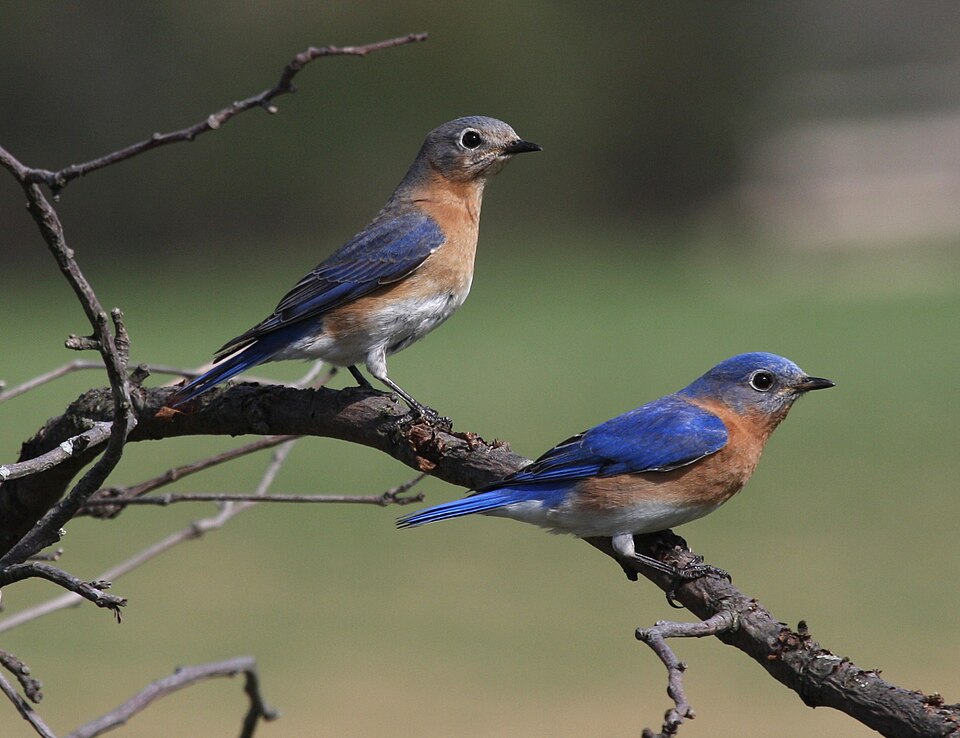
A small thrush of open country: the male is bright blue above with a rusty throat and chest, and a white belly.
Presence varies. Bird presence and timing change with location, weather, habitat and migration. Treat this page as a starting point, then check recent local sightings (for example on eBird) before you go.
Identification features
- Male is vivid blue above with a rusty-orange throat and chest and a white belly.
- Female is similar but paler and grayer, with blue mostly on the wings and tail and a softer orange tone.
- Perches low on wires, fence posts and branches, often sitting upright and dropping to the ground for prey.
- Young birds are heavily spotted on a gray-brown chest and show blue on the wings and tail.
- Found east of the Rocky Mountains, with an extension into southeastern Arizona.
Size and appearance
A bit smaller than a robin, the Eastern Bluebird has a round head, large dark eyes, a slim bill and a short tail. Males are a deep, bright blue on the head, back, wings and tail, with a rusty throat and chest and a white belly. Females look similar but are duller, with gray on the head and back and only a blue wash on the wings and tail. Juveniles are speckled with white spots, a reminder that bluebirds are thrushes, just like robins. In low light, a bluebird can look dark and nondescript, until the sun hits the blue.
Bill: A short, slim, dark bill suited to picking insects and berries.
Habitat
Eastern Bluebirds like open country with scattered trees: farms, pastures, roadsides, orchards, golf courses, large lawns, forest clearings, burned areas and open pine woods. They also settle into suburbs with big lawns and good nest sites. Nests go in natural tree cavities, old woodpecker holes or nest boxes, usually from 2 to 20 feet above the ground. Habitat loss and competition for nest holes caused major declines in the past. In winter, bluebirds wander into other habitats in search of berries, including thickets and woodlots.
Geographic range
Despite the name “Eastern,” this is the most widespread of the three North American bluebirds. It is found east of the Rocky Mountains, from southern Canada to the Gulf states, with a separate range from southeastern Arizona south into Mexico and Central America as far as Nicaragua. Tree planting and the reduction of wildfires on the Great Plains helped it spread westward. It does not occur naturally along the Pacific coast; in the West look for Western and Mountain Bluebirds. Many southern birds stay put all year, while many northern ones move south for winter.
Seasonal presence
Whether a bluebird migrates depends largely on food. In the South, birds are present year-round, and in winter their numbers may grow with arrivals from farther north. In the North, bluebirds often return early in spring, sometimes while snow lingers, and stay late into fall, with some staying all winter if berries last. Winter groups are small flocks roaming the countryside. Summer is nesting season, and pairs may raise two broods, sometimes three. Dates change with weather, so reports from local birders are the best guide to timing in your area.
| Region | Spring | Summer | Fall | Winter |
|---|---|---|---|---|
| Northeast | Present | Present | Present | Not typical |
| Southeast | Present | Present | Present | Present |
| Midwest | Present | Present | Present | Not typical |
| Southwest | Present | Present | Present | Present |
A dot means the species is regularly present in that region in that season. Dates shift with latitude, elevation, weather and migration, and some regions are only partly covered by the species’ range.
Diet
Insects and berries make up most of what bluebirds eat. In warm months they catch crickets, grasshoppers, beetles and many other insects, plus spiders, earthworms and snails; in winter they eat berries in quantity from trees such as hollies, sumac, dogwood and juniper. They typically watch from a low perch, then drop to the ground to catch prey, and sometimes hover to pick it up. Bluebirds rarely eat seed, but they will come to feeders offering mealworms. Choose dried or live mealworms from a reputable source, offer small amounts, and keep the dish clean.
Behavior
A bluebird hunting from a perch is easy to recognize: it sits quietly, scans the grass, then drops to the ground and flies back up with a bug. Outside the nesting season they roam in small flocks. During courtship the male sings, flutters his wings and tail in front of the female, and may offer food. The female builds a cup nest of grass, weeds and twigs inside a cavity, and incubates for around two weeks. Both parents feed the nestlings, which leave after about 18 to 19 days. Nest boxes help bluebirds, but boxes should be monitored by experienced people, and wild nests should never be touched.
Vocalizations
The song is a soft, burbling warble, often phrased as “chur-lee, chur-lee” or a quiet, flowing series of liquid notes. The most common call is a gentle, rolling “tur-wee” or “queedle,” often heard when birds fly overhead or while a flock is moving together. You may hear these notes before you see the birds. Pairs also give short chatters when predators approach their nest site. Compared with robins, the voice is softer, higher and less carrying, so listening in quiet open areas pays off.
Recordings are not hosted on this site. For audio, see the sources below. Please avoid playing recordings to attract birds in the field. See Learning Bird Songs and Calls.
Similar species
- Western Bluebird. Males have a blue throat and rusty color across the back as well as the chest. The ranges meet in parts of the Southwest.
- Mountain Bluebird. Males are sky blue all over, with no rusty chest. Often seen in open mountain and prairie country in the West.
- Blue Jay. Much larger, with a crest, black necklace and white on the wings. Bluebirds are small and smooth-headed with an orange chest. Compare side by side
Observation tips
- Scan fence lines, wires and low branches along country roads and the edges of meadows, where bluebirds perch to look for insects.
- Watch for the drop-and-return hunting pattern from a distance, and avoid walking toward a perched bird.
- If you put up a nest box, learn the local guidelines and monitor it carefully, and leave natural nests alone.
- In winter, check berry-bearing trees for small flocks, and offer clean, small portions of mealworms if you feed.
- Do not play recordings to lure a bluebird, especially near nests, because it disrupts them.
Always keep your distance, stay on trails and leave nests alone. See How to Observe Birds Responsibly.
Conservation status
IUCN Red List: Least Concern. The IUCN lists the Eastern Bluebird as Least Concern. Audubon notes that numbers dropped sharply in many areas when habitat and nest sites were lost, and have risen again in recent decades, partly thanks to nest boxes. Status and trends change, so check the IUCN Red List and your state wildlife agency.
Status last checked 2026-11-03. Status and trends change, so check the linked sources for the latest. Search the IUCN Red List.
Questions and answers
Do Eastern Bluebirds stay in winter?
In the South they are often year-round residents, and some northern birds also stay if berries are available. Many others move south. Winter bluebirds roam in small flocks looking for fruit, so they can appear and vanish.
How can I attract bluebirds to my yard?
Open lawn with a few trees, berry-producing shrubs, a water source and a well-placed, monitored nest box help. Avoid pesticides that kill insects. Small amounts of clean mealworms can draw them in, but never bread.
Related entries
Related birds
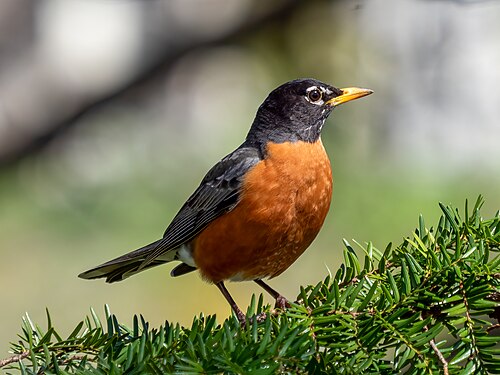
American Robin
Turdus migratorius
A gray-brown thrush with a rusty-orange breast, often seen sprinting and pausing across lawns while hunting worms.
- Medium
- Backyards
- Cities
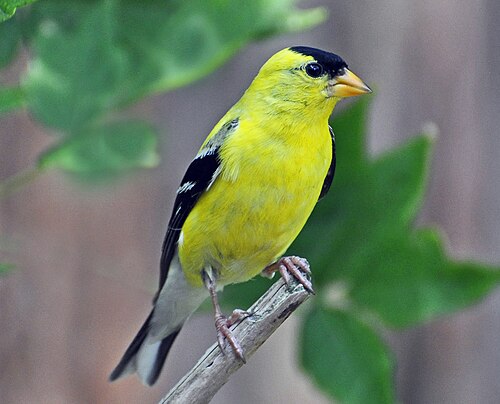
American Goldfinch
Spinus tristis
A small seed-eating finch. Breeding males are bright yellow with a black cap; winter birds turn a muted tan-olive.
- Tiny
- Grasslands
- Backyards
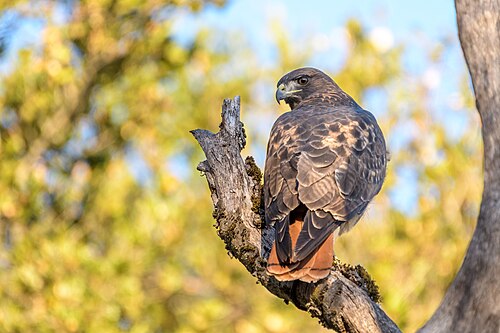
Red-tailed Hawk
Buteo jamaicensis
The most common large hawk in North America, often seen soaring over fields or perched on roadside poles, with a brick-red tail as an adult.
- Large
- Grasslands
- Forests
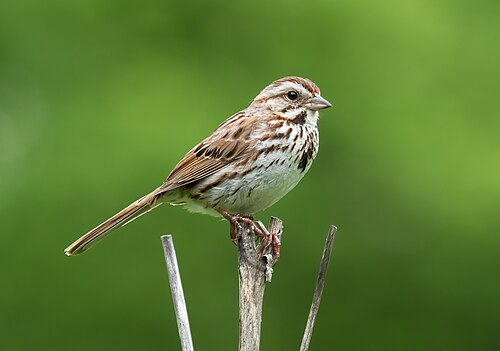
Song Sparrow
Melospiza melodia
A streaky, medium-sized sparrow with a central breast spot and a loud, varied song. It turns up in thickets, marsh edges and yards across the continent.
- Small
- Wetlands
- Backyards
Related guides
Sources
Sources are the pages consulted when this entry was written. How we choose and use sources: sources and identification criteria.
Further reading (not used as a source for this entry): All About Birds, Cornell Lab of Ornithology.