
Woodpeckers · Picidae
Red-bellied Woodpecker
Melanerpes carolinus
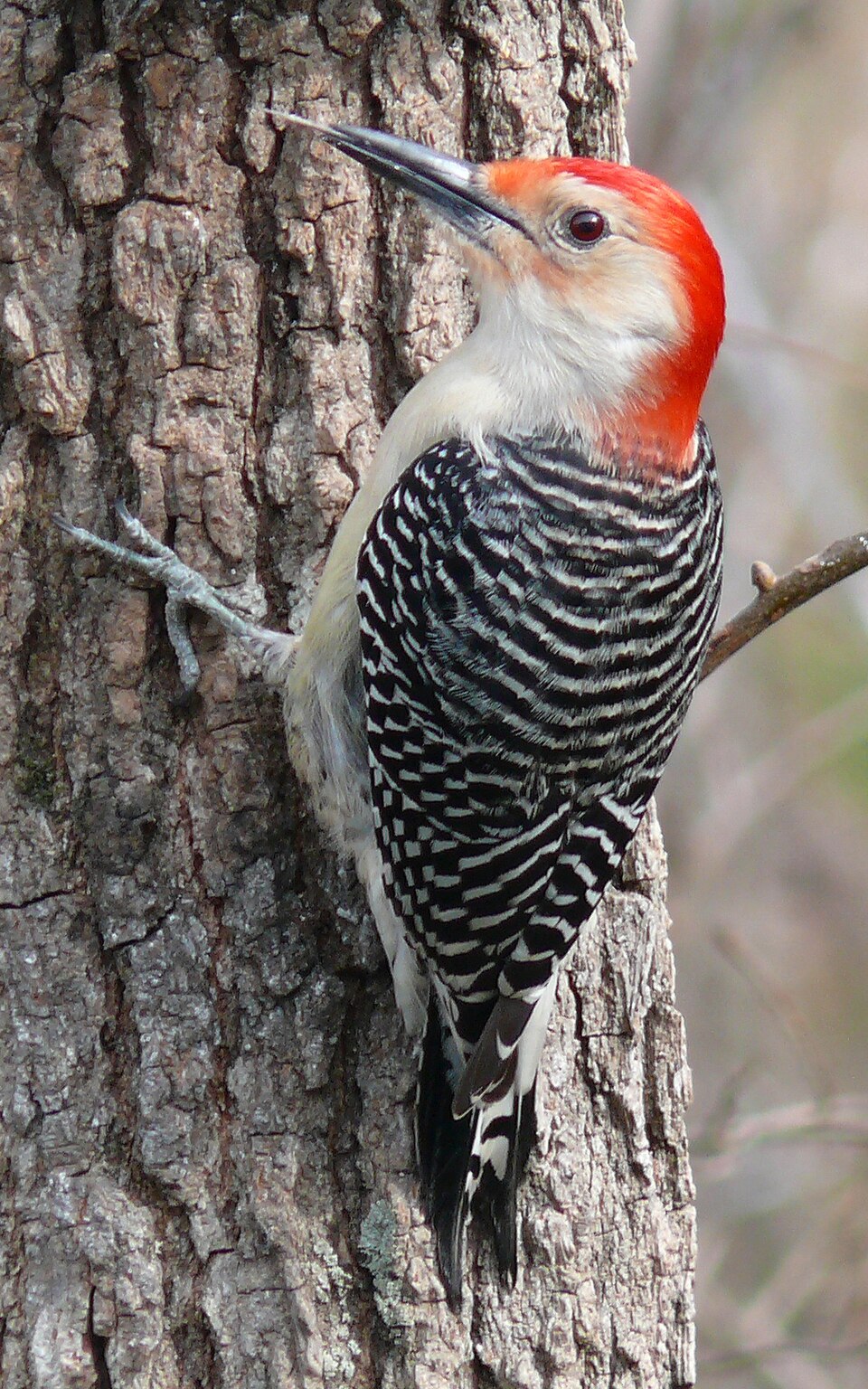
A medium woodpecker with a zebra-striped back and a red cap, familiar in eastern woods, suburbs and at suet feeders.
Presence varies. Bird presence and timing change with location, weather, habitat and migration. Treat this page as a starting point, then check recent local sightings (for example on eBird) before you go.
Identification features
- Narrow black-and-white bars across the back and wings give a ladder or zebra pattern.
- Pale buffy face and chest, with the faint red belly patch rarely noticeable in the field.
- Males show red from forehead to nape; females show red only on the nape.
- White patches at the wing edge and rump are visible in flight.
- A loud, rolling “churr” or a repeated “chuck” call usually announces the bird first.
Size and appearance
The Red-bellied Woodpecker is about the size of a robin, with a long chisel bill and a stiff, wedge-shaped tail. The back is covered in fine black-and-white bars, while the face and underparts are a pale buffy gray. The reddish belly patch that gives it its name is faint and rarely visible. Males have a red crown running from the forehead to the nape, while females have a gray crown with red only on the back of the head. In flight, pale patches show on the wings and rump. Young birds look similar but duller, without strong red on the head.
Bill: A strong, straight chisel bill, long for the size of the head.
Habitat
This woodpecker lives in deciduous and mixed forests, especially along rivers and in swamps, and it also uses forest edges, farm groves, orchards, parks and suburban yards with mature trees. It is less common in pure stands of pine. Nests are excavated in dead trunks or limbs, though it will use old holes and nest boxes. It spends much of its day climbing trunks and large branches, but also feeds on the ground, in vines and at feeders, so mature trees with some dead wood are a big draw.
Forests & woodlands Backyards & feeders Cities & parks Wetlands & water edges
Geographic range
The Red-bellied Woodpecker is widespread in the eastern and central United States, from Florida and Texas north into the Great Lakes and the Mid-Atlantic and New England states. It has expanded northward in recent decades, so sightings in the north now occur where it was once rare. It does not occur regularly in the Rocky Mountain states or the Pacific states. Most birds are year-round residents. In Texas and the Plains it is mainly an eastern and central bird, so western parts of those states hold few if any.
Seasonal presence
Because it is mostly a permanent resident, you can look for the Red-bellied Woodpecker in any season across its range. Some northern birds, such as those in the Great Lakes, may shift south in harsh winters, though this movement is not well documented. Winter is a good time to find them at suet feeders and in bare trees, when the pale face and barred back stand out. In spring, calling and drumming increase and pairs search for nest sites. Local timing varies with weather and food, so use this as a general guide, not a guarantee.
| Region | Spring | Summer | Fall | Winter |
|---|---|---|---|---|
| Northeast | Present | Present | Present | Present |
| Southeast | Present | Present | Present | Present |
| Midwest | Present | Present | Present | Present |
| Southwest | Present | Present | Present | Present |
A dot means the species is regularly present in that region in that season. Dates shift with latitude, elevation, weather and migration, and some regions are only partly covered by the species’ range.
Diet
This is an omnivore that eats many insects but also a lot of plant food. It picks beetles, ants and other insects from trunks, and in some seasons plant matter makes up more than half of its diet, including acorns and other nuts, fruits and seeds. It occasionally takes tree sap, small tree frogs and eggs. In fall it stores nuts and seeds in bark crevices for winter. At feeders it takes suet, peanuts, sunflower seed and halved oranges. Offer fresh, unsalted foods and avoid bread.
Behavior
Red-bellied Woodpeckers climb up trunks in short hops, probing and tapping, and they fly with a flap-and-glide, undulating path. They also hang on thin branches to pick berries and sometimes catch flying insects. In territorial displays they spread wings, raise head feathers and make slow, floating flights. The male may start several holes, and the female chooses which one the pair finishes. Both parents incubate and feed the young. One brood is typical in the north, and more are possible in the south. Do not approach nest holes; watch from a distance.
Vocalizations
The Red-bellied Woodpecker is a talker. Its classic call is a rolling “churr” or “kwirr,” often repeated, that carries a long way through woods. A series of “chuck” notes that slide down in pitch is also common. Both sexes also drum and rattle, especially in spring when pairs are forming. It is more often heard than seen in leafy summer woods. Avoid using playback to attract it, particularly in nesting season.
Recordings are not hosted on this site. For audio, see the sources below. Please avoid playing recordings to attract birds in the field. See Learning Bird Songs and Calls.
Similar species
- Downy Woodpecker. Much smaller with a short bill, a clean white back stripe, and no zebra barring. Compare side by side
- Northern Flicker. Brown with spotted underparts, a bold black chest crescent and a white rump patch, and often feeds on the ground.
- Golden-fronted Woodpecker. Replaces the Red-bellied in central and southern Texas; has a yellow nape and a yellowish-gold nose patch.
Observation tips
- Look for a loud, rolling call in mature trees, then scan the trunk and large limbs.
- Offer suet, peanuts or halved oranges at a feeder in fall and winter.
- The red belly is hard to see; focus on the red cap and zebra-barred back instead.
- Check river woods and swamp edges, where this bird is especially common.
- Stay well back from nest holes and do not use recordings to draw the bird close.
Always keep your distance, stay on trails and leave nests alone. See How to Observe Birds Responsibly.
Conservation status
IUCN Red List: Least Concern. Audubon lists the Red-bellied Woodpecker as Least Concern on the IUCN list and a species of low conservation concern, with a population that appears stable or slightly increasing. Birds and their nests are generally protected under US law, though we did not verify the details. Status and trends change over time, so check the linked sources.
Status last checked 2026-11-03. Status and trends change, so check the linked sources for the latest. Search the IUCN Red List.
Questions and answers
Why is it called Red-bellied if I cannot see red on the belly?
The red on the belly is a pale wash that is rarely visible in the field. The bird got its name from specimens. What you will notice is the red cap and nape, which are much easier to see than the belly.
Do Red-bellied Woodpeckers visit feeders?
Yes. They are regular visitors to suet cakes and also take peanuts, sunflower seed and fruit like orange halves. They often grab a bite and fly off to eat or store it. Fresh, unsalted foods are best, and clean feeders regularly.
Related entries
Related birds
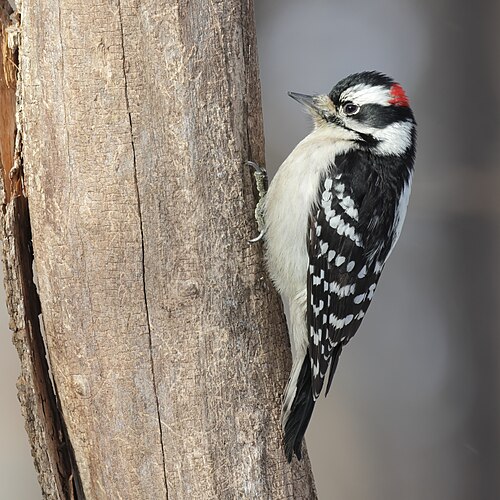
Downy Woodpecker
Dryobates pubescens
The smallest woodpecker in North America, a black-and-white bird with a short bill that visits suet feeders and tiny branches.
- Small
- Forests
- Backyards
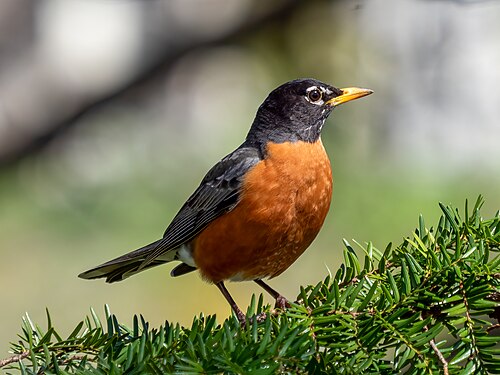
American Robin
Turdus migratorius
A gray-brown thrush with a rusty-orange breast, often seen sprinting and pausing across lawns while hunting worms.
- Medium
- Backyards
- Cities
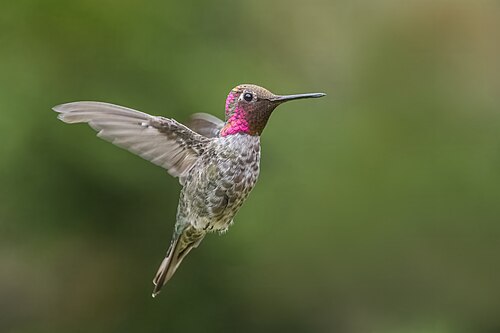
Anna’s Hummingbird
Calypte anna
A stocky Pacific Coast hummingbird with a rose-red head, now a year-round presence in many western yards and feeders.
- Tiny
- Backyards
- Cities
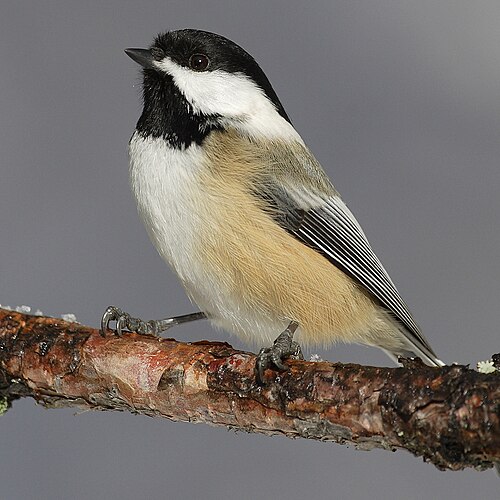
Black-capped Chickadee
Poecile atricapillus
A tiny, curious songbird with a black cap and bib, white cheeks and a clear fee-bee song. A resident across the northern states.
- Small
- Forests
- Backyards
Related guides
Sources
- Audubon Field Guide — Red-bellied Woodpecker
- Wikipedia: Red-bellied woodpecker (secondary cross-check of the IUCN category)
Sources are the pages consulted when this entry was written. How we choose and use sources: sources and identification criteria.
Further reading (not used as a source for this entry): All About Birds, Cornell Lab of Ornithology.