
Finches · Fringillidae
American Goldfinch
Spinus tristis
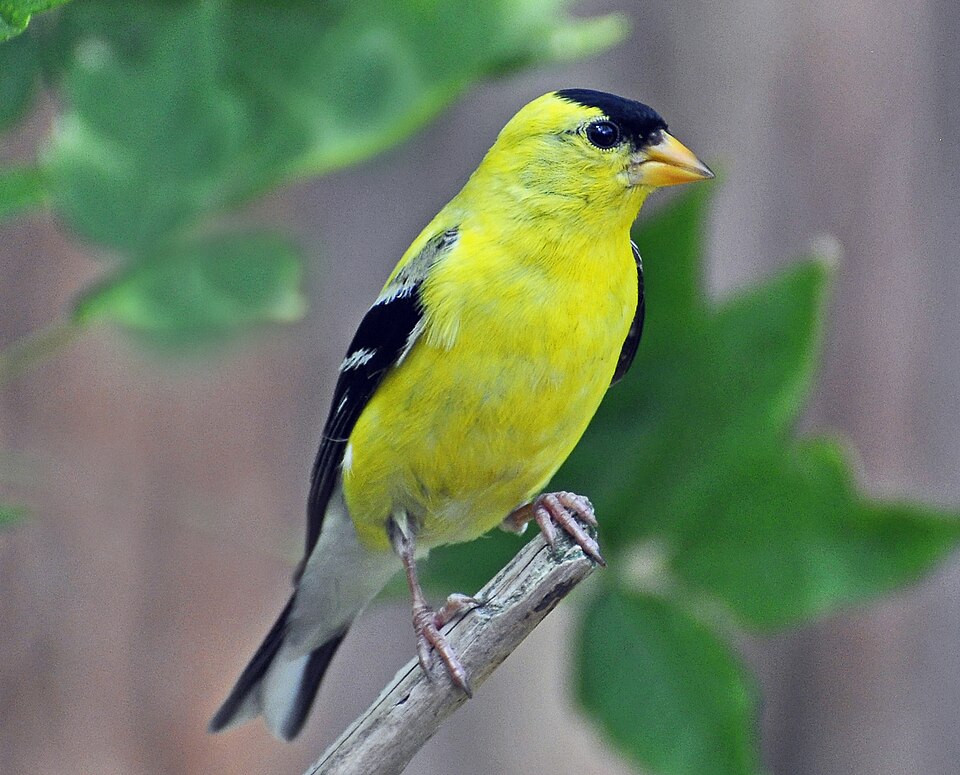
A small seed-eating finch. Breeding males are bright yellow with a black cap; winter birds turn a muted tan-olive.
Presence varies. Bird presence and timing change with location, weather, habitat and migration. Treat this page as a starting point, then check recent local sightings (for example on eBird) before you go.
Identification features
- Breeding males are bright lemon yellow with a black forehead patch, black wings and white wing bars.
- Females are duller yellow-olive below and olive-brown above, with no black cap.
- In winter both sexes are a plain tan-brown with darker wings and pale wing bars; the male keeps a hint of yellow in the face.
- Flight is deeply undulating, and birds often call as they dip.
- The short pale bill and notched tail help set it apart from warblers.
Size and appearance
A tiny, compact finch, noticeably smaller than a sparrow, with a short tail. Males in spring and summer are unmistakable: golden yellow all over, with a black cap and black wings marked with white. Females are subtler, olive-yellow with brown wings. The big change comes in fall, when both sexes molt into a plain, brownish winter plumage that surprises people who expect yellow. The male’s shoulders stay dark and the female’s coloration fades even further. Males molt back into yellow in late winter and spring, a gradual change that can leave patchy birds at feeders. The tail is notched, the wings are dark with pale bars, and the bill is short.
Bill: Small, short and cone-shaped, orange in breeding males and pale in winter.
Habitat
American Goldfinches like semi-open places with weedy ground and scattered trees or shrubs: overgrown fields, roadsides, streamsides, woodland edges, orchards and suburbs. Their food plants, such as thistles and sunflowers relatives, are what draw them. In winter some use very open fields. A garden with native seed-bearing plants, such as coneflowers, can draw them in numbers. They are not forest birds, but they use tall trees for singing and perching.
Geographic range
American Goldfinches breed across much of the northern two-thirds of the lower 48 states and into southern Canada. They winter across most of the United States and parts of northern Mexico. Audubon lists them for regions from New England and the Great Lakes to the Plains, the Rockies, the Southwest, Texas, Florida, California and the Northwest. They are not regular in Alaska. A bird’s status in a given place depends heavily on the season: northern states have breeding birds in summer and a smaller winter group, while the South has mainly winter visitors, and some linger there into late spring.
Seasonal presence
Goldfinches are on the move more than many birds, but the movements are irregular. Spring brings flocks of molting males in patchy yellow. Nesting starts late compared with most songbirds, with most activity in July and August in many areas, timed to when thistle and similar seeds are ripe. In fall, flocks drift south, with peak movement in mid-fall and again in early spring, mostly by day. In winter, more birds stay north when food is plentiful and fewer when it is not. In the South, expect them in the cold months only. Timing varies by location, weather and food supply.
| Region | Spring | Summer | Fall | Winter |
|---|---|---|---|---|
| Northeast | Present | Present | Present | Present |
| Southeast | Present | Not typical | Present | Present |
| Midwest | Present | Present | Present | Present |
| Southwest | Present | Not typical | Present | Present |
| Pacific West | Present | Present | Present | Present |
A dot means the species is regularly present in that region in that season. Dates shift with latitude, elevation, weather and migration, and some regions are only partly covered by the species’ range.
Diet
Goldfinches are among the most seed-focused of all birds. They favor seeds of the daisy family, such as thistle, coneflower and sunflower, plus weed and grass seeds and the small seeds of trees like elm, birch and alder. They also nibble buds and take a few insects in summer. Nestlings are fed mostly regurgitated seeds, not insects. At feeders, they like nyjer (thistle) seed in a tube feeder with small ports, and hulled or black oil sunflower in other feeders. Keep seed fresh and dry, and clean feeders regularly to reduce disease spread.
Behavior
Goldfinches are social and acrobatic, clinging to seed heads and even hanging upside down to reach them. Outside the breeding season they roam in flocks and often mix with other finches, siskins and sparrows. Males perform a fluttering, circling song flight during courtship. Pairs form in spring but breeding waits until summer. The female builds a tightly woven cup nest in a shrub or tree fork, often using plant down, and the young leave the nest about two weeks after hatching. Observers should keep well back from nests. Birds at feeders may squabble, but they tolerate crowding better than many species.
Vocalizations
The flight call is a bouncy per-chick-o-ree or potato-chip, given on the upswing of each dip in the flight path. The song is a long, cheerful string of twittering, warbling and trilling notes, delivered from a perch or in flight. In winter, flocks make musical, plaintive calls such as a soft tee-yee. Males sing most in spring and summer. A passing flock overhead, calling on each dip, is often noticed by ear before it is seen.
Recordings are not hosted on this site. For audio, see the sources below. Please avoid playing recordings to attract birds in the field. See Learning Bird Songs and Calls.
Similar species
- Pine Siskin. Siskins are heavily streaked brown with a thin, sharp bill and yellow only in flashes on the wing and tail.
- Lesser Goldfinch. A western and southwestern species whose male has a black cap and a greenish or black back, rather than the American Goldfinch’s black wings on a yellow back.
- House Finch. House Finches are larger, brown-streaked and heavier-billed, and males are red rather than yellow. Compare side by side
Observation tips
- Plant coneflowers, sunflowers and other native seed plants, and leave some seed heads standing into fall.
- Use a tube feeder with nyjer seed and replace damp or moldy seed promptly.
- Learn the per-chick-o-ree flight call. Many goldfinches are found by ear first.
- Do not expect yellow in winter. Check brown birds with bold wing bars before dismissing them.
- Keep distance from nests and do not trim shrubs in midsummer when nests may be active.
Always keep your distance, stay on trails and leave nests alone. See How to Observe Birds Responsibly.
Conservation status
IUCN Red List: Least Concern. The IUCN lists the American Goldfinch as Least Concern. Audubon describes it as widespread, with an estimated population of about 44 million, though numbers may have fallen in some areas in recent years. Status and trends change over time, so check the [IUCN Red List](https://www.iucnredlist.org) for the latest information.
Status last checked 2026-11-03. Status and trends change, so check the linked sources for the latest. Search the IUCN Red List.
Questions and answers
Why did my goldfinches turn brown?
They molt into a drab winter plumage each fall, and males turn bright yellow again in spring. The birds at your feeder are the same species. Look for pale wing bars and the short pale bill to confirm.
Why do goldfinches nest so late?
They rely on seeds, including the seeds of thistle and similar plants that ripen in midsummer. Timing the nest to the seed supply lets them feed the young on seeds, which is rare among songbirds.
Related entries
Related birds
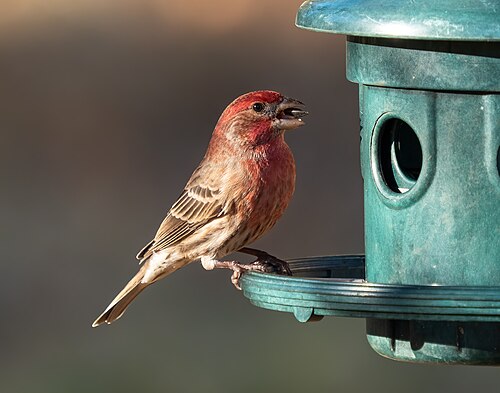
House Finch
Haemorhous mexicanus
A streaky brown finch. Males have a red head and chest. Native to the Southwest and now widespread in cities across the US.
- Small
- Cities
- Backyards
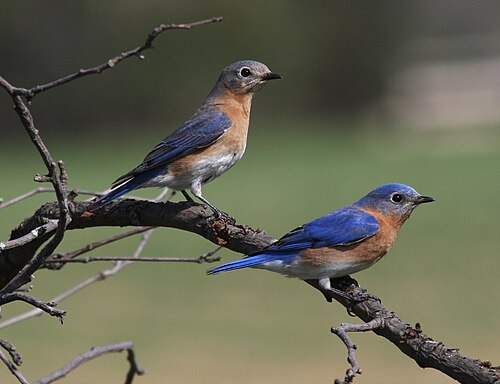
Eastern Bluebird
Sialia sialis
A small thrush of open country: the male is bright blue above with a rusty throat and chest, and a white belly.
- Small
- Grasslands
- Backyards
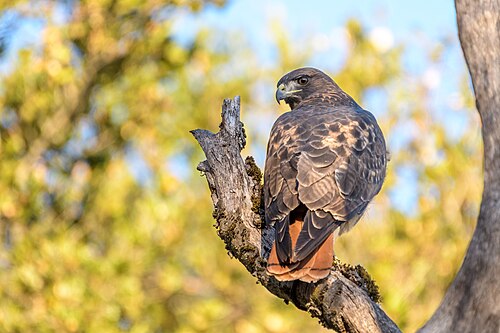
Red-tailed Hawk
Buteo jamaicensis
The most common large hawk in North America, often seen soaring over fields or perched on roadside poles, with a brick-red tail as an adult.
- Large
- Grasslands
- Forests
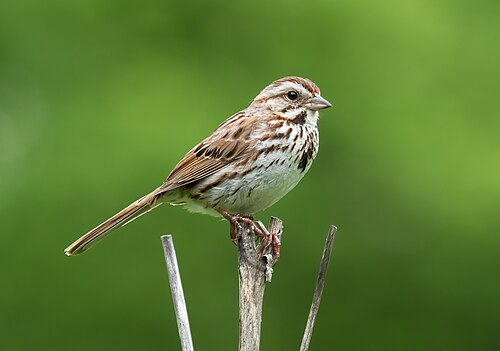
Song Sparrow
Melospiza melodia
A streaky, medium-sized sparrow with a central breast spot and a loud, varied song. It turns up in thickets, marsh edges and yards across the continent.
- Small
- Wetlands
- Backyards
Related guides
Sources
- Audubon Field Guide — American Goldfinch
- Wikipedia: American goldfinch (secondary cross-check of the IUCN category)
Sources are the pages consulted when this entry was written. How we choose and use sources: sources and identification criteria.
Further reading (not used as a source for this entry): All About Birds, Cornell Lab of Ornithology.