
Mockingbirds and Thrashers · Mimidae
Northern Mockingbird
Mimus polyglottos
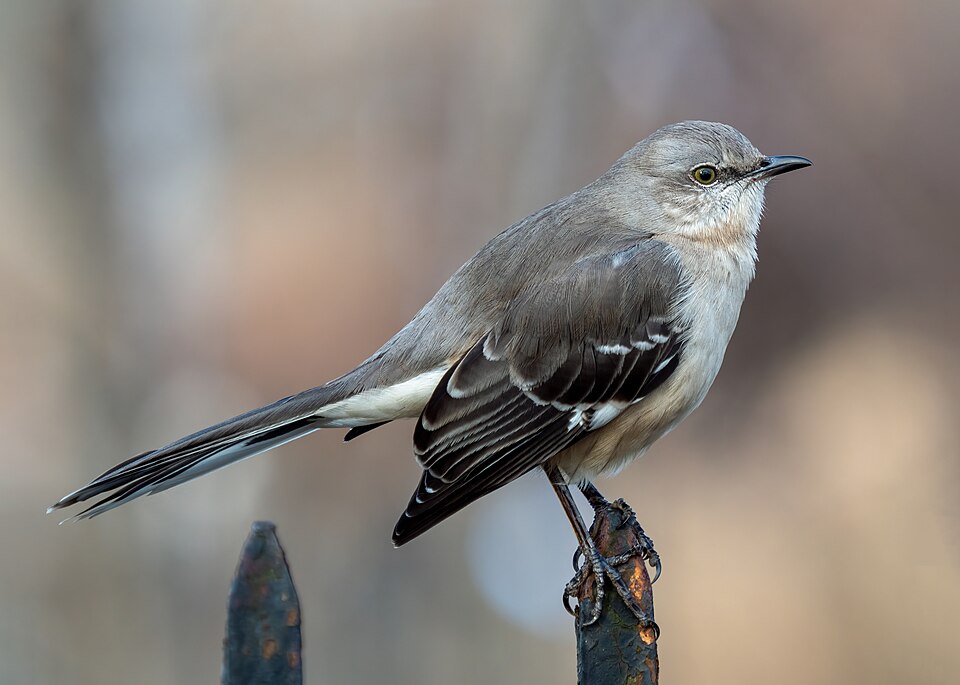
A slim gray songbird that sings from rooftops and wires, repeats borrowed phrases, and flashes white wing patches when it hops across a lawn.
Presence varies. Bird presence and timing change with location, weather, habitat and migration. Treat this page as a starting point, then check recent local sightings (for example on eBird) before you go.
Identification features
- Pale gray above and paler gray to whitish below, with a long, slim tail that it often flicks or holds cocked.
- Large white patches on the wings and white outer tail feathers show clearly in flight and when the bird partly opens its wings on the ground.
- Males and females look alike, so plumage will not tell you the sex.
- Juveniles have dark streaks across the chest and darker eyes than adults.
- A mockingbird that sings the same phrase three or more times in a row, then moves on to a new one, is a strong clue even before you see it.
Size and appearance
The Northern Mockingbird is roughly robin-sized but built more slimly, with a long tail and a slender frame. Adults are soft gray on the head and back, with lighter underparts that can look almost white. Dark wings carry bold white patches, and the outer tail feathers are white too. Many of these marks hide when the bird is perched, which is why a mockingbird can look plain until it moves. The sexes are alike. Young birds in summer look scruffier, with spotted or streaked breasts and darker eyes. Take a moment to watch the bird run a few steps across open ground, stop, and raise its wings. That brief flash is one of the most dependable ways to confirm the species.
Bill: A fairly short, slim, dark bill with a slight downward curve at the tip.
Habitat
Mockingbirds like open ground edged by dense, low cover. That combination shows up in suburban neighborhoods, where lawns meet hedges and foundation shrubs, and also on farms, along roadsides, and in brushy second-growth. They use woodland edges and thickets rather than deep forest. In the West the species is often common in desert thickets and along canyon streams. Fruiting shrubs matter, because berries make up a large share of the diet in cooler months. Towns and city parks with scattered shrubs and short grass can hold as many mockingbirds as wilder places, so you do not have to travel far to find one.
Backyards & feeders Cities & parks Deserts & arid scrub Grasslands & fields
Geographic range
This is a bird of the lower 48 states, with the heaviest concentrations in the South and Southwest. It is also found in southern Canada, Mexico, and the Caribbean. In recent decades its range has crept north, especially in the Northeast, and sources suggest that planted multiflora rose, which offers both berries and nest sites, may have helped. Earlier, collecting for the cage-bird trade from the late 1700s to the early 1900s made the species scarce near its northern limit, and it recovered once that trade ended. Abundance still falls off toward the northern states and the high mountains, so a mockingbird there can be a local specialty.
Seasonal presence
In much of the South, Southwest, and California, mockingbirds are present all year and are often singing in late winter, when nesting can already begin in warm areas. Farther north they are more of a spring-to-fall bird. Migration is not well understood: some birds drift south for the colder months, at least a short distance, while others stay at the northern edge of the range through winter if food holds out. Do not count on seeing one in a northern state in January, but do not rule it out near berry-rich shrubs either. Timing shifts with local weather and food supply, and singing is loudest in spring and early summer.
| Region | Spring | Summer | Fall | Winter |
|---|---|---|---|---|
| Northeast | Present | Present | Present | Not typical |
| Southeast | Present | Present | Present | Present |
| Midwest | Present | Present | Present | Not typical |
| Southwest | Present | Present | Present | Present |
| Pacific West | Present | Present | Present | Present |
A dot means the species is regularly present in that region in that season. Dates shift with latitude, elevation, weather and migration, and some regions are only partly covered by the species’ range.
Diet
About half of what a mockingbird eats over the year is insects and other small invertebrates, and about half is fruit. In late spring and summer it takes beetles, grasshoppers, caterpillars, ants, and wasps, plus spiders and the occasional snail or earthworm. In fall and winter it leans on wild berries and sometimes cultivated fruit. Native fruiting shrubs are the best way to invite one into a yard. At a feeder, mockingbirds are not seed eaters, but some will take chopped fruit, raisins, or mealworms. Skip bread and processed scraps.
Behavior
Mockingbirds hunt mostly on the ground, walking or running after insects, or dropping from a low perch onto prey. When they run across open ground they often pause and lift their wings in short flashes. The purpose of the flash is still debated, so treat it as a field mark rather than a fact about what the bird intends. Many birds defend a territory fiercely, including in autumn, when a single bird may guard a berry bush. During nesting they are bold and will dive at cats, dogs, and people who come too close to the nest. If you see this, take it as a sign to walk away from that spot; there is no need to look for the nest. Pairs often raise two or three broods a year in a dense shrub or small tree, and the young leave the nest before they can fly well.
Vocalizations
The song is a long, varied string of musical and harsh phrases, each usually repeated three or more times before the bird switches to something new. Much of the material is borrowed from other birds, and the bird may also copy sounds like alarms or squeaks. That is where the name comes from. Mockingbirds often sing at night, which surprises many people who hear them from a bedroom window. The common call is a flat, harsh "chack." If a yard seems to hold a whole flock of different species, look for one gray bird on a high perch and listen for the repeated phrases.
Recordings are not hosted on this site. For audio, see the sources below. Please avoid playing recordings to attract birds in the field. See Learning Bird Songs and Calls.
Similar species
- Loggerhead Shrike. A shrike has a black mask, a thick hooked-tipped bill, and a stockier look. It sits motionless on wires and does not run across lawns flashing its wings.
- Gray Catbird. A catbird is darker slate gray with a black cap and rusty patch under the tail. It has no white wing patches.
- Brown Thrasher. A thrasher is rusty brown above with a heavily streaked, buff underside and a longer, curved bill.
Observation tips
- Scan the highest perches in the neighborhood at dawn: rooftops, antennas, and utility wires are favorite singing posts.
- Watch lawns edge to edge and look for a bird that runs, stops, and flashes white; that behavior is rare enough to be a useful clue.
- Stay well back from any shrub where a mockingbird is diving at you or calling harshly, since it may be guarding a nest.
- Plant or protect native fruiting shrubs if you have a yard, which feeds mockingbirds more naturally than any feeder.
- Do not use recordings to draw one out. Mockingbirds are common, but the stress of repeated playback still costs a territorial bird time and energy.
Always keep your distance, stay on trails and leave nests alone. See How to Observe Birds Responsibly.
Conservation status
IUCN Red List: Least Concern. The IUCN lists the Northern Mockingbird as Least Concern, and Audubon describes it as widespread and common, with an estimated population of around 43 million. The species recovered after being heavily caught for the cage-bird trade and has spread north in recent decades. Status and trends change over time, so check the IUCN Red List and Cornell Lab pages for current information.
Status last checked 2026-11-03. Status and trends change, so check the linked sources for the latest. Search the IUCN Red List.
Questions and answers
Why does a mockingbird sing at night?
Singing after dark is a well-known habit of the species, and it is most noticeable in spring. Sources describe the habit but the reasons are not fully settled, so it may vary from bird to bird and place to place.
Why is a mockingbird attacking me?
Mockingbirds guard nests and territories boldly and may swoop at cats, pets, and people who come close. Moving away from the spot usually ends it, and the behavior is tied to the nesting period.
Related entries
Related birds
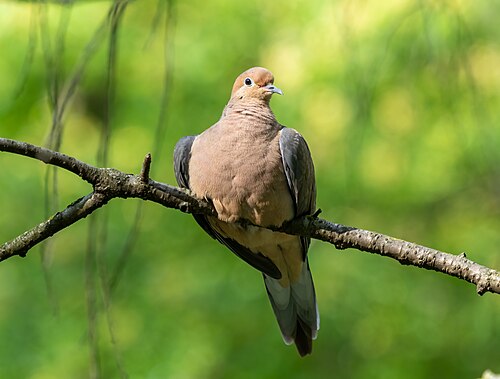
Mourning Dove
Zenaida macroura
A slim, soft gray-tan dove with a long pointed tail and a low, owl-like coo, common on wires, lawns and under feeders.
- Medium
- Backyards
- Grasslands
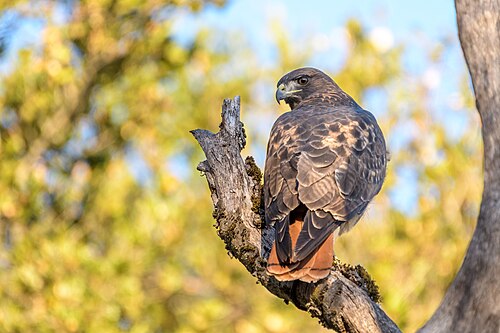
Red-tailed Hawk
Buteo jamaicensis
The most common large hawk in North America, often seen soaring over fields or perched on roadside poles, with a brick-red tail as an adult.
- Large
- Grasslands
- Forests
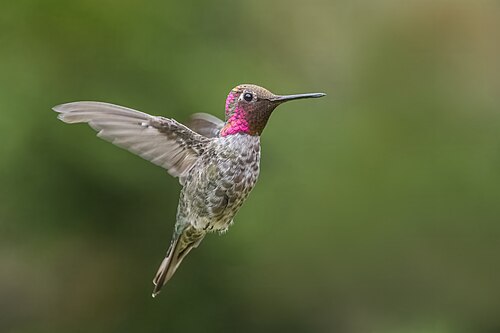
Anna’s Hummingbird
Calypte anna
A stocky Pacific Coast hummingbird with a rose-red head, now a year-round presence in many western yards and feeders.
- Tiny
- Backyards
- Cities
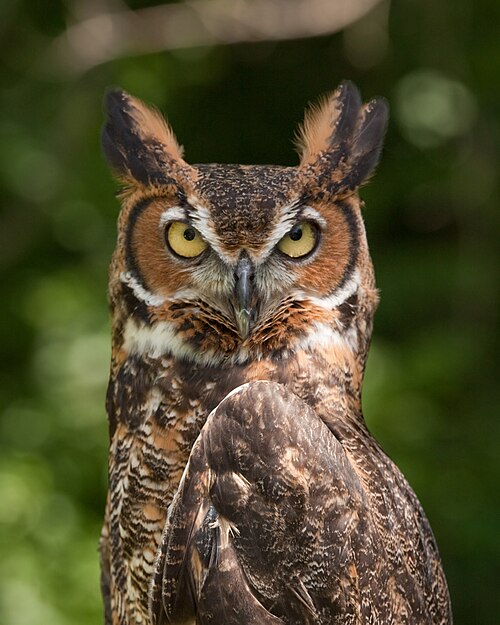
Great Horned Owl
Bubo virginianus
A big, heavy-bodied owl with feather tufts like horns and a deep, steady hoot. It lives in almost every kind of wooded or semi-open country.
- Large
- Forests
- Deserts
Related guides
Sources
- Audubon Field Guide — Northern Mockingbird
- Wikipedia: Northern mockingbird (secondary cross-check of the IUCN category)
Sources are the pages consulted when this entry was written. How we choose and use sources: sources and identification criteria.
Further reading (not used as a source for this entry): All About Birds, Cornell Lab of Ornithology.