
Herons, Egrets and Bitterns · Ardeidae
Great Blue Heron
Ardea herodias
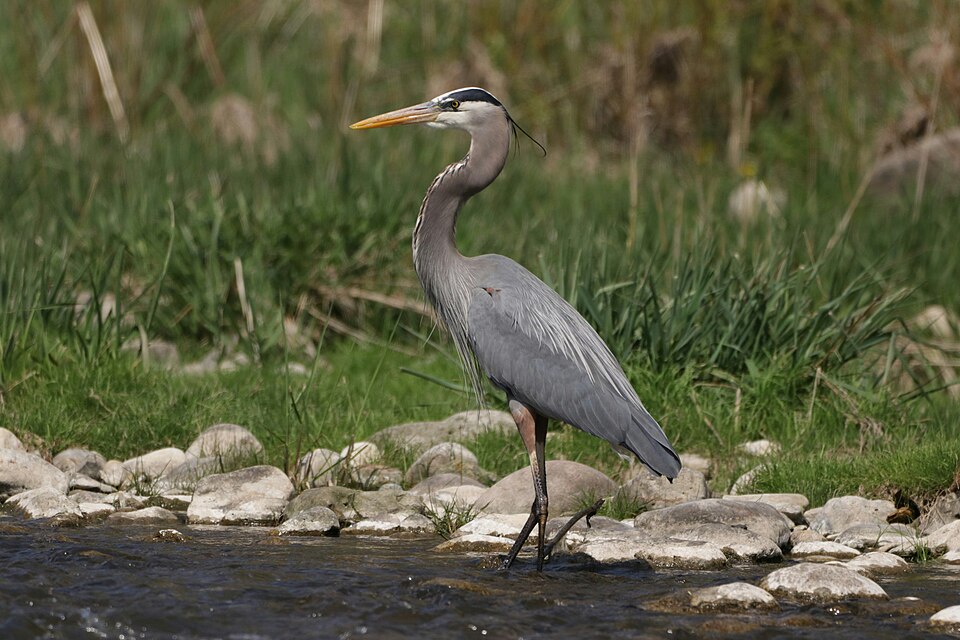
North America’s largest heron, a tall gray-blue wader that stands motionless in shallows and strikes with a spear-like bill.
Presence varies. Bird presence and timing change with location, weather, habitat and migration. Treat this page as a starting point, then check recent local sightings (for example on eBird) before you go.
Identification features
- Stands roughly 3 to 4.5 feet long, with a wingspan near 6 feet, so it dwarfs nearly every other wading bird in the US.
- Bluish-gray body with a pale head, a black stripe that runs back from the eye, and a heavy, dagger-shaped bill.
- In flight the neck folds into an S-curve and the head rests close to the shoulders, while the long legs trail behind.
- Wingbeats are slow and deep, and the broad wings look dark gray above with a darker edge along the flight feathers.
- In South Florida a white form, often called the Great White Heron, lives alongside the gray-blue birds.
Size and appearance
This is the biggest heron in North America, a lanky bird that can be mistaken for a crane at a distance. Adults are blue-gray overall with a whitish face, a black stripe sweeping back from the eye, and long plumes hanging from the neck and chest. The bill is heavy and pointed, and the legs are long and dull in color. Males and females look alike. Young birds are duller, with a darker crown and less fancy plumage. South Florida has two distinct forms of this species: an all-white bird, and a white-headed bird, mostly found around the Keys. Both can confuse beginners who expect only the gray version.
Bill: A long, straight, pointed bill that is yellowish to dusky and strong enough to spear a fish.
Habitat
Great Blue Herons use almost any place with shallow water and fish. Look for them along marshes, swamps, lake edges, slow rivers, tidal flats and shallow coastal bays. They are just as at home at a suburban retention pond or a park lagoon as in a big wetland. Nests are usually built in trees or large shrubs near water, often high up, and sometimes on the ground on predator-free islands. Because the species is adaptable, it can stay farther north through winter than many herons, provided it finds open water where fish can still be caught.
Geographic range
The species breeds across most of the lower 48 states and into southern Canada, and it reaches the southern coast of Alaska. Birds east of the Rockies that nest in the north are largely migratory, and many winter along the southern Atlantic and Gulf coasts or farther south into the Caribbean and Central America. Along the Pacific coast, herons are often permanent residents, as far north as southeastern Alaska. Florida holds the unusual white and white-headed forms. Year-round presence in the South and on the West Coast is common, but local movement depends on food and ice, so check recent sightings for your area.
Northeast Southeast Midwest Southwest Pacific West Alaska & Hawaii
Seasonal presence
Timing differs a lot from one region to another. In the northern states, herons often arrive at nesting sites as ice melts in late winter or spring, stay through summer, and leave in fall as water freezes. Some hardy birds linger wherever a stream or spring stays open. In the Southeast, along the Gulf coast and on the Pacific coast, many herons stay all year, and northern migrants add to the numbers in winter. Late summer can bring wandering young and adults to places farther north than usual. Weather, water levels and the local food supply all shift when birds come and go, so the dates here are rough.
| Region | Spring | Summer | Fall | Winter |
|---|---|---|---|---|
| Northeast | Present | Present | Present | Not typical |
| Southeast | Present | Present | Present | Present |
| Midwest | Present | Present | Present | Not typical |
| Southwest | Present | Present | Present | Present |
| Pacific West | Present | Present | Present | Present |
| Alaska & Hawaii | Present | Present | Present | Present |
A dot means the species is regularly present in that region in that season. Dates shift with latitude, elevation, weather and migration, and some regions are only partly covered by the species’ range.
Diet
Fish make up the biggest share of what a Great Blue Heron eats, but the menu is wide. It also takes frogs, salamanders, turtles, snakes, insects, rodents and even small birds. Birds have been seen stalking voles and gophers in open fields and catching small waterbirds at the edge of a marsh. It hunts by day or night. This species does not come to feeders, and it should never be fed by hand or from a dock. Fish scraps dumped at boat ramps can draw herons toward people and fishing lines, so leave their food to them.
Behavior
A hunting heron usually stands still or walks in slow, deliberate steps through shallow water, then strikes with a fast thrust of the neck. It may also fish from the shore, from a floating object or on dry grassland. In flight it moves with slow wingbeats and sometimes soars high overhead. Nesting is usually social. Many pairs build large stick platforms in the same group of trees, called a colony, sometimes mixed with other wading birds. Males choose the site and display to attract a mate, and females do much of the building. Both parents feed the chicks by regurgitating food. Colonies are sensitive to disturbance, especially early in the season, so watch from a long way off.
Vocalizations
The voice is not musical. The usual call is a harsh, low squawk, flat and simple in pattern, often described as a croak or a guttural “fraaank.” You are most likely to hear it when a heron is startled and flaps away, or when birds jostle over nest sites in a colony. A colony in spring can sound like a crowd of rusty gates, with deep croaks, clacks and squawks coming from the treetops. Herons are quiet while hunting, so a silent bird at the water’s edge is normal and is not a sign of trouble.
Recordings are not hosted on this site. For audio, see the sources below. Please avoid playing recordings to attract birds in the field. See Learning Bird Songs and Calls.
Similar species
- Sandhill Crane. Cranes fly with the neck fully straight and the wings flicking in quick upstrokes, and they have a short bill. A heron flies with its neck folded into an S and a long, spear-like bill. Compare side by side
- Little Blue Heron. Much smaller, with a slate-blue body and a two-tone bill. The Great Blue is far taller and has a pale face with a black stripe.
- Green Heron. A small, hunched heron with a dark cap and chestnut neck. It is a fraction of the Great Blue’s size.
Observation tips
- Scan the edges of ponds, marsh channels and quiet bays at dawn and dusk, when herons often hunt, and watch for a still, tall shape.
- Stay well back from the water’s edge and use binoculars. A heron that stops fishing and stands tall with its neck stretched is already uneasy.
- In spring, look up into tall trees near water for stick nests. Never walk into a colony, and keep a long distance, because disturbance can lead birds to abandon eggs or young.
- Do not throw fish scraps or feed herons. It teaches them to approach people and can lead to fishing-line injuries.
- A pair of binoculars and a patient 10 minutes beside a shallow bank often shows the full strike sequence without needing to move closer.
Always keep your distance, stay on trails and leave nests alone. See How to Observe Birds Responsibly.
Conservation status
IUCN Red List: Least Concern. The IUCN lists the Great Blue Heron as Least Concern, and Audubon describes it as common, widespread and likely stable. Birds were once shot more often, which is now rare, but human disturbance can still hurt nesting colonies. Status and trends change, so check the IUCN Red List and your state wildlife agency for current information.
Status last checked 2026-11-03. Status and trends change, so check the linked sources for the latest. Search the IUCN Red List.
Questions and answers
Is the Great Blue Heron a crane?
No. It is a heron, and the two are easy to confuse. In flight, herons tuck the neck back into an S shape, while cranes hold the neck straight out. Herons also nest in trees, usually in groups, and spear fish with a long bill.
Do Great Blue Herons migrate?
Some do and some do not. Northern birds east of the Rockies are mostly migratory, while many birds in the South and along the Pacific coast stay all year. A few remain in the north wherever open water lets them fish.
Related entries
Related birds
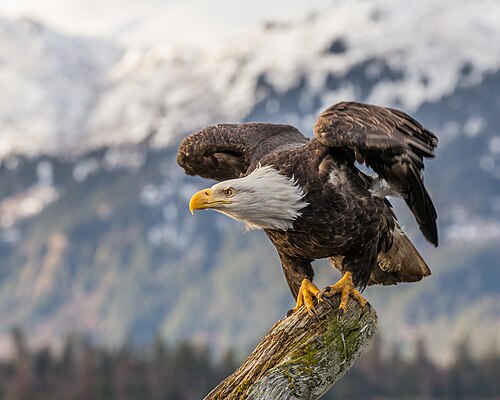
Bald Eagle
Haliaeetus leucocephalus
America’s national bird, a huge dark-brown raptor with a white head and tail that fishes along coasts, rivers and large lakes.
- Very large
- Wetlands
- Coastlines
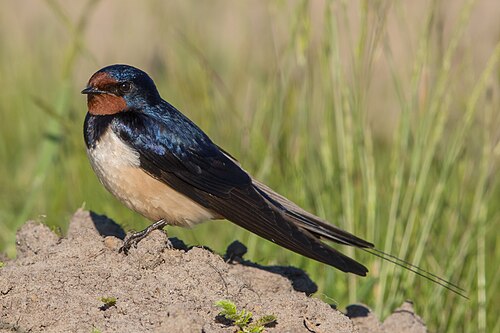
Barn Swallow
Hirundo rustica
A graceful, blue-backed swallow with a rusty throat and a deeply forked tail, often seen skimming over fields and nesting under bridges.
- Small
- Grasslands
- Wetlands
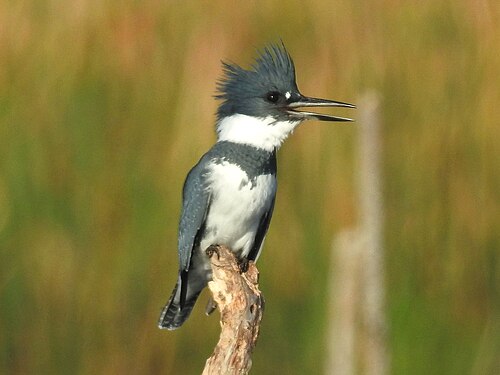
Belted Kingfisher
Megaceryle alcyon
A shaggy-crested, blue-gray waterside bird that rattles along rivers and plunges headfirst for fish.
- Medium
- Wetlands
- Coastlines
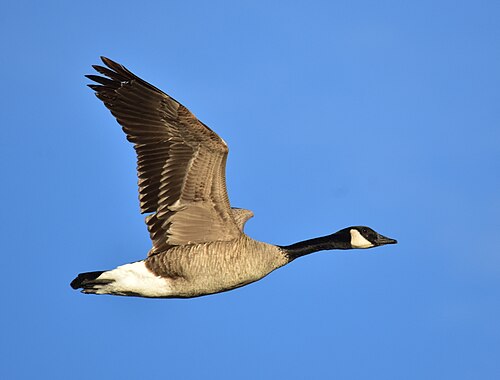
Canada Goose
Branta canadensis
A big brown goose with a black head and neck and a white chinstrap, now common on lakes, golf courses and fields across the US.
- Very large
- Wetlands
- Cities
Related guides
Sources
Sources are the pages consulted when this entry was written. How we choose and use sources: sources and identification criteria.
Further reading (not used as a source for this entry): All About Birds, Cornell Lab of Ornithology.