
Ducks, Geese and Swans · Anatidae
Canada Goose
Branta canadensis
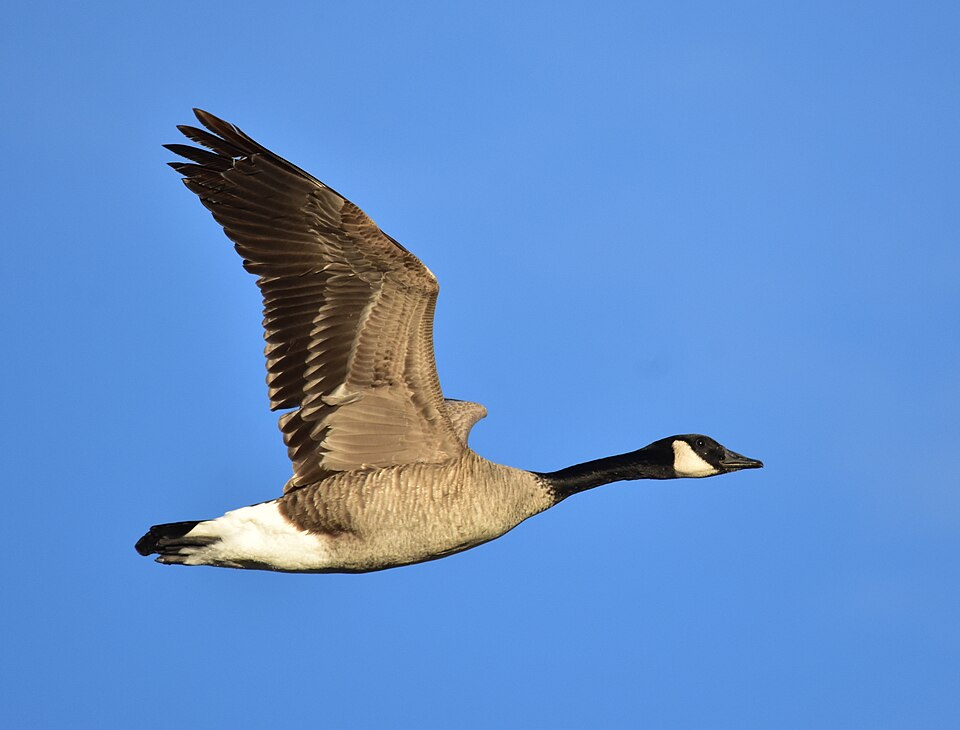
A big brown goose with a black head and neck and a white chinstrap, now common on lakes, golf courses and fields across the US.
Presence varies. Bird presence and timing change with location, weather, habitat and migration. Treat this page as a starting point, then check recent local sightings (for example on eBird) before you go.
Identification features
- Black head and neck with a bold white “chinstrap” patch that stretches from cheek to cheek.
- Brown-gray back, pale chest and belly, black tail with white at the base and a white rump band.
- Size varies hugely by population, from not much bigger than a large duck to a bird of more than 10 pounds.
- Flies in V-shaped lines or loose lines with loud honking, and lands on water with its feet out in front.
- Males and females look alike; young birds look like adults but their markings are a little duller.
Size and appearance
The Canada Goose is large and long-necked, with a brown-gray body, a black head and neck, and a white chinstrap that is the main field mark. The black tail is framed by white feathers above and below. Males are a little bigger than females, but you can not tell them apart in the field. Different populations vary greatly in size and color, from small, dark-chested geese to large, pale-chested ones. Some small forms were split off in 2004 as a separate species, the Cackling Goose, which looks like a pocket-sized version with a stubbier bill and a rounder head.
Bill: A short, black, flat-edged bill that suits grazing on grass and shoots.
Habitat
Canada Geese live near water, and prefer lakes, ponds, bays, marshes and nearby fields. Wild birds nest in tundra, freshwater and salt marshes and on lakes within wooded country. They feed on short grass and farm fields, which is why lawns, golf courses, airports, office-park ponds and city parks are so attractive. Nest sites are usually slightly raised, dry spots close to water, though geese will also use muskrat houses, cliff ledges, tree nests and artificial platforms. Refuges where grain is grown for waterfowl hold big crowds in migration and winter.
Geographic range
Canada Geese occur in every region of the lower 48 states and across Canada and Alaska. Wild populations breed from the arctic tundra south across Canada and the northern US. Historically each population followed its own migration route. Today many geese, especially those in cities and on refuges, are permanent residents, with big resident groups on the Pacific coast, the Great Lakes, and the Atlantic coast from the Chesapeake region and beyond. In many states, wintering flocks include northern migrants as well as resident birds, so it can be hard to say which are which.
Northeast Southeast Midwest Southwest Pacific West Alaska & Hawaii
Seasonal presence
In most of the US you can find Canada Geese in every season, but the mix of birds changes. Resident flocks stay on local ponds and fields all year. Migrant geese arrive in fall and winter from farther north and head back north in late winter and spring, with the V-shaped flights that mark the change of seasons. Northern birds may linger until water freezes. Alaska sees geese mostly from spring to fall. Goose families with fuzzy goslings are a common sight in late spring. Exact timing varies by weather, ice and food, and with the population you are watching.
| Region | Spring | Summer | Fall | Winter |
|---|---|---|---|---|
| Northeast | Present | Present | Present | Present |
| Southeast | Present | Present | Present | Present |
| Midwest | Present | Present | Present | Present |
| Southwest | Present | Present | Present | Present |
| Pacific West | Present | Present | Present | Present |
| Alaska & Hawaii | Present | Present | Present | Not typical |
A dot means the species is regularly present in that region in that season. Dates shift with latitude, elevation, weather and migration, and some regions are only partly covered by the species’ range.
Diet
Canada Geese eat almost entirely plant material: grass and sedge shoots, aquatic plants, seeds, berries and waste grain from harvested fields. They sometimes take insects, small shellfish or small fish. They graze on land and also feed in water by dipping the head and neck, or tipping up. Please do not feed geese bread, crackers, popcorn or snacks. Those foods are poor nutrition, make birds depend on people and can cause large, messy, sometimes aggressive crowds. Many parks and local ordinances discourage or restrict feeding waterfowl, so check the signs where you are.
Behavior
Geese graze in flocks, with some birds raising their heads to watch for danger. They fly in V-formations or lines, and during the nesting season pairs are fiercely protective. Pairs may stay together for life. The male defends the territory with head-lowering, hissing and wing-spreading displays, so give any goose that hisses a wide berth. The female selects the nest site, builds the nest and incubates, while the male stands guard nearby. Goslings leave the nest within a day or two and feed themselves, guided by both parents. Families often travel in a line, with one adult in front and another at the back.
Vocalizations
The Canada Goose is famous for its deep, rich honk, often given in two parts as a rising “ah-honk.” Flocks in flight produce a constant chorus, with individual birds calling back and forth, which helps keep the group together. On the ground, geese give low murmurs, grunts and throaty cackles. A goose that feels threatened hisses with its neck stretched low and forward, which is a warning sign to back away. Goslings peep with high, soft notes. Small Cackling Geese have higher, more yelping voices.
Recordings are not hosted on this site. For audio, see the sources below. Please avoid playing recordings to attract birds in the field. See Learning Bird Songs and Calls.
Similar species
- Cackling Goose. Smaller, with a stubby bill, a rounder head and a shorter neck. Size overlaps with some small Canada Goose forms, so careful views are needed.
- Greater White-fronted Goose. Browner overall, with a white patch at the base of a pink bill and dark belly bars. It lacks the black neck and white chinstrap.
- Snow Goose. White (or blue-gray) with black wingtips, not brown with a black neck.
Observation tips
- Please do not feed geese bread or snacks. It harms their health, damages the water and encourages crowding and aggression.
- Give nesting pairs and goose families a big gap. A goose that lowers its head and hisses is telling you to back off.
- Look carefully at flocks for rarer visitors, such as Cackling Geese or other goose species mixed in with Canada Geese.
- In fall and spring, watch the sky early or late in the day for V-shaped lines heading to or from feeding fields.
- Count the goslings from a distance with binoculars and avoid walking between young and their parents.
Always keep your distance, stay on trails and leave nests alone. See How to Observe Birds Responsibly.
Conservation status
IUCN Red List: Least Concern. The IUCN lists the Canada Goose as Least Concern, and Audubon notes that the species as a whole is probably still increasing, while some local populations are scarce or declining. In the US it is covered by the Migratory Bird Treaty Act, which limits hunting and capture to designated seasons. Status and trends change, so check the IUCN Red List and USFWS.
Status last checked 2026-11-03. Status and trends change, so check the linked sources for the latest. Search the IUCN Red List.
Questions and answers
Why are Canada Geese everywhere now?
Many geese found that mowed lawns, ponds and refuges give them food and safety, so they stay year-round instead of migrating. Protection and wildlife management helped populations grow. As a result, resident flocks are now common in cities and suburbs.
Are Canada Geese dangerous?
They are usually harmless, but nesting geese defend their space. A goose that hisses, lowers its neck or spreads its wings is warning you. Walk away slowly and calmly, keep your distance and do not feed them.
Related entries
Related birds
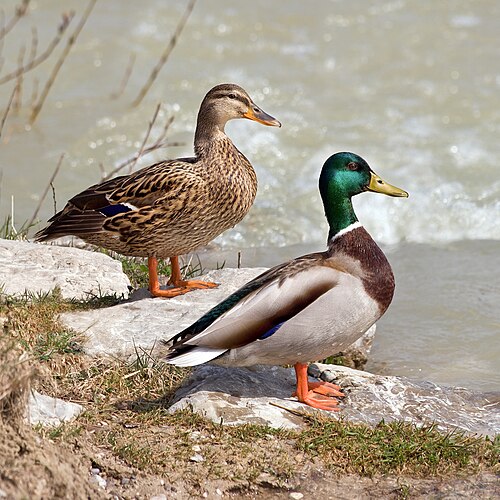
Mallard
Anas platyrhynchos
The familiar dabbling duck of ponds and park lakes. Males have a glossy green head; females are mottled brown with an orange bill.
- Large
- Wetlands
- Cities
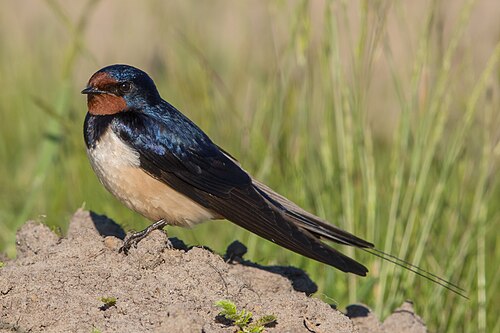
Barn Swallow
Hirundo rustica
A graceful, blue-backed swallow with a rusty throat and a deeply forked tail, often seen skimming over fields and nesting under bridges.
- Small
- Grasslands
- Wetlands
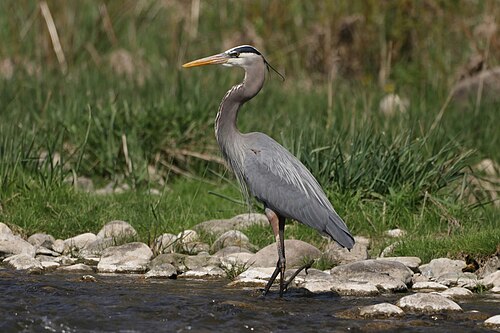
Great Blue Heron
Ardea herodias
North America’s largest heron, a tall gray-blue wader that stands motionless in shallows and strikes with a spear-like bill.
- Very large
- Wetlands
- Coastlines
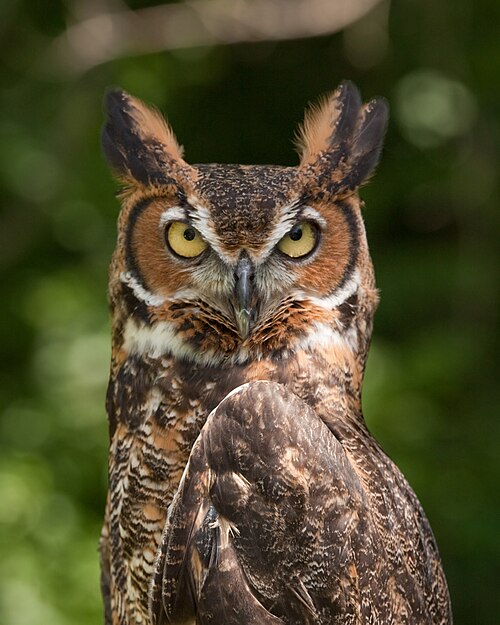
Great Horned Owl
Bubo virginianus
A big, heavy-bodied owl with feather tufts like horns and a deep, steady hoot. It lives in almost every kind of wooded or semi-open country.
- Large
- Forests
- Deserts
Related guides
Sources
Sources are the pages consulted when this entry was written. How we choose and use sources: sources and identification criteria.
Further reading (not used as a source for this entry): All About Birds, Cornell Lab of Ornithology.