
Kingfishers · Alcedinidae
Belted Kingfisher
Megaceryle alcyon
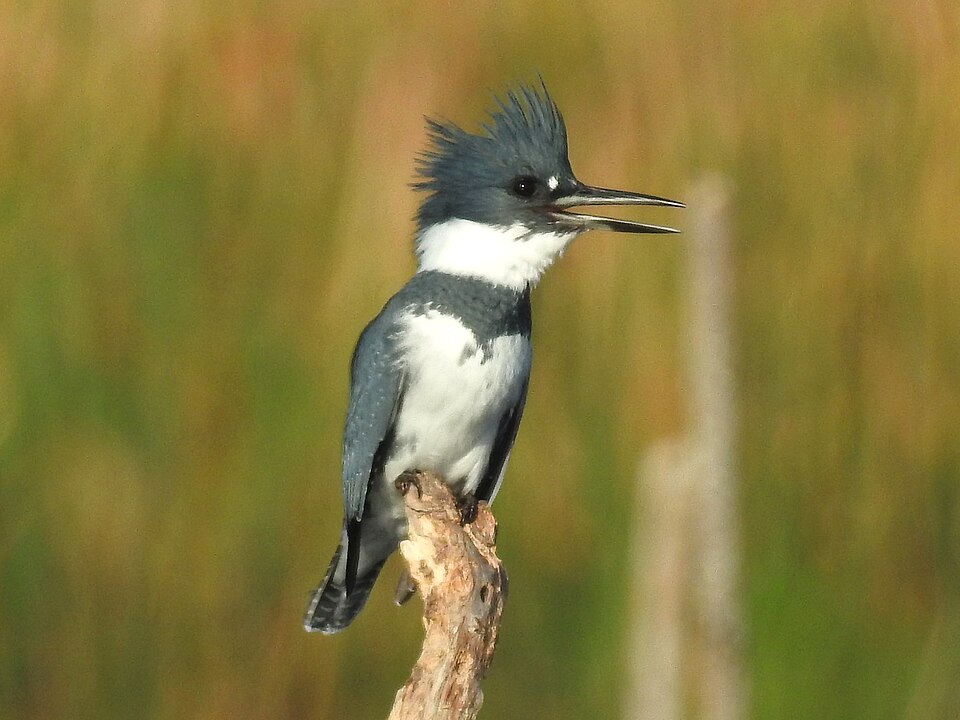
A shaggy-crested, blue-gray waterside bird that rattles along rivers and plunges headfirst for fish.
Presence varies. Bird presence and timing change with location, weather, habitat and migration. Treat this page as a starting point, then check recent local sightings (for example on eBird) before you go.
Identification features
- A big-headed, shaggy-crested bird with a blue-gray back and a white collar and underparts.
- Males show one blue-gray band across the chest; females add a rusty band on the belly.
- It perches on a branch or wire over open water and often flies off with a loud rattle.
- A long, thick, dagger-like bill and a short tail give it a front-heavy look.
- It sometimes hovers over water before it plunges headfirst.
Size and appearance
The Belted Kingfisher is a stocky, big-headed bird, ranging from robin-sized to crow-sized in different guides, with a shaggy crest, a stout bill, and short legs. The back, wings, and head are blue-gray, with a white collar and white underparts. A blue-gray belt crosses the chest of both sexes. This species is unusual because the female is the more colorful: she also has a rusty band across the belly. Juveniles have rusty spotting on the breast bands and more white on the wings and tail. In flight the wings look narrow and pointed, and the tail is rounded or square. The bird often looks hunched and front-heavy even when perched.
Bill: A long, thick, straight, dark bill built for spearing small fish.
Habitat
A kingfisher must have water that holds fish, and it needs clear water and good perches to find them. Streams, rivers, lakes, ponds, bays, and coasts are all used, as long as there are branches, wires, or posts to hunt from and prey is visible. In winter and migration it uses almost any aquatic habitat: small creeks, large rivers, lakes, marshes, estuaries, and rocky shores. For breeding, it also needs an earthen bank for a nesting burrow. That bank may be natural or may be a cut in a roadside, gravel pit, or similar spot.
Geographic range
The Belted Kingfisher is widespread across most of North America. In the US it can be found in nearly every state, from southern Alaska to Florida and from the Atlantic to the Pacific, wherever there is suitable water. It also winters south to Central America, the West Indies, and northern South America. The species wanders and has been recorded rarely in places such as Hawaii, Britain, Ireland, and Iceland. Local numbers depend on water quality, fish, and bank availability, so a stream with perches but no clear water may not hold one.
Northeast Southeast Midwest Southwest Pacific West Alaska & Hawaii
Seasonal presence
Kingfishers are partial migrants, so presence depends on where you are. Birds in the northern states and Canada often move south when ponds and rivers freeze over, while others stay as long as open water and food remain; some even winter on the southern coast of Alaska. In the South and along the Pacific coast, many are present year-round. Migrants tend to follow rivers, lakeshores, and coastlines. In many northern areas, a kingfisher in winter is often a lone bird at a patch of open water, such as the base of a dam. Timing varies with weather and freeze-up, so you cannot count on seeing one at a given place in a given month.
| Region | Spring | Summer | Fall | Winter |
|---|---|---|---|---|
| Northeast | Present | Present | Present | Present |
| Southeast | Present | Present | Present | Present |
| Midwest | Present | Present | Present | Present |
| Southwest | Present | Present | Present | Present |
| Pacific West | Present | Present | Present | Present |
| Alaska & Hawaii | Present | Present | Present | Not typical |
A dot means the species is regularly present in that region in that season. Dates shift with latitude, elevation, weather and migration, and some regions are only partly covered by the species’ range.
Diet
Belted Kingfishers eat mostly small fish, such as trout, sticklebacks, and mummichogs. They also take crayfish, frogs, tadpoles, and aquatic insects, and occasionally small mammals, young birds, reptiles, and berries. A kingfisher hunts from a perch or by hovering, then plunges headfirst into the water, closing its eyes at impact, to catch prey near the surface. Bones, scales, and shells are later coughed up as pellets. There is no safe way to feed a kingfisher at a bird feeder, and fishing ponds should be left alone, since the species was once persecuted near hatcheries and streams.
Behavior
Kingfishers are mostly solitary except when nesting. They watch from a perch, sometimes bobbing the head, and launch into a fast dive, then return to the perch to beat the fish before swallowing it. They defend stretches of water from other kingfishers, and the loud rattle is often part of that territorial display. During courtship the male offers a fish to the female. Both sexes dig a long, mostly upward-sloping tunnel into a bank, ending in a nest chamber. Eggs are usually 6 to 7 and both parents take turns incubating. Parents feed the young partly digested fish at first and later whole fish. Because adults can abandon territories near heavy human activity, stay far from any bank where a pair is going in and out.
Vocalizations
The classic kingfisher sound is a loud, dry rattle that carries across the water and often announces the bird before it appears. It is given when the bird is disturbed, when it defends territory, and during flight. Audubon also lists buzzes, trills, and screams, and both sexes may scream when displaying or retreating from a conflict. There is no musical song. A rattle that starts as you walk near a stream is often a bird leaving ahead of you, so a quiet approach gives you more time to see it perched.
Recordings are not hosted on this site. For audio, see the sources below. Please avoid playing recordings to attract birds in the field. See Learning Bird Songs and Calls.
Similar species
- Green Kingfisher. A Green Kingfisher is much smaller and mostly dark green. It is found mainly in southern Texas and parts of Arizona.
- Blue Jay. A Blue Jay is bluer with a black necklace and a slim bill. It does not sit over water or plunge for fish. Compare side by side
Observation tips
- Scan wires, dead branches, and posts that stick out over water, especially along clear rivers, ponds, and shorelines.
- Approach quietly and look for the rattle. A kingfisher that has been flushed once often returns to the same perch.
- Pick a spot with a clear view and let the bird come to you. Moving along the shore repeatedly pushes it away from its fishing area.
- Keep your distance from earthen banks that might hold a nest, and never block or probe a burrow.
- Do not play kingfisher recordings to attract the bird. Territorial rattles are stressful to the birds.
Always keep your distance, stay on trails and leave nests alone. See How to Observe Birds Responsibly.
Conservation status
IUCN Red List: Least Concern. The IUCN lists the Belted Kingfisher as Least Concern, and Audubon gives an estimated population of about 1.8 million. The species was once hunted near streams and hatcheries, and it is still vulnerable to loss of nesting banks and to disturbance during breeding. Status and trends change over time, so check the IUCN Red List and Cornell Lab pages for current information.
Status last checked 2026-11-03. Status and trends change, so check the linked sources for the latest. Search the IUCN Red List.
Questions and answers
Why is the female kingfisher more colorful than the male?
In this species the female carries an extra rusty band across the belly, so she looks brighter than the male, who has only the blue-gray chest band. Reverse color patterns like this are unusual in birds, and sources describe the difference without explaining it.
Do kingfishers stay in the north in winter?
Some do, as long as open water and food remain. Others move south as ponds and rivers freeze. It depends on the local climate, so check local reports; in cold regions the best chance is a stretch of moving or open water.
Related entries
Related birds
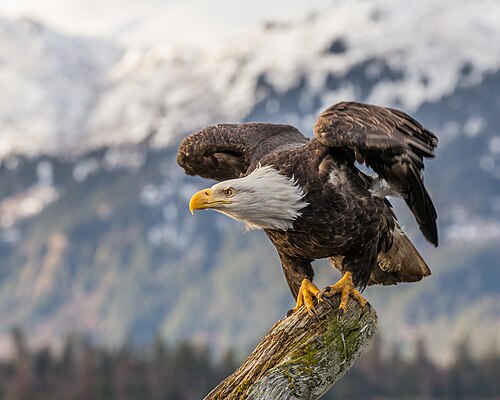
Bald Eagle
Haliaeetus leucocephalus
America’s national bird, a huge dark-brown raptor with a white head and tail that fishes along coasts, rivers and large lakes.
- Very large
- Wetlands
- Coastlines
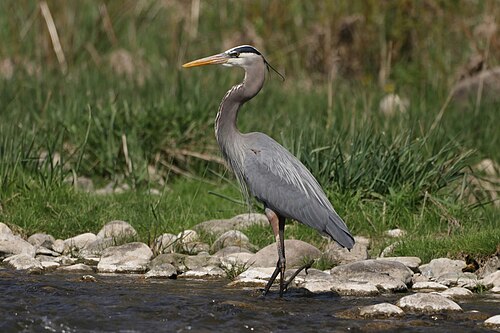
Great Blue Heron
Ardea herodias
North America’s largest heron, a tall gray-blue wader that stands motionless in shallows and strikes with a spear-like bill.
- Very large
- Wetlands
- Coastlines
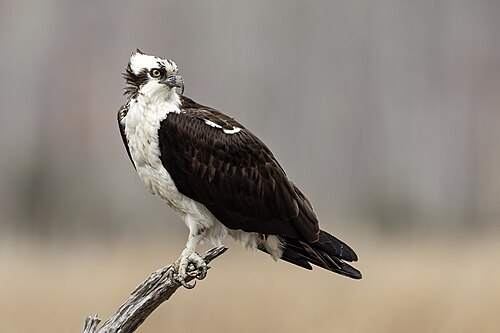
Osprey
Pandion haliaetus
A large fish-eating raptor that hovers over water and plunges feet-first for its catch. Look for its stick nests on poles and platforms.
- Large
- Wetlands
- Coastlines
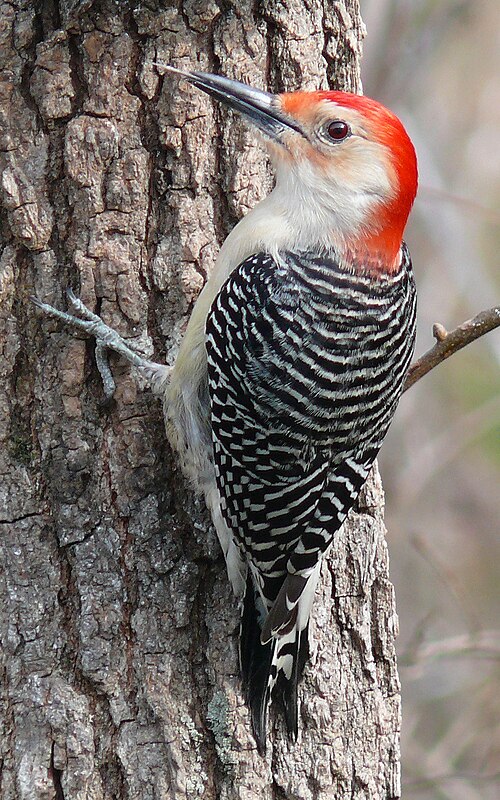
Red-bellied Woodpecker
Melanerpes carolinus
A medium woodpecker with a zebra-striped back and a red cap, familiar in eastern woods, suburbs and at suet feeders.
- Medium
- Forests
- Backyards
Related guides
Sources
- Audubon Field Guide — Belted Kingfisher
- Wikipedia: Belted kingfisher (secondary cross-check of the IUCN category)
Sources are the pages consulted when this entry was written. How we choose and use sources: sources and identification criteria.
Further reading (not used as a source for this entry): All About Birds, Cornell Lab of Ornithology.