
Woodpeckers · Picidae
Downy Woodpecker
Dryobates pubescens
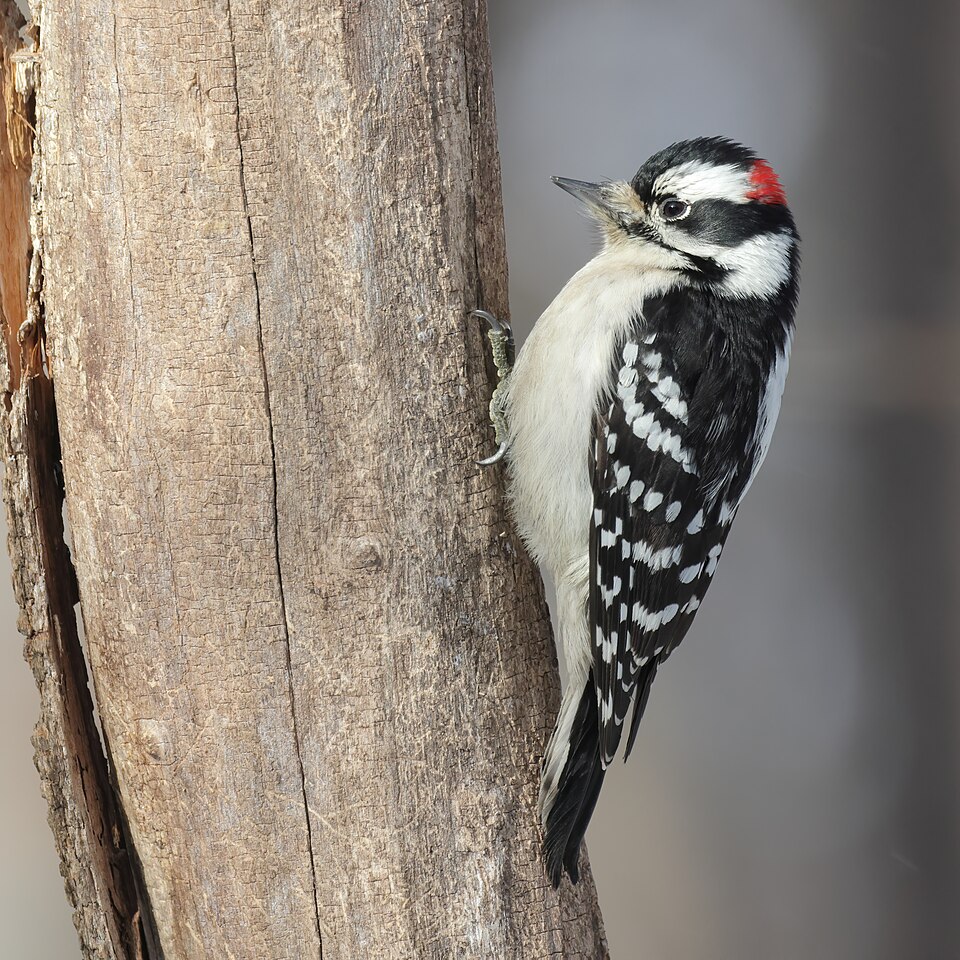
The smallest woodpecker in North America, a black-and-white bird with a short bill that visits suet feeders and tiny branches.
Presence varies. Bird presence and timing change with location, weather, habitat and migration. Treat this page as a starting point, then check recent local sightings (for example on eBird) before you go.
Identification features
- North America’s smallest woodpecker, about sparrow- to robin-sized, with a black-and-white checkered look.
- A clean white stripe down the center of the back, visible when the bird clings to a trunk.
- A short, stubby bill, much smaller than the head in profile.
- White outer tail feathers marked with a few black bars.
- Adult males wear a red patch on the back of the head; females lack it.
Size and appearance
The Downy Woodpecker is a compact black-and-white bird, noticeably smaller than most other woodpeckers. The wings are black with white spots, the face has two white stripes, and a bold white band runs down the middle of the back. The bill is short and stubby, about a third the length of the head. Males show a small red patch on the nape, which is the easiest way to tell the sexes apart. Birds in the Rocky Mountain region can have less white spotting on the wings. Juveniles look much like adults, but some young birds can show a bit of red on the crown.
Bill: A short, stubby chisel bill, noticeably small for a woodpecker.
Habitat
Downy Woodpeckers use many kinds of wooded places, from forests and river groves to orchards, woodlots, and shade trees in suburban yards. They prefer deciduous trees, and in the far north and in mountains they are often found in groves of aspen or willow. They also forage in weedy fields and on thin stalks, where larger woodpeckers cannot reach. For nesting, they dig a cavity in a dead trunk or limb, usually 12 to 30 feet off the ground. They tend to avoid the driest parts of the Southwest.
Geographic range
This is a widespread resident across most of the United States and Canada. It ranges from the Northeast through the Southeast and Midwest to the Plains, Rockies and Pacific states, and into Alaska and much of Canada. Western birds have slightly different markings than eastern ones. The species is scarce in arid desert country in the Southwest, where large treeless areas limit it. Hawaii is outside its range. In the mountains and the far north, some individuals drop to valleys or move south in winter.
Northeast Southeast Midwest Southwest Pacific West Alaska & Hawaii
Seasonal presence
Downy Woodpeckers are mostly year-round residents, so you can usually find one in any season where trees are available. In fall and winter they often join small mixed flocks with chickadees and nuthatches, which makes them easier to find by following the flock. Northern birds and some mountain birds move south or down to lower valleys in winter, so a feeder in the far north may see more or fewer in cold months. Drumming is more frequent in late winter and spring as pairs form. Exact timing shifts with location, weather and food supply.
| Region | Spring | Summer | Fall | Winter |
|---|---|---|---|---|
| Northeast | Present | Present | Present | Present |
| Southeast | Present | Present | Present | Present |
| Midwest | Present | Present | Present | Present |
| Southwest | Present | Present | Present | Present |
| Pacific West | Present | Present | Present | Present |
| Alaska & Hawaii | Present | Present | Present | Not typical |
A dot means the species is regularly present in that region in that season. Dates shift with latitude, elevation, weather and migration, and some regions are only partly covered by the species’ range.
Diet
Insects make up most of what Downy Woodpeckers eat, especially beetles and ants, along with caterpillars and the larvae of gall-making insects. They also take seeds and berries, mostly in colder months. They tap and probe into bark and chip into small stems to reach grubs, and in summer they glean more from surfaces. At feeders they visit suet cakes and also eat sunflower seeds and peanut pieces. Plain suet is a safe choice; avoid honey, bread and salty foods.
Behavior
A Downy often climbs trunks in short hops, then turns and probes branches, and sometimes hangs upside down on thin stems. It uses a flap-and-glide flight, with a series of quick beats followed by a short swoop. Both sexes drum on dead limbs to claim territory and to communicate with mates. In late winter, pairs form after spending the fall and early winter feeding in separate areas. The pair excavates a cavity in dead wood, and the female lays a handful of white eggs. Both parents share incubation and feeding of the young. Do not approach nest holes, which are easily disturbed.
Vocalizations
The most common call is a short, sharp “pik,” often given repeatedly. A descending whinny or rattle, made of rapid notes that fall in pitch, is used between neighbors and between mates. Drumming is a fast, even roll on a dead limb, a bit softer and faster than the drumming of larger woodpeckers. Because the Hairy Woodpecker’s call is louder and flatter, listening can help you tell the two apart. Avoid using recordings to draw woodpeckers in, particularly during nesting.
Recordings are not hosted on this site. For audio, see the sources below. Please avoid playing recordings to attract birds in the field. See Learning Bird Songs and Calls.
Similar species
- Hairy Woodpecker. Larger with a bill nearly as long as the head, and plain white outer tail feathers without black bars.
- Ladder-backed Woodpecker. Has a barred back instead of a clean white stripe and lives in arid Southwest and Texas scrub.
- Red-bellied Woodpecker. Larger, with a zebra-barred back and a buffy face rather than a clean white back stripe. Compare side by side
Observation tips
- Offer plain suet in a cage or log feeder, and clean it often in warm weather.
- Look for small, tapping birds on thin branches and weed stalks, not only on big trunks.
- In winter, follow chickadee and nuthatch flocks; a Downy is often tagging along.
- Compare the bill length to the head to separate it from a Hairy Woodpecker.
- Watch drumming birds from a distance and do not approach nest holes.
Always keep your distance, stay on trails and leave nests alone. See How to Observe Birds Responsibly.
Conservation status
IUCN Red List: Least Concern. Audubon describes the Downy Woodpecker as very common and widespread, with no evidence of population declines, and lists it as Least Concern on the IUCN list. Birds and their active nests are generally protected by US law, but we did not verify the details for this page. Status and trends change over time, so check the linked sources.
Status last checked 2026-11-03. Status and trends change, so check the linked sources for the latest. Search the IUCN Red List.
Questions and answers
How can I tell a Downy from a Hairy Woodpecker?
Size and bill are the best clues. A Downy is smaller and has a stubby bill that looks short against its head. A Hairy is larger with a bill about as long as the head. Downy outer tail feathers also have small black bars.
What should I feed a Downy Woodpecker?
Plain suet is the most reliable choice, and many Downy Woodpeckers will also take black oil sunflower seed or peanut pieces. Keep suet fresh and clean the feeder regularly. Avoid honey, bread and heavily salted foods.
Related entries
Related birds
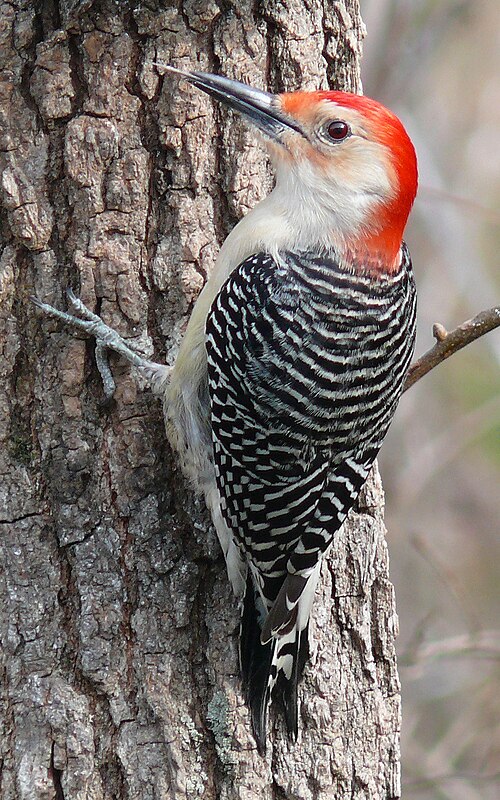
Red-bellied Woodpecker
Melanerpes carolinus
A medium woodpecker with a zebra-striped back and a red cap, familiar in eastern woods, suburbs and at suet feeders.
- Medium
- Forests
- Backyards
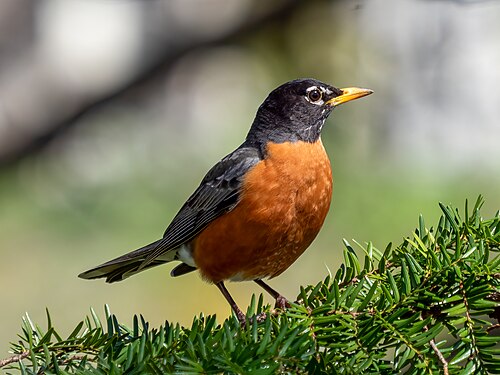
American Robin
Turdus migratorius
A gray-brown thrush with a rusty-orange breast, often seen sprinting and pausing across lawns while hunting worms.
- Medium
- Backyards
- Cities
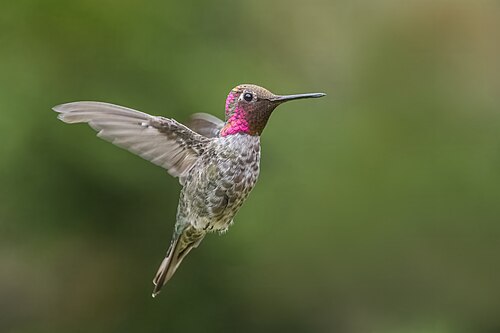
Anna’s Hummingbird
Calypte anna
A stocky Pacific Coast hummingbird with a rose-red head, now a year-round presence in many western yards and feeders.
- Tiny
- Backyards
- Cities
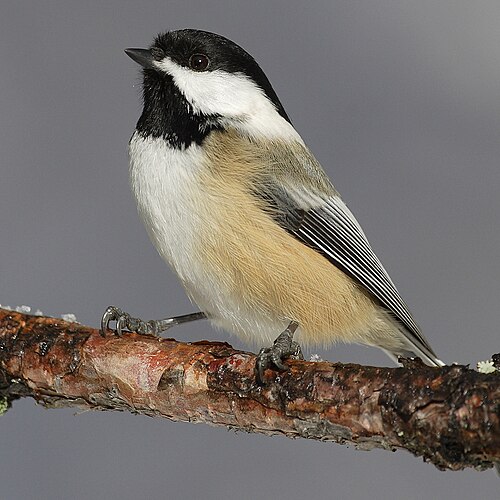
Black-capped Chickadee
Poecile atricapillus
A tiny, curious songbird with a black cap and bib, white cheeks and a clear fee-bee song. A resident across the northern states.
- Small
- Forests
- Backyards
Related guides
Sources
- Audubon Field Guide — Downy Woodpecker
- Wikipedia: Downy woodpecker (secondary cross-check of the IUCN category)
Sources are the pages consulted when this entry was written. How we choose and use sources: sources and identification criteria.
Further reading (not used as a source for this entry): All About Birds, Cornell Lab of Ornithology.