
Thrushes · Turdidae
American Robin
Turdus migratorius
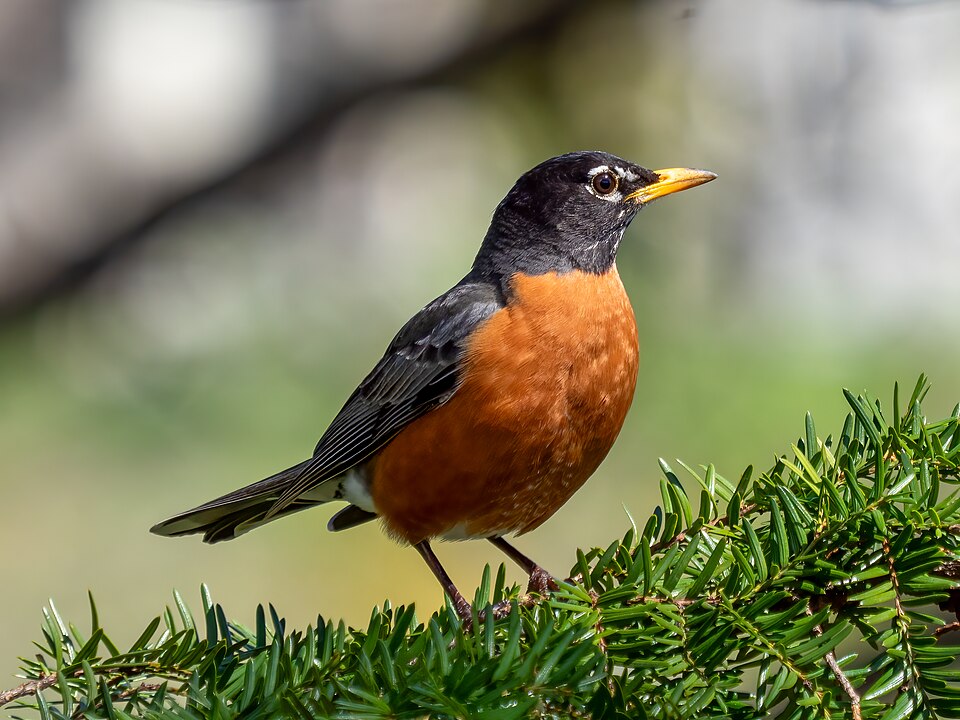
A gray-brown thrush with a rusty-orange breast, often seen sprinting and pausing across lawns while hunting worms.
Presence varies. Bird presence and timing change with location, weather, habitat and migration. Treat this page as a starting point, then check recent local sightings (for example on eBird) before you go.
Identification features
- Rusty-orange breast and belly contrast with a gray-brown back and a darker head.
- Broken white arcs around the eye, and a mostly yellow bill.
- White patches on the lower belly and under the tail show when the bird flies or stretches.
- On lawns it moves in short runs, then stops upright and tilts its head.
- Juveniles have a pale orange breast covered in dark spots, which fade by their first fall.
Size and appearance
The American Robin is a large, round-bodied songbird with long legs and a fairly long tail. Adults have a dark gray-brown back and a warm orange chest and belly. Males usually look richer and darker on the head than females, but the two sexes are close enough that the difference is hard to judge in the field. A white eye-ring, a yellow bill and white marks under the tail help confirm the ID. Young birds look different: their breast is paler and heavily spotted, a pattern shared by many young thrushes. Robins in the arid West and in the far north can look slightly paler or darker than eastern birds, so use the overall shape and the orange underparts rather than exact shade.
Bill: Yellow and slender, with a darker tip in many birds.
Habitat
Few birds live as comfortably around people as the robin. In summer it uses lawns, parks, farms, forest edges and open woods, as long as it can find both trees or shrubs for nest sites and bare, damp ground for foraging and mud for nest building. In the dry Southwest, breeding birds are often tied to mountain conifer forests. Outside the breeding season the habitat shifts. Robins gather in flocks where berries and small fruits are plentiful, such as woodlots, hedgerows, and neighborhoods with fruiting trees like crabapple or juniper. During those months they can be much harder to find on lawns.
Geographic range
The American Robin breeds across most of North America, from Alaska and Canada south through the United States into Mexico. It is common in every region of the lower 48 at some point in the year. Alaska’s robins are summer visitors. Farther south, the picture is more tangled. Robins nest across the northern states, and many of those birds move south for winter, while others stay if food holds out. Where individuals winter changes from year to year with the berry crop and the weather. Mexico and Central America host part of the winter population, along with the Gulf Coast, the Southeast and the Pacific coast.
Northeast Southeast Midwest Southwest Pacific West Alaska & Hawaii
Seasonal presence
In spring, males are among the first songbirds to sing before sunrise, and lawn-hunting birds become obvious as the ground thaws. Summer brings nesting, with up to a few broods in many areas. In fall, robins form flocks and drift south, often by day. Winter is where the species surprises people. Many birds leave the northern states, yet others stay wherever fruit remains, and flocks can swell into the hundreds in southern woodlands. Timing varies with location, weather and food supply, so a mild winter may keep robins far north while a hard freeze can empty a region within days. Spring arrival dates differ from year to year, too.
| Region | Spring | Summer | Fall | Winter |
|---|---|---|---|---|
| Northeast | Present | Present | Present | Present |
| Southeast | Present | Present | Present | Present |
| Midwest | Present | Present | Present | Present |
| Southwest | Present | Present | Present | Present |
| Pacific West | Present | Present | Present | Present |
| Alaska & Hawaii | Present | Present | Present | Not typical |
A dot means the species is regularly present in that region in that season. Dates shift with latitude, elevation, weather and migration, and some regions are only partly covered by the species’ range.
Diet
Robins eat a mix of animal and plant food, and the balance moves with the seasons. In spring and early summer they take earthworms, beetle grubs, caterpillars and other insects, mostly from the ground. Nestlings are raised mainly on this protein. As summer ends the diet turns toward fruit, and fruit and berries make up a large part of the yearly total, especially in winter. Wild fruit from trees such as holly, juniper, hawthorn and crabapple is a typical winter food. Robins rarely eat typical seed at feeders. Mealworms, chopped fruit and a shallow bird bath are the most useful offerings. Avoid bread and anything salty.
Behavior
A foraging robin runs a few steps, stops with its body upright, and then lunges at prey it has spotted, often an earthworm. Vision seems to do most of the work, though the head tilt is often mistaken for listening. Outside the nesting season robins feed and roost in flocks, which may become large in fall and winter. During breeding, males defend territories with song and short chases, and some will attack their own reflection in a window or car mirror. The female builds a cup nest of grass reinforced with mud, set on a branch, a building ledge or a similar sturdy support, and lays pale blue eggs. Pairs can raise two or three broods in a season. If you find a nest, watch from a distance, and leave fledglings on the ground alone, since their parents are usually nearby.
Vocalizations
The song is a flowing, whistled carol of short phrases that rise and fall, often written as cheerily, cheer-up, cheerio. A singing male can repeat it for long stretches and is often the first voice in the dawn chorus. The calls are just as useful. A sharp, rapid tut-tut-tut and a thin, high seeee warn of cats and hawks, and a fast chattering rattle appears in quarrels. Singing is strongest from late winter or early spring into midsummer. In fall and winter robins are mostly quiet apart from soft calls from flocks and the occasional alarm.
Recordings are not hosted on this site. For audio, see the sources below. Please avoid playing recordings to attract birds in the field. See Learning Bird Songs and Calls.
Similar species
- Varied Thrush. The Varied Thrush, a Pacific Northwest bird, has a dark breast band and orange eyebrow stripe that the robin lacks.
- Eastern Bluebird. Bluebirds are smaller and bright blue above, with a paler belly, while robins are gray-brown above with an orange belly. Compare side by side
- Spotted Towhee. Towhees live in thick brush and have black hoods, white spots on the wings, and red eyes, unlike the robin’s plain gray back.
Observation tips
- Scan open lawns right after rain or at dawn, when robins are most active at the surface.
- In winter, check fruiting trees and shrubs. Flocks often feed there instead of on lawns.
- Listen before sunrise in spring. The carol is a reliable way to find territorial males.
- Use binoculars from a distance near nests, and do not touch or move eggs or nestlings.
- Offer a shallow, clean bird bath. Robins use it year-round, and it keeps them in view.
Always keep your distance, stay on trails and leave nests alone. See How to Observe Birds Responsibly.
Conservation status
IUCN Red List: Least Concern. The IUCN lists the American Robin as Least Concern, and sources estimate a very large population, in the hundreds of millions. The species is widespread and appears stable. In the United States, native songbirds like robins fall under the Migratory Bird Treaty Act. Status and trends can change, so check the [IUCN Red List](https://www.iucnredlist.org) for the current assessment.
Status last checked 2026-11-03. Status and trends change, so check the linked sources for the latest. Search the IUCN Red List.
Questions and answers
Do robins really leave in winter?
Some do, but many stay. Robins shift to wherever berries and fruit remain, so a region can have plenty one winter and few the next. Flocks in woods can look like a fresh arrival even though the birds were nearby all along.
Is a robin on the ground in trouble?
Usually not. Young robins leave the nest before they can fly well and hop around while their parents feed them. Keep pets away, observe from a distance, and do not pick the bird up unless it is clearly injured.
Related entries
Related birds
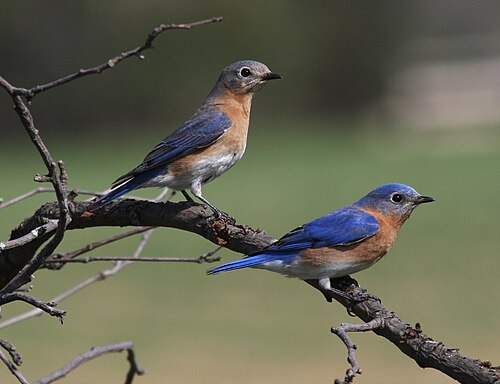
Eastern Bluebird
Sialia sialis
A small thrush of open country: the male is bright blue above with a rusty throat and chest, and a white belly.
- Small
- Grasslands
- Backyards
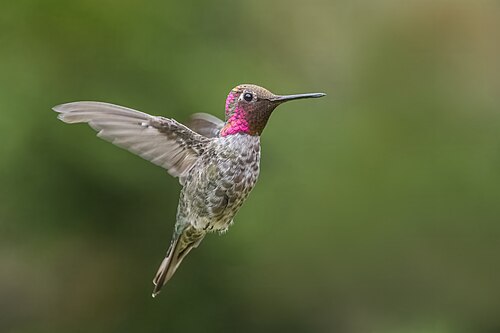
Anna’s Hummingbird
Calypte anna
A stocky Pacific Coast hummingbird with a rose-red head, now a year-round presence in many western yards and feeders.
- Tiny
- Backyards
- Cities
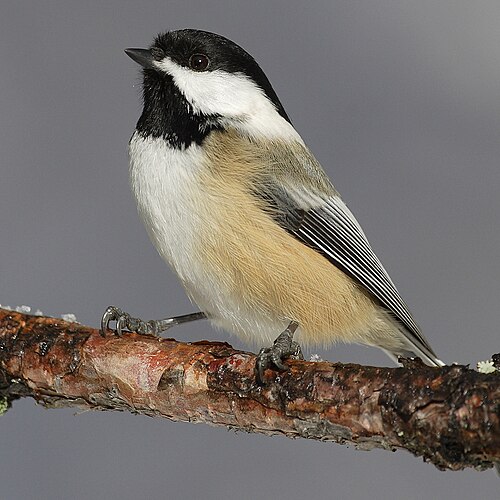
Black-capped Chickadee
Poecile atricapillus
A tiny, curious songbird with a black cap and bib, white cheeks and a clear fee-bee song. A resident across the northern states.
- Small
- Forests
- Backyards
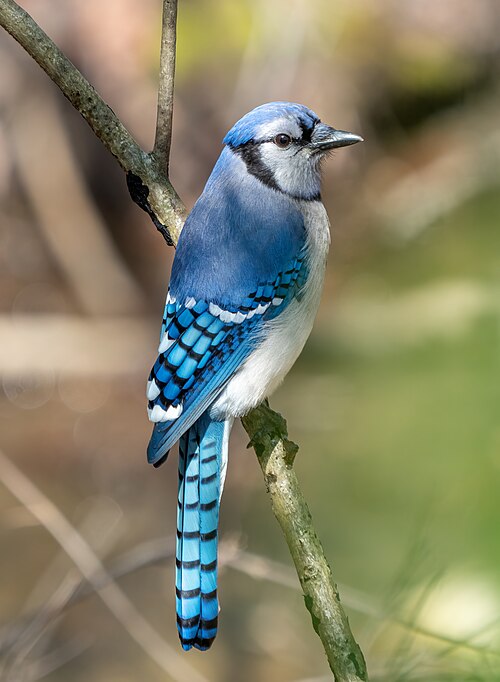
Blue Jay
Cyanocitta cristata
A loud, crested jay in blue, white and black. Common in eastern woods and yards, with some birds migrating in fall.
- Medium
- Forests
- Backyards
Related guides
Sources
Sources are the pages consulted when this entry was written. How we choose and use sources: sources and identification criteria.
Further reading (not used as a source for this entry): All About Birds, Cornell Lab of Ornithology.