
Ospreys · Pandionidae
Osprey
Pandion haliaetus
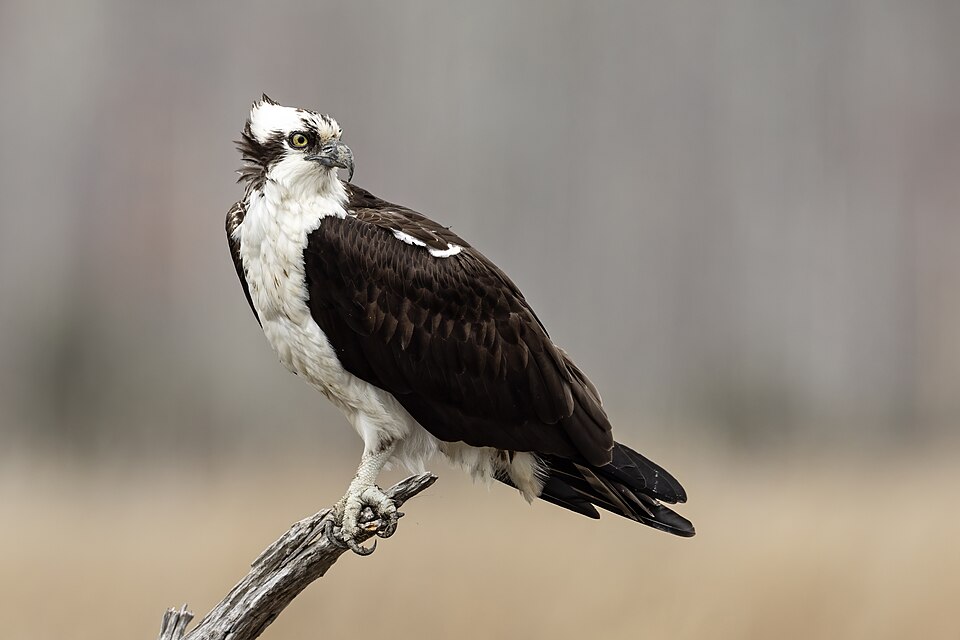
A large fish-eating raptor that hovers over water and plunges feet-first for its catch. Look for its stick nests on poles and platforms.
Presence varies. Bird presence and timing change with location, weather, habitat and migration. Treat this page as a starting point, then check recent local sightings (for example on eBird) before you go.
Identification features
- Dark brown above and mostly white below, with a dark stripe running through the eye.
- In flight the long, narrow wings bend at the wrist, forming an M shape, and dark wrist patches show underneath.
- A white head with a dark eye stripe separates it from the all-dark-headed look of many other raptors.
- At a distance it can resemble a big gull more than a hawk.
- It hovers and then dives feet-first into the water.
- A bulky stick nest on a high platform, pole or dead tree near water is a strong clue.
Size and appearance
The Osprey is a big, lean raptor with long, narrow wings and a short tail. Above it is dark brown, and below it is mostly white, with a dark band across the eye that gives it a masked look. Seen from beneath, the wings show a dark patch at the bend of each wrist and a barred flight-feather pattern. In the air, the wings are held in a gentle bend. Females tend to be larger, and many show a streaky band of brown across the chest, but this is a poor way to separate the sexes. Juveniles have pale edges on the back feathers that give a scaled look.
Bill: A short, black, strongly hooked bill used for tearing fish.
Habitat
Ospreys live where there is fish-bearing water: coasts, estuaries, salt marshes, lakes, large rivers and reservoirs. They are especially common around coastal estuaries and salt marshes, where fish are plentiful. They need an open nest site with a clear view, and they often build on tall dead trees, utility poles, navigation markers and platforms put up for them. During migration, birds can be found far from water, even over desert, as they cross land between hunting spots. Nests are visible from far away, which helps in finding them.
Geographic range
Ospreys breed over much of North America, and in the US they nest from Alaska and the northern states through the Great Lakes, the Rockies, the Pacific coast, New England and the Mid-Atlantic, and along the Gulf and Atlantic coasts. In the Southeast and Florida they are common, and some stay year-round in southern Florida. Most others are migratory, spending winter in Central and South America. Ospreys also occur on other continents. Migrants travel alone and often follow coastlines, lakeshores, rivers and mountain ridges, so a bird can turn up at ponds in places where no nesting happens.
Northeast Southeast Midwest Southwest Pacific West Alaska & Hawaii
Seasonal presence
In most of the US, Ospreys arrive from their wintering areas in spring, often when lakes thaw, and they quickly return to the same nest sites. Summer is the nesting season, when adults are easy to see over open water. In fall they head south, traveling alone rather than in flocks, sometimes in good numbers at coastal and ridge lookouts. Winter sightings are limited mostly to the far South and a few Gulf and Atlantic coastal areas, with only part of Florida holding year-round birds. Dates shift by latitude, weather and the year, and in the Southwest the species is mainly seen during migration.
| Region | Spring | Summer | Fall | Winter |
|---|---|---|---|---|
| Northeast | Present | Present | Present | Not typical |
| Southeast | Present | Present | Present | Present |
| Midwest | Present | Present | Present | Not typical |
| Southwest | Present | Not typical | Present | Not typical |
| Pacific West | Present | Present | Present | Not typical |
| Alaska & Hawaii | Not typical | Present | Not typical | Not typical |
A dot means the species is regularly present in that region in that season. Dates shift with latitude, elevation, weather and migration, and some regions are only partly covered by the species’ range.
Diet
Ospreys eat almost nothing but live fish, typically about four to twelve inches long. The species taken depends on the region, such as flounder, smelt, mullet, bullheads, suckers or gizzard shad. They only rarely take small mammals, birds or reptiles, usually when fish are scarce. A hunting Osprey flies slowly over the water, sometimes hovers, and then drops feet-first to grab a fish with its talons. After a catch it rises heavily and carries the fish headfirst, which lessens drag. Bald Eagles sometimes chase Ospreys and force them to drop a catch. Ospreys never visit feeders.
Behavior
An Osprey hunts by flying low and slow, scanning the water, hovering for a moment and then plunging, often going completely under. Its feet have rough pads and a reversible outer toe to grip slippery fish. Pairs build big piles of sticks on tall, open sites, and they often reuse and add to the nest over the years. Eggs number one to four, mostly incubated by the female for around five to six weeks, and the young fledge at roughly seven to eight weeks. Pairs raise one brood a year. Adults may be loud and defensive near the nest, and people who linger underneath can cause eggs to chill or chicks to be left exposed. Watching from a distance is best.
Vocalizations
The Osprey’s call is a series of loud, musical chirps and whistles that often seem surprisingly small for such a big bird. A common call is a rapid string of clear, rising notes, and an alarm call is a more urgent, loud run of whistles that may escalate to a scream if an intruder nears the nest. Pairs use softer calls near the nest, and fledglings beg with high-pitched, repeated cries. Most calls are falling and simple in pattern. Do not use recordings to lure birds near nests.
Recordings are not hosted on this site. For audio, see the sources below. Please avoid playing recordings to attract birds in the field. See Learning Bird Songs and Calls.
Similar species
- Bald Eagle. Bald Eagles are bigger and broader, with a heavy yellow bill and flat wings; adults have a solid white head and tail but no dark eye stripe. Compare side by side
- Red-tailed Hawk. Red-tailed Hawks have broad, rounded wings and a short fanned tail and don't hover over water for fish. Compare side by side
- Herring Gull. A gull flies with steadier, straighter wings and does not have a dark eye stripe or the wrist bend of an Osprey.
Observation tips
- Scan lakes, bays and slow rivers for a bird hovering and then diving. Binoculars show the head stripe and wrist patches well.
- Look for large stick nests on poles, channel markers and platforms, but watch from a long distance so adults do not abandon the nest.
- Do not approach nest sites or climb poles, and don't stand under a nest for long. Disturbance can lead adults to leave chicks exposed.
- In fall, try coastlines and ridge lookouts, where migrating Ospreys pass singly rather than in big flocks.
- Don't play recordings to draw adults out, particularly near nests.
Always keep your distance, stay on trails and leave nests alone. See How to Observe Birds Responsibly.
Conservation status
IUCN Red List: Least Concern. The IUCN lists the Osprey as Least Concern. Audubon notes that pesticides seriously harmed Ospreys in the mid-20th century, and that after DDT and related chemicals were banned in 1972 numbers recovered well in many parts of North America. Status and trends change over time, so check the IUCN Red List and current monitoring data. This guide did not verify specific US legal protections.
Status last checked 2026-11-03. Status and trends change, so check the linked sources for the latest. Search the IUCN Red List.
Questions and answers
Do Ospreys stay in the US all year?
Mostly no. Most migrate to Central and South America for winter. The main exceptions are birds in southern Florida, which can be present year-round. Arrival and departure dates change with location and weather.
Why do Ospreys nest on utility poles?
They look for tall, open sites with a good view near fish-bearing water, and poles, markers and nest platforms provide that. If a nest is on a pole, leave it alone and contact the local utility or wildlife agency about concerns.
Related entries
Related birds
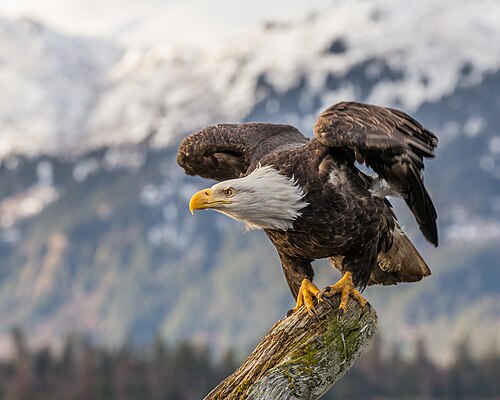
Bald Eagle
Haliaeetus leucocephalus
America’s national bird, a huge dark-brown raptor with a white head and tail that fishes along coasts, rivers and large lakes.
- Very large
- Wetlands
- Coastlines
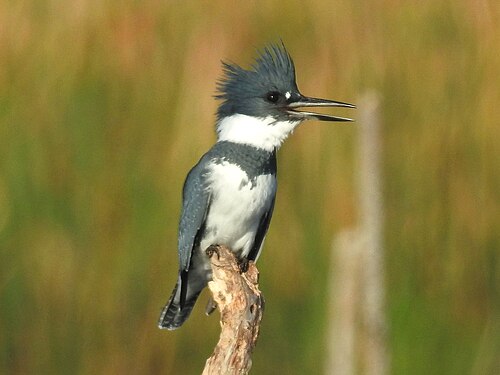
Belted Kingfisher
Megaceryle alcyon
A shaggy-crested, blue-gray waterside bird that rattles along rivers and plunges headfirst for fish.
- Medium
- Wetlands
- Coastlines
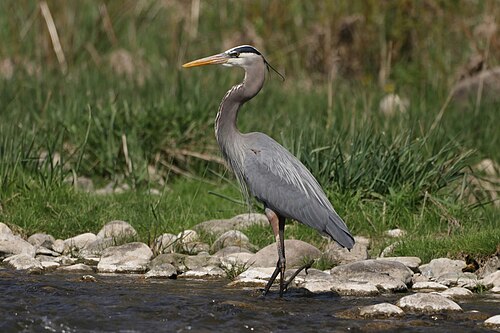
Great Blue Heron
Ardea herodias
North America’s largest heron, a tall gray-blue wader that stands motionless in shallows and strikes with a spear-like bill.
- Very large
- Wetlands
- Coastlines
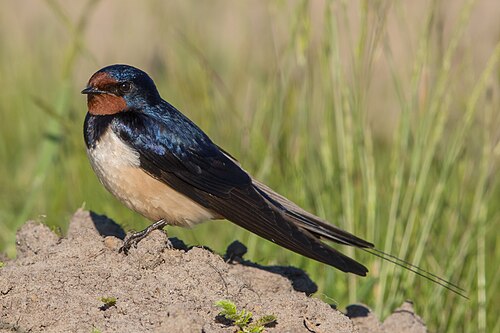
Barn Swallow
Hirundo rustica
A graceful, blue-backed swallow with a rusty throat and a deeply forked tail, often seen skimming over fields and nesting under bridges.
- Small
- Grasslands
- Wetlands
Related guides
Sources
Sources are the pages consulted when this entry was written. How we choose and use sources: sources and identification criteria.
Further reading (not used as a source for this entry): All About Birds, Cornell Lab of Ornithology.