
Ducks, Geese and Swans · Anatidae
Mallard
Anas platyrhynchos
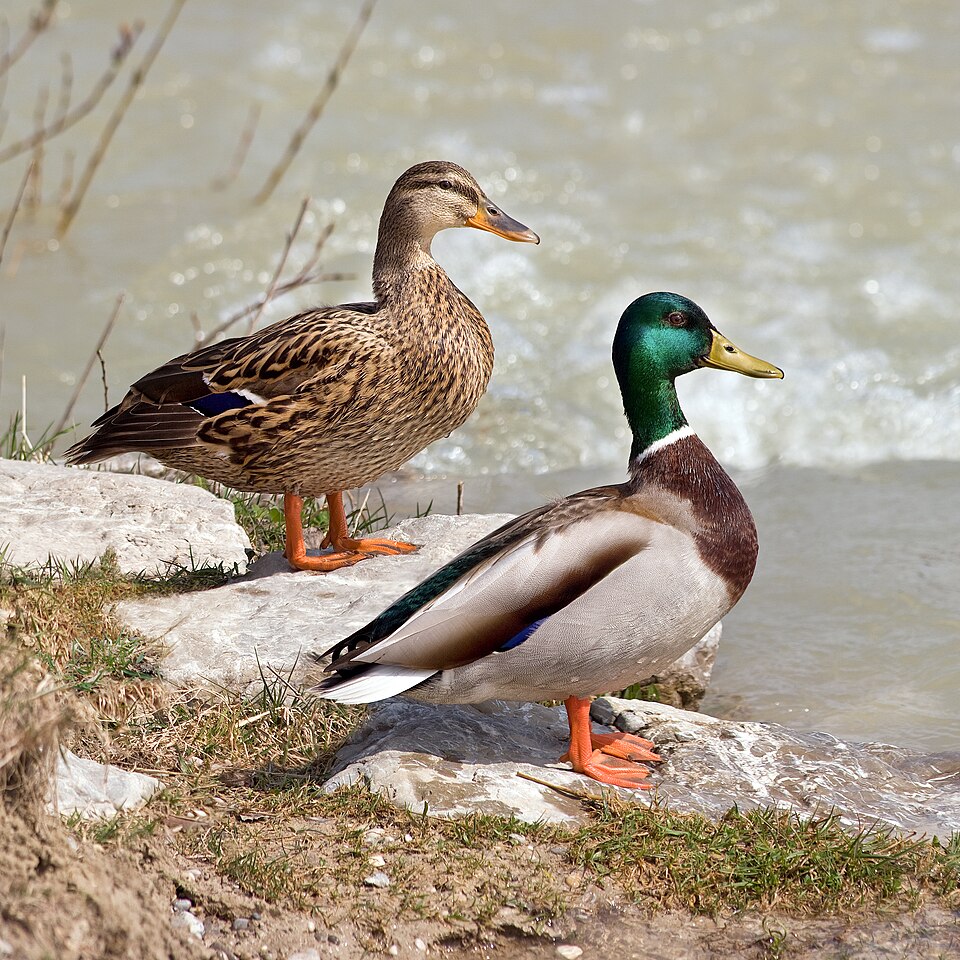
The familiar dabbling duck of ponds and park lakes. Males have a glossy green head; females are mottled brown with an orange bill.
Presence varies. Bird presence and timing change with location, weather, habitat and migration. Treat this page as a starting point, then check recent local sightings (for example on eBird) before you go.
Identification features
- Breeding male has a glossy green head, a yellow bill, a thin white neck ring and a chestnut chest over a pale gray body.
- Female is streaky brown with an orange bill that has dark smudges, and she is the source of the classic loud quack.
- Both sexes show a blue wing patch, called a speculum, bordered with white at the front and back.
- Feeds by dabbling: tipping forward with the tail up and the head under water, rather than diving.
- Often hybridizes with American Black Ducks and domestic ducks, so odd-looking birds are common.
Size and appearance
Mallards are medium-large ducks, roughly gull-sized, with a stocky body and a broad flat bill. Males and females are about the same size but look very different. In winter and spring a male wears the well-known glossy green head, white collar, rusty chest and gray body, with black at the tail and a curled black feather above the rump. Females are mottled in browns with an orange bill. In summer, males molt into a drab, female-like plumage, but they keep the yellow bill. Ducklings are fuzzy, dark and yellow-patterned. Both adult sexes show a bright blue wing patch edged in white.
Bill: A broad, flat bill: yellow-green on the male, orange with dark blotches on the female.
Habitat
Few ducks are as adaptable. Mallards use marshes, wooded swamps, ponds, lakes, rivers, flooded grain fields and city park lagoons, and they strongly prefer fresh water all year. In summer they are most plentiful on prairie potholes and in open country north of the prairies. In winter many gather on lakes and swamps in the lower Mississippi Valley, and some use sheltered bays and estuaries on the coast. Nests are usually on the ground in thick cover, sometimes a long walk from water, and occasionally in a tree hollow or an elevated basket.
Geographic range
Mallards occur in every part of the continental US and across southern Canada, and they range through southern and central Alaska. Wild northern birds are strongly migratory, while many urban and feral birds stay in one area through the year, which makes the exact status of any pond hard to predict. The species also lives across Europe and Asia. In the Northeast, Mallards often interbreed with American Black Ducks, and in Florida and parts of the Southwest they can hybridize with local relatives such as the Mottled Duck, a worry for those native birds.
Northeast Southeast Midwest Southwest Pacific West Alaska & Hawaii
Seasonal presence
Expect Mallards in every region for much of the year, but not always the same individuals. In the northern states, wild birds usually arrive soon after ice melts in spring and head south in fall, and fall migration stretches over a long period. In the South and on the West Coast, winter swells the numbers with birds from farther north. City and park Mallards often stay put year-round, regardless of the weather. In Alaska, Mallards are mainly spring through fall visitors. Timing shifts with weather, freeze-up and food, so check local reports for your area.
| Region | Spring | Summer | Fall | Winter |
|---|---|---|---|---|
| Northeast | Present | Present | Present | Present |
| Southeast | Present | Present | Present | Present |
| Midwest | Present | Present | Present | Present |
| Southwest | Present | Present | Present | Present |
| Pacific West | Present | Present | Present | Present |
| Alaska & Hawaii | Present | Present | Present | Not typical |
A dot means the species is regularly present in that region in that season. Dates shift with latitude, elevation, weather and migration, and some regions are only partly covered by the species’ range.
Diet
Mallards eat mostly plant material: seeds, stems and roots of sedges, grasses, pondweeds and smartweeds, plus acorns and spilled grain from fields. They also take insects, snails, crustaceans, tadpoles, small frogs, earthworms and small fish, and ducklings begin on aquatic insects. At a park, do not feed bread, crackers, chips or other human snacks. These foods have little nutrition, can foul the water and can draw crowds of birds. If you want to give something, ask the park staff first. Many parks prefer that you do not feed ducks at all, because natural foraging is the healthiest option.
Behavior
A feeding Mallard dabbles on the surface, dips its head and neck, and up-ends to reach plants below. It rarely dives. On land it grazes, picks up seeds and digs for roots. Outside breeding season it travels in flocks, sometimes with other duck species. Pairs form in fall and winter, and the female picks the nest and incubates alone while the male stays with her for a time. Nests are a shallow bowl of plant material lined with down. Ducklings leave the nest within a day of hatching and feed themselves under the mother’s watch. Keep your distance from any hen with young.
Vocalizations
The female gives the famous loud, descending quack, usually a run of several notes that gets slower and quieter at the end. The male is quieter, with a soft, rasping, reedy call that sounds more like “raeb” than a quack. Hens also give a rapid, repeated call when calling to ducklings and a rough alarm quack when a flock is startled. Flocks on a pond make a constant chatter of quacks and rasps. Wings add their own noise, as takeoff produces a loud whoosh and a whistling sound.
Recordings are not hosted on this site. For audio, see the sources below. Please avoid playing recordings to attract birds in the field. See Learning Bird Songs and Calls.
Similar species
- American Black Duck. Both sexes are dark brown with a paler head and no white-bordered blue wing patch showing at rest. Males have a plain olive-yellow bill.
- Northern Shoveler. Males also have a green head, but the huge spoon-shaped bill, white chest and rusty sides make the difference. Mallards have a normal-sized bill and a chestnut chest.
- Gadwall. Females look like Mallards, but have a thinner bill with orange sides and a white wing patch. Males are plain gray with a black rear end.
Observation tips
- Please do not feed Mallards bread, crackers or snacks. These foods hurt their health and water quality, and feeding can attract crowds and aggressive behavior.
- Scan flocks for quieter species mixed in with Mallards. Park ponds in winter can hold surprise ducks.
- Give a hen with ducklings plenty of room and use binoculars. Never chase ducklings or try to pick them up.
- Use the speculum as a check: the blue wing patch with white borders helps confirm females and young birds at a distance.
- In late summer, males look drab and female-like, so look for the yellow bill to sort them out.
Always keep your distance, stay on trails and leave nests alone. See How to Observe Birds Responsibly.
Conservation status
IUCN Red List: Least Concern. The IUCN lists the Mallard as Least Concern, and Audubon calls it one of the most abundant and widespread ducks in the world. Numbers swing from year to year, and feral populations make wild-bird counts hard to interpret. Status and trends change, so check the IUCN Red List and USFWS for current information.
Status last checked 2026-11-03. Status and trends change, so check the linked sources for the latest. Search the IUCN Red List.
Questions and answers
Can I feed bread to ducks?
No. Bread fills ducks up without giving them what they need, and it can foul the water. Ducks do best on natural foods. If you enjoy watching them, bring binoculars instead and let them forage on their own.
Why do female and male Mallards look so different?
The male’s bright plumage is used to attract a mate, while the female’s mottled brown blends into nesting cover. Males molt into a duller coat in summer. The female does the nesting alone, so camouflage helps keep her and the eggs hidden.
Related entries
Related birds
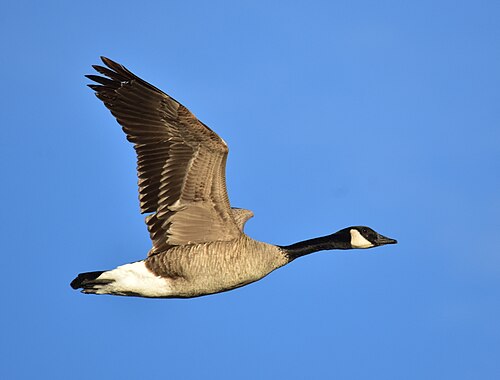
Canada Goose
Branta canadensis
A big brown goose with a black head and neck and a white chinstrap, now common on lakes, golf courses and fields across the US.
- Very large
- Wetlands
- Cities
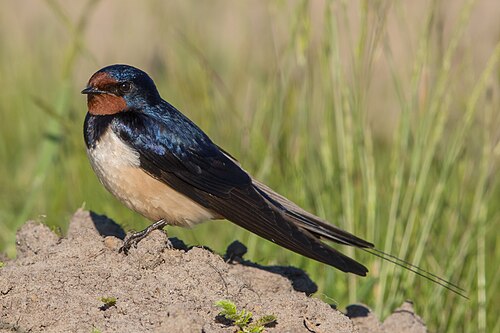
Barn Swallow
Hirundo rustica
A graceful, blue-backed swallow with a rusty throat and a deeply forked tail, often seen skimming over fields and nesting under bridges.
- Small
- Grasslands
- Wetlands
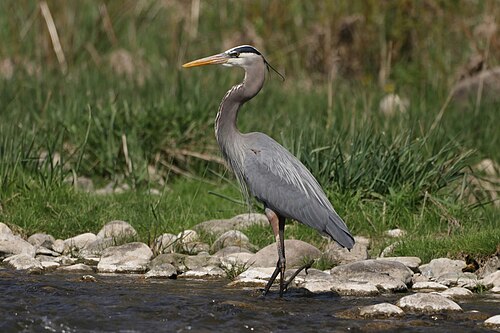
Great Blue Heron
Ardea herodias
North America’s largest heron, a tall gray-blue wader that stands motionless in shallows and strikes with a spear-like bill.
- Very large
- Wetlands
- Coastlines
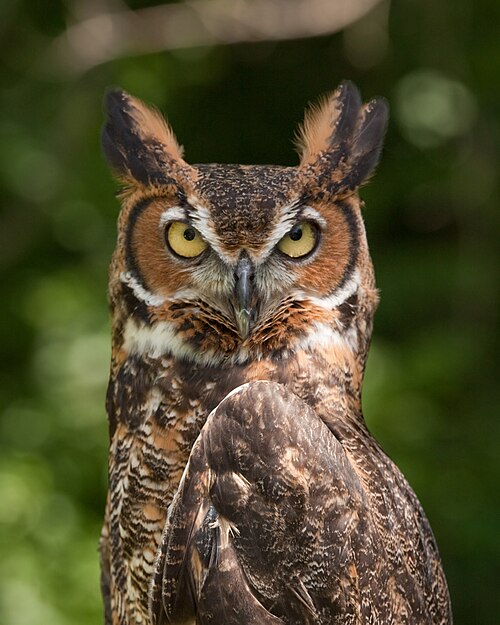
Great Horned Owl
Bubo virginianus
A big, heavy-bodied owl with feather tufts like horns and a deep, steady hoot. It lives in almost every kind of wooded or semi-open country.
- Large
- Forests
- Deserts
Related guides
Sources
Sources are the pages consulted when this entry was written. How we choose and use sources: sources and identification criteria.
Further reading (not used as a source for this entry): All About Birds, Cornell Lab of Ornithology.