
Finches · Fringillidae
House Finch
Haemorhous mexicanus
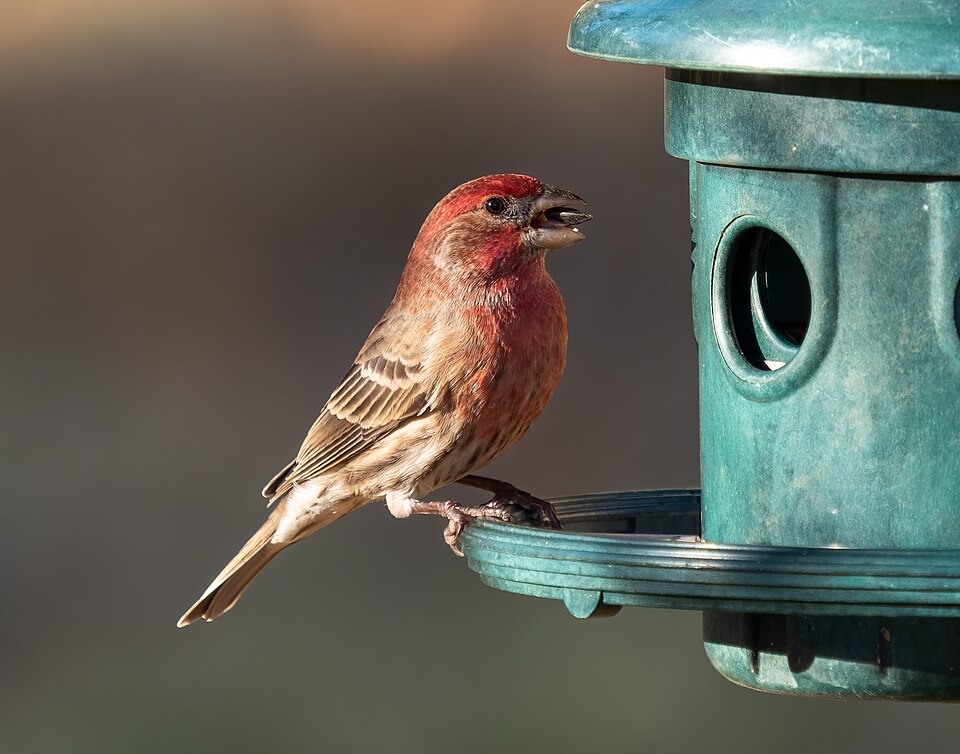
A streaky brown finch. Males have a red head and chest. Native to the Southwest and now widespread in cities across the US.
Presence varies. Bird presence and timing change with location, weather, habitat and migration. Treat this page as a starting point, then check recent local sightings (for example on eBird) before you go.
Identification features
- Males have a red to orange-red forehead, face and breast, with a brown cap and back.
- The belly and flanks are streaked brown and white on both sexes.
- Females are plain gray-brown with blurry streaks and no red.
- The bill is stout and conical, and the tail is slightly notched.
- Birds usually travel in noisy flocks and perch on wires, treetops and feeders.
Size and appearance
The House Finch is a slim, sparrow-sized bird with a rounded head and a short, thick bill. Adult males show red on the head, chest and rump, set against streaky brown wings and flanks. The red can run from pale orange-yellow to deep crimson, depending on the food eaten while the feathers grow. Females are a duller gray-brown with fuzzy streaking on the underparts and a plain face. Young birds look like females. The streaked belly and sides separate males from the similar Purple Finch, whose red extends farther over the back and sides.
Bill: Thick, short and curved on the upper edge, built for crushing seeds.
Habitat
House Finches live where people do: cities, suburbs, farms, parks and canyon edges, particularly where there are lawns, weedy patches, trees and buildings. The original habitat is dry country, with streamside trees and brush, woodland edges and chaparral. They avoid dense, unbroken forest and wide-open grassland. They nest on ledges, in hanging planters, in vines, in evergreens and in cavities, so a house or porch can be enough. In the desert Southwest they are found around water and towns.
Geographic range
The House Finch is native to the Southwest and western United States and Mexico. Birds in the West are mostly permanent residents, though some move to lower elevations in winter. In 1940, caged birds were released in New York, where they were being sold illegally as Hollywood Finches. The population grew and spread across the eastern United States and southern Canada, and today House Finches live in most of the country. Many eastern birds stay put year-round, while others migrate south in fall.
Seasonal presence
In most areas House Finches are year-round birds, but the experience changes with the season. Winter flocks of dozens gather at feeders and in weedy fields. In spring males sing from high perches and pairs form, and nesting continues through summer with up to three broods. Fall brings flocks moving through, since some eastern birds migrate south in groups, usually during the day. In the West, some birds drop to lower elevations in cold weather. Where you are, how cold the winter is and what food is available all influence what you see.
| Region | Spring | Summer | Fall | Winter |
|---|---|---|---|---|
| Northeast | Present | Present | Present | Present |
| Southeast | Present | Present | Present | Present |
| Midwest | Present | Present | Present | Present |
| Southwest | Present | Present | Present | Present |
| Pacific West | Present | Present | Present | Present |
A dot means the species is regularly present in that region in that season. Dates shift with latitude, elevation, weather and migration, and some regions are only partly covered by the species’ range.
Diet
House Finches eat mostly plant matter. Weed seeds are the main food, supplemented in spring by buds and flower parts and in late summer and fall by berries and small fruits. A few insects, such as aphids, are eaten too. At feeders, they favor black oil sunflower seed and nyjer, and they may use sugar-water feeders meant for hummingbirds. If you offer nectar, use only a plain sugar and water mix, with no red dye or honey, and change it often. Clean all feeders regularly, because finches can spread disease at crowded stations.
Behavior
Except during nesting, House Finches feed in flocks on the ground, in weeds and in shrubs and trees. At the feeder, they are persistent and sometimes push around other small birds. Males sing from rooftops and treetops for long stretches, and in display they flutter upward and glide down. Pairs can raise up to three broods per year. Their nests are open cups, often tucked against buildings, and a nest should be left undisturbed. In parts of the East, a bacterial eye infection called conjunctivitis has harmed local populations, and a sick bird with swollen, crusty eyes at a feeder is a sign to clean the feeder and give birds time to disperse.
Vocalizations
The song is a long, bright, warbling series of notes, canary-like but without clear trills, often ending in a buzzy zeee or a downslurred note. Males sing for extended periods from high perches. Flock members trade chirps that resemble those of a young House Sparrow, along with softer, cheeping contact notes. Singing is heard in most months but is most constant in spring. A rooftop singer with a streaky chest is often a House Finch.
Recordings are not hosted on this site. For audio, see the sources below. Please avoid playing recordings to attract birds in the field. See Learning Bird Songs and Calls.
Similar species
- Purple Finch. Purple Finch males are raspberry-red over the head, back and breast with little streaking underneath. Females show a bold white eyebrow and dark cheek.
- Cassin’s Finch. A western mountain species with a peaked crown, a longer bill and finer streaking, often in conifer forests.
- Northern Cardinal. Cardinals are much larger with a crest, a long tail and a black mask. Compare side by side
Observation tips
- Check roof edges, utility wires and treetops for singing males, especially in spring.
- Offer black oil sunflower or nyjer seed and clean feeders every week or two.
- For ID, compare the streaky belly, not just the red color, to avoid confusing males with Purple Finches.
- If you see birds with swollen or crusty eyes, clean your feeders and pause feeding for a while.
- Give nests on porches and sills space. Watch from a window instead of looking in.
Always keep your distance, stay on trails and leave nests alone. See How to Observe Birds Responsibly.
Conservation status
IUCN Red List: Least Concern. The IUCN lists the House Finch as Least Concern. Audubon estimates a population of about 40 million and notes that it is now abundant across much of North America, although eye disease has hit some local populations hard. Status and trends change, so check the [IUCN Red List](https://www.iucnredlist.org) for current information.
Status last checked 2026-11-03. Status and trends change, so check the linked sources for the latest. Search the IUCN Red List.
Questions and answers
Is the House Finch native to the eastern US?
No. It is native to the Southwest and the West. Eastern birds descend from a small release on Long Island, New York, in 1940, and the species spread across the East from there.
Why are some male House Finches orange or yellow?
The red comes from pigments in the food eaten when the feathers grow, so males can range from yellow to orange to deep red. It is normal variation, not a different species.
Related entries
Related birds
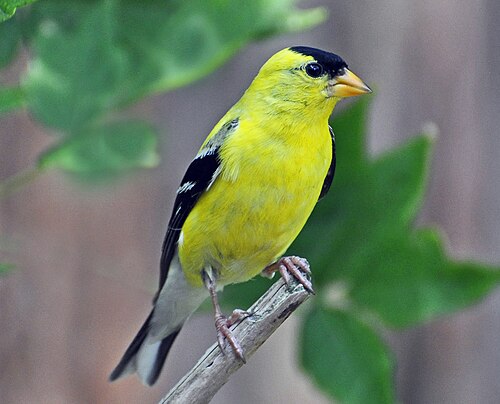
American Goldfinch
Spinus tristis
A small seed-eating finch. Breeding males are bright yellow with a black cap; winter birds turn a muted tan-olive.
- Tiny
- Grasslands
- Backyards
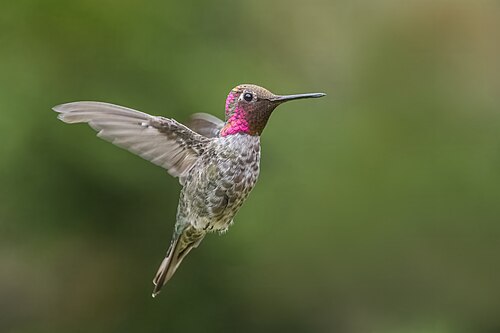
Anna’s Hummingbird
Calypte anna
A stocky Pacific Coast hummingbird with a rose-red head, now a year-round presence in many western yards and feeders.
- Tiny
- Backyards
- Cities
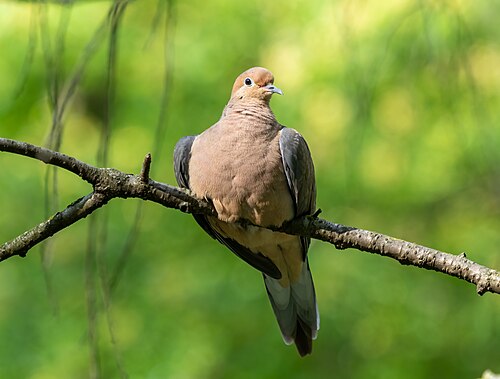
Mourning Dove
Zenaida macroura
A slim, soft gray-tan dove with a long pointed tail and a low, owl-like coo, common on wires, lawns and under feeders.
- Medium
- Backyards
- Grasslands
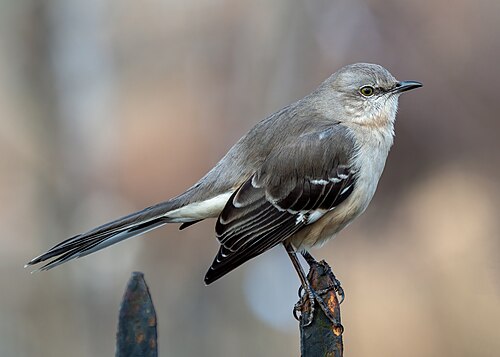
Northern Mockingbird
Mimus polyglottos
A slim gray songbird that sings from rooftops and wires, repeats borrowed phrases, and flashes white wing patches when it hops across a lawn.
- Medium
- Backyards
- Cities
Related guides
Sources
- Audubon Field Guide — House Finch
- Wikipedia: House finch (secondary cross-check of the IUCN category)
Sources are the pages consulted when this entry was written. How we choose and use sources: sources and identification criteria.
Further reading (not used as a source for this entry): All About Birds, Cornell Lab of Ornithology.