
Hummingbirds · Trochilidae
Ruby-throated Hummingbird
Archilochus colubris
The only hummingbird that breeds across eastern North America, a tiny summer visitor that migrates to Mexico and Central America.
Presence varies. Bird presence and timing change with location, weather, habitat and migration. Treat this page as a starting point, then check recent local sightings (for example on eBird) before you go.
Identification features
- Tiny size, with a long thin bill and a green back and wings that glint in the light.
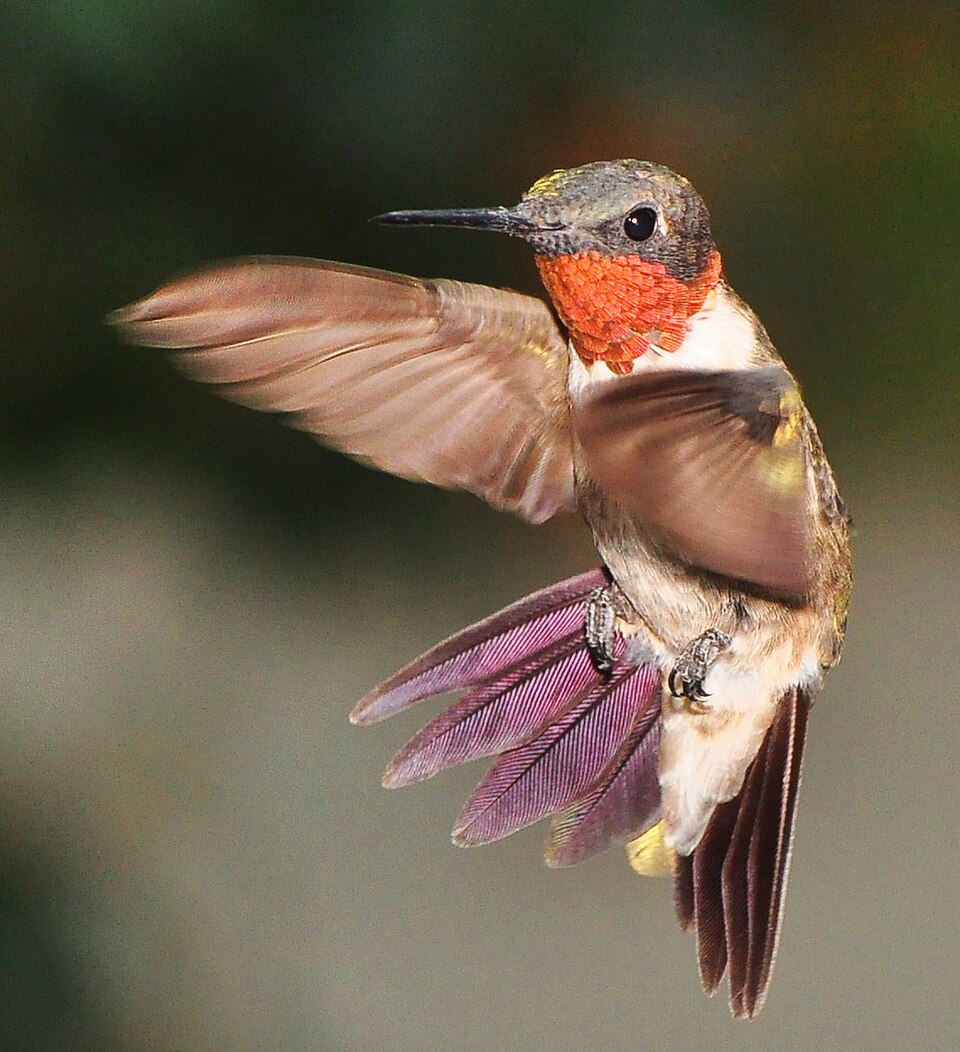
- Adult males show a ruby-red throat that can look black in poor light, with a forked black tail.
- Females and young birds have a dull whitish throat and white tips on the outer tail feathers.
- Whitish underparts and a rounded tail (in females) help separate them from western hummingbirds.
- In most of the East, any hummingbird is likely this species, so range is a key clue.
Size and appearance
At about the length of your thumb and weighing only a few grams, the Ruby-throated Hummingbird is tiny. The back and crown are a metallic green, and the underparts are pale gray-white. Adult males have a fiery throat patch, called a gorget, that can flash red or look black depending on the angle of the light, and they have a forked tail. Females lack the red throat and have a rounded tail with white corners. Juveniles look like females; young males may show a few dark streaks on the throat. Females are slightly larger than males.
Bill: A long, thin, straight needle bill used to reach nectar deep in flowers.
Habitat
During the breeding season, Ruby-throated Hummingbirds use open woods, forest edges, clearings, gardens and city parks. They visit flowers and feeders in suburban yards. The nest is a tiny cup of plant fibers and spider silk, built by the female on a small branch and camouflaged with lichen. In winter they live in open or dry scrub in Mexico and Central America. During migration they can show up in almost any open place with flowers, from coastal thickets to roadsides and backyard gardens.
Geographic range
This is the only hummingbird that regularly breeds in eastern North America, nesting across the eastern United States and into southern Canada. Its breeding range reaches roughly to the 100th meridian, so it becomes scarce farther west on the Great Plains. In fall it travels through the Gulf Coast states toward southern Mexico and Central America, a journey that includes crossing or skirting the Gulf of Mexico. A small number may spend winter in Florida and along parts of the Gulf Coast, but this is not typical. It is not a regular bird of the Pacific states.
Seasonal presence
In most of the eastern United States this is a spring-to-fall bird. Males usually arrive on the Gulf Coast first, and the northward movement continues over spring, with males arriving before females. Nesting takes place in summer, and in late summer and early fall birds start moving south again. Exact dates depend on latitude, weather and food, and feeder birds may stay later than the calendar suggests. Because arrival dates vary by year and location, avoid planning around a specific date; watch for local reports. Winter sightings in the contiguous US are unusual.
| Region | Spring | Summer | Fall | Winter |
|---|---|---|---|---|
| Northeast | Present | Present | Present | Not typical |
| Southeast | Present | Present | Present | Not typical |
| Midwest | Present | Present | Present | Not typical |
| Southwest | Present | Present | Present | Not typical |
A dot means the species is regularly present in that region in that season. Dates shift with latitude, elevation, weather and migration, and some regions are only partly covered by the species’ range.
Diet
Nectar supplies most of the energy. Ruby-throated Hummingbirds visit tubular flowers such as trumpet vine, cardinal flower and bee balm, and they also catch tiny insects and pick spiders from webs for protein. At feeders they drink plain sugar water made from one part white table sugar to four parts water. Do not add red dye or honey, and do not use artificial sweeteners. Clean feeders every few days, more often in hot weather, and replace the sugar water before it turns cloudy.
Behavior
A hummingbird’s wings beat more than 50 times a second, which lets it hover, fly backward and dart between flowers. Males defend feeding spots and chase rivals, and in courtship a male flies in a wide U-shaped arc in front of a female while making a whirring sound. The female builds the nest, incubates the two small eggs alone and feeds the young by herself. Birds are feisty at feeders and often perch between visits. Never touch or approach a nest; watching from a distance is safest for the tiny chicks.
Vocalizations
The Ruby-throated Hummingbird is not much of a singer. It mainly gives quick, mouse-like squeaks and chips, often when chasing a rival or defending a feeder. You may also hear short trills and buzzes during interactions. In flight, the wings make a soft humming sound, and the male’s courtship dive produces a whirring noise. Listen for squeaky chattering at flowers and feeders, especially in the morning. Avoid using recordings to attract birds, since it can stress territorial males.
Recordings are not hosted on this site. For audio, see the sources below. Please avoid playing recordings to attract birds in the field. See Learning Bird Songs and Calls.
Similar species
- Black-chinned Hummingbird. Lives mainly in the West; males have a black throat with a violet band and rarely overlap with this species except in Texas.
- Rufous Hummingbird. Has orange-rusty color on the back and sides; males have an orange-red throat. It is a western bird that passes through the Southeast in fall and winter.
- Anna’s Hummingbird. A West Coast bird with a pink-red throat and crown in males and a gray-green belly, found in a different part of the country. Compare side by side
Observation tips
- Plant tubular flowers like trumpet vine, bee balm and cardinal flower to bring birds in.
- Use only a plain 1:4 sugar-and-water solution, with no dye or honey, and clean the feeder often.
- Hang a feeder in a spot with shade nearby and put it up before the expected spring arrival.
- Watch quietly from a chair rather than approaching a bird that is feeding or perched.
- Keep a feeder up a week or two after you see your last bird, since late migrants may pass through.
Always keep your distance, stay on trails and leave nests alone. See How to Observe Birds Responsibly.
Conservation status
IUCN Red List: Least Concern. Audubon lists the Ruby-throated Hummingbird as Least Concern on the IUCN list and notes that populations have increased since 1966. It is regarded as common and widespread. Status and trends change, and long-distance migrants face risks along their route, so check the linked sources for current information.
Status last checked 2026-11-03. Status and trends change, so check the linked sources for the latest. Search the IUCN Red List.
Questions and answers
When should I put out my hummingbird feeder?
Put it up a week or two before birds usually arrive in your area. Arrival depends on your latitude, and males usually come before females. Check local birding reports for the first sightings, and keep the feeder up until a couple of weeks after you see your last bird.
Can I use red dye in the nectar?
No. Use only white table sugar and water at about one part sugar to four parts water. Red dye is not needed because the red parts of the feeder attract the birds. Avoid honey and artificial sweeteners, and clean the feeder often.
Related entries
Related birds
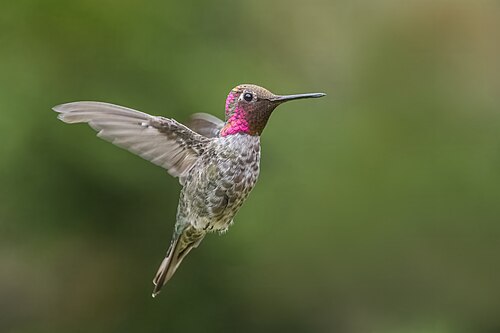
Anna’s Hummingbird
Calypte anna
A stocky Pacific Coast hummingbird with a rose-red head, now a year-round presence in many western yards and feeders.
- Tiny
- Backyards
- Cities
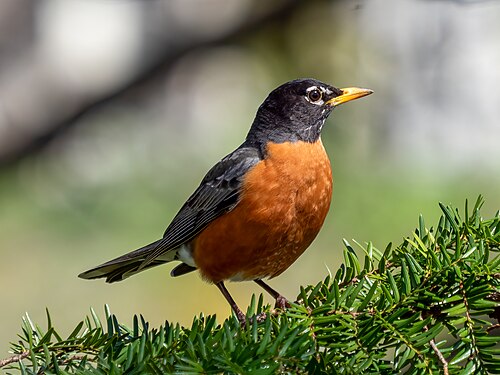
American Robin
Turdus migratorius
A gray-brown thrush with a rusty-orange breast, often seen sprinting and pausing across lawns while hunting worms.
- Medium
- Backyards
- Cities
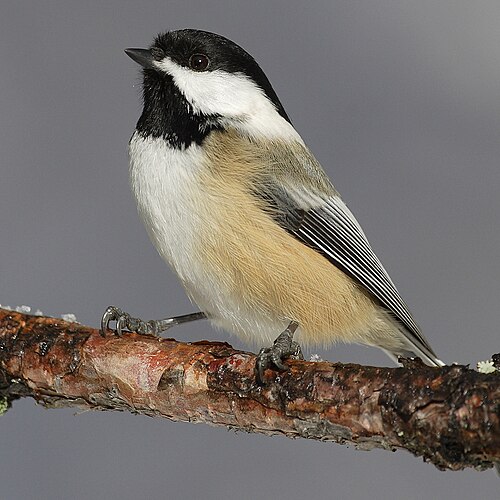
Black-capped Chickadee
Poecile atricapillus
A tiny, curious songbird with a black cap and bib, white cheeks and a clear fee-bee song. A resident across the northern states.
- Small
- Forests
- Backyards
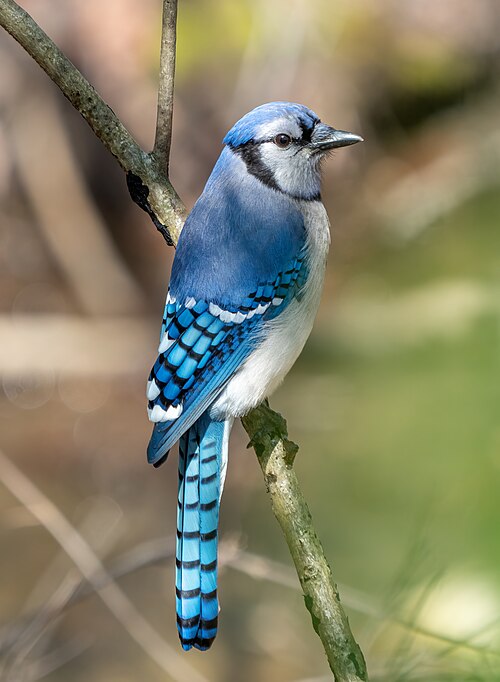
Blue Jay
Cyanocitta cristata
A loud, crested jay in blue, white and black. Common in eastern woods and yards, with some birds migrating in fall.
- Medium
- Forests
- Backyards
Related guides
Sources
- Audubon Field Guide — Ruby-throated Hummingbird
- Wikipedia — Ruby-throated hummingbird (secondary cross-check)
Sources are the pages consulted when this entry was written. How we choose and use sources: sources and identification criteria.
Further reading (not used as a source for this entry): All About Birds, Cornell Lab of Ornithology.