
Bird Behavior · 8 min read
Reading Bird Behavior
Plumage gets the attention, but what a bird is doing often tells you more than what it looks like. Learning to read feeding style, flight, posture, and voice turns a quick glimpse into a clear story and keeps you at a respectful distance while you watch.
Why behavior is worth watching
A bird sitting still in poor light may show you almost nothing. A bird moving through a tree shows you a great deal: how it holds its body, where it searches, how it lands, what it does when another bird gets close. Experienced birders often name a bird from these habits before they have seen a single color.
Behavior also tells you how the bird is doing. A relaxed bird feeds, preens, and moves on its own schedule. A bird that freezes, calls sharply, or keeps looking at you is telling you something different. Reading those signals is the foundation of watching birds without bothering them, which is covered more fully in how to observe birds responsibly.
Nothing here is a rule without exceptions. Individual birds differ, and the same species can act differently in a quiet forest and a busy city park. Treat each pattern below as a clue, not a guarantee.
Foraging styles: how a bird finds its meal
Feeding method is one of the most reliable identification clues because it is tied to bill shape and body design. Once you notice the method, you start to see it everywhere.
Watch the American Robin on a lawn: it runs, stops with its head cocked, and then lunges for something in the grass. Compare that with the White-breasted Nuthatch, which often works down a trunk headfirst, while the Downy Woodpecker climbs upward in short hitches and taps at bark. Same tree, completely different approach.
- Ground foragers, such as sparrows, doves, and robins, walk or hop and scratch or peck at the surface.
- Trunk and bark foragers, such as woodpeckers and nuthatches, cling to vertical surfaces and probe crevices.
- Aerial feeders, such as swallows, catch insects in flight and are almost always moving.
- Perch hunters, such as the Belted Kingfisher and many hawks, watch from a stable spot and then drop on prey.
- Waders, such as herons, move slowly through shallow water or stand motionless.
- Hoverers, such as hummingbirds, hang in the air in front of flowers or feeders.
Flight patterns and posture
Flight style can identify a bird at a distance when nothing else is visible. Woodpeckers typically fly in a rising and dipping, wave-like line. Many small finches do something similar, with a bouncing path and short pauses between wingbeat bursts. Ducks and geese tend to fly in a straight line on steady wingbeats, often in groups. Large hawks may circle on rising warm air with barely a wingbeat, and a heron flies with its neck folded back and slow, deep wing strokes.
Posture adds more. A bird standing tall and sleek is often alert. A bird fluffed into a round ball on a cold morning is probably conserving heat, not sick. Tail position matters too: some birds hold the tail up, some flick it, and some bob it steadily. A tail that moves in a regular pattern is a useful field mark once you recognize it.
Try describing a bird to yourself in this order: where it is, how it moves, then what it looks like. That habit makes every later identification step easier, and it fits well with the approach in bird identification basics.
Territory, courtship, and display
During the breeding season, many male songbirds defend a patch of habitat. The defense is usually loud and visual rather than violent: singing from an exposed perch, chasing intruders, puffing up, or showing patches of color. The Red-winged Blackbird is a classic example. A male perched on a cattail and flashing his shoulder patches is announcing ownership of a marsh edge.
Courtship takes many forms. Some birds perform aerial displays, some offer food to a mate, and some pairs sing together or perform matching movements. Waterfowl pairs may bob and call in synchrony. These displays are easiest to appreciate from far away, with binoculars, where your presence does not change the outcome.
If two birds of the same kind keep chasing each other, that is usually a territorial dispute and not a sign that anything is wrong. Let it play out.
Alarm calls and mobbing
Birds pay close attention to each other. A sharp, repeated call from a robin or jay can send nearby birds diving for cover, and small woodland birds often share information across species. Research on chickadees has found that the number of notes in their alarm call varies with how dangerous the predator seems, and other birds respond to it.
Mobbing is the loud, crowded harassment that small birds direct at a larger one, most often an owl or hawk. The little birds swoop, scold, and gather in a noisy cluster. It usually drives the predator away rather than injuring it. Owls roosting in the daytime are often hard to spot, so a cluster of agitated chickadees, jays, or nuthatches calling at one spot is a good lead.
If you find an owl this way, keep your distance, stay quiet, and do not try for a closer look. A daytime owl is trying to rest, and the mobbing birds are already making its day harder.
Flocks, seasons, and nesting
Flocking changes through the year. Many birds that defend territories in summer gather in groups after breeding. Blackbirds, waxwings, and finches can form large flocks in fall and winter, and chickadees often travel in mixed groups with nuthatches and woodpeckers through the cold months. Groups help with finding food and spotting predators. When you find one member of a mixed flock, scan carefully, because there are usually more species nearby.
Nesting seasons vary a lot by region and species. In general terms, many US songbirds nest from spring into summer, some start earlier, and a few raise young in the cooler months. Owls and some others may begin nesting in winter. Because timing is so variable, the safest assumption in any season is that a bird making repeated trips with food, carrying nest material, or scolding you from a nearby branch may have a nest close by.
Never touch or move a nest, and do not part branches to look for one. If you find a nest by accident, leave quietly and do not return repeatedly. Frequent visits can draw predators to the site.
What stress looks like and how to back away
A bird that is stressed by your presence will usually show it before it leaves. Watch for these signs, and treat any one of them as a cue to move away.
Ground-nesting birds can show dramatic versions. A Killdeer, for instance, may drag a wing and call as if injured to lead you away from its nest. That is a deliberate display, and the right answer is to walk away from the area.
- Repeated sharp alarm calls aimed at you.
- Freezing with feathers pressed tight, staring in your direction.
- Fluttering a wing or tail as if hurt, or running off in a low crouch.
- Flying back and forth near one spot, carrying food but not delivering it.
- Leaving a feeding or nesting area entirely.
How to back away well
Move slowly, face away from the bird as you go, and avoid sudden gestures. Do not circle around for a better angle. Once you are well beyond where the bird calmed down, stop and use binoculars instead of your feet. The goal is for the bird to go back to what it was doing as if you had never been there.
Photographers deserve a special note: a long lens is a tool for distance, and a bird that changes its behavior because of you has already told you that you are too close.
Using behavior to identify birds
Behavior gets even more useful when you combine it with the other clues. Suppose you see a small brown bird on the ground in a shrubby field edge. If it scratches with both feet at once and then pecks, that points toward sparrows and towhees. If it tail-bobs by a stream, a different group becomes more likely. Pair the behavior with habitat, season, and voice, and the list of possibilities shrinks fast. The Bird Finder lets you filter by the feeding behaviors described above, which can help you narrow down a mystery bird.
Keep a short note for each outing: what the bird did, where, and when. Even three words, like ground, flocking, tail-bobbing, build a useful memory. Over a season you will notice patterns that no field guide page can fully capture, such as which trees a woodpecker visits in the morning or when a flock arrives at a feeder.
Frequently asked questions
How can I tell if a bird is stressed by me?
Look for repeated sharp calls aimed at you, freezing, fluttering a wing as if injured, or flying back and forth without landing. Any of these means you are too close. Move away slowly, then use binoculars from a greater distance.
Why do small birds chase hawks and owls?
This is called mobbing. Small birds gather, call loudly, and swoop at a predator to push it away from their area. It rarely injures the predator. Listening for a cluster of scolding birds is a good way to locate a daytime owl, which you should then observe quietly from far away.
Is it okay to use recordings to attract a bird so I can see it?
Birding ethics guidance advises against it, especially during nesting season and around rare or heavily visited birds. A recorded call can look like a rival to a territorial bird and pull it away from feeding or its nest. Patience and quiet work better and cause no harm.
Birds mentioned in this guide
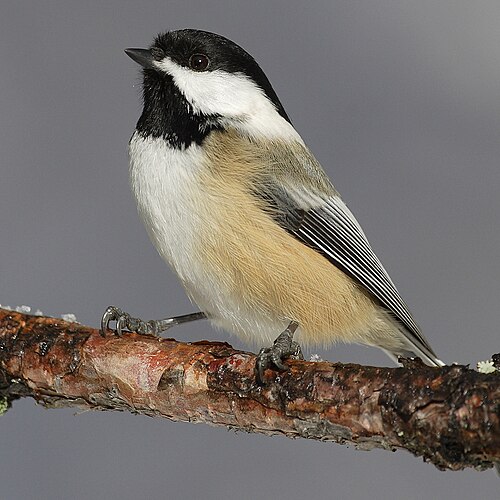
Black-capped Chickadee
Poecile atricapillus
A tiny, curious songbird with a black cap and bib, white cheeks and a clear fee-bee song. A resident across the northern states.
- Small
- Forests
- Backyards
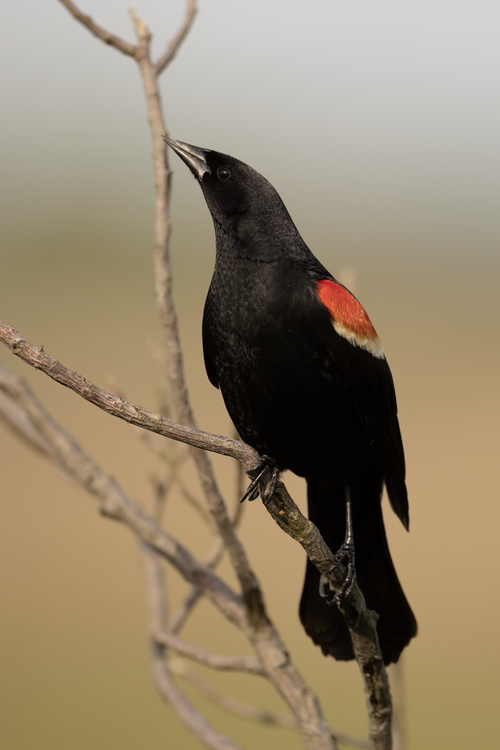
Red-winged Blackbird
Agelaius phoeniceus
A marsh-edge blackbird: males are glossy black with red-and-yellow shoulder patches, females are heavily streaked brown.
- Small
- Wetlands
- Grasslands
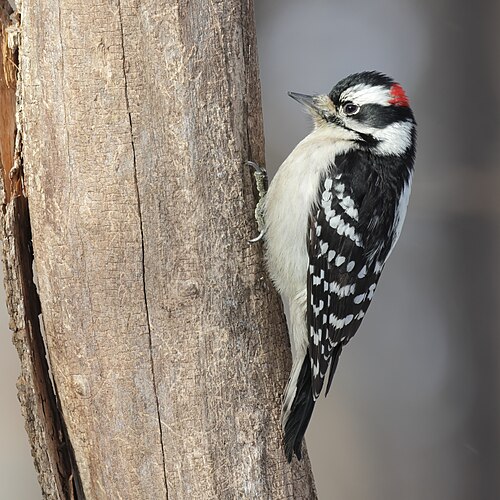
Downy Woodpecker
Dryobates pubescens
The smallest woodpecker in North America, a black-and-white bird with a short bill that visits suet feeders and tiny branches.
- Small
- Forests
- Backyards
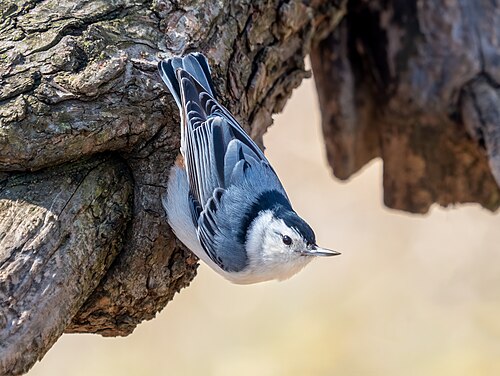
White-breasted Nuthatch
Sitta carolinensis
A compact, blue-gray bird that creeps headfirst down tree trunks and gives a nasal yank-yank. A regular at feeders with sunflower seeds and suet.
- Small
- Forests
- Backyards
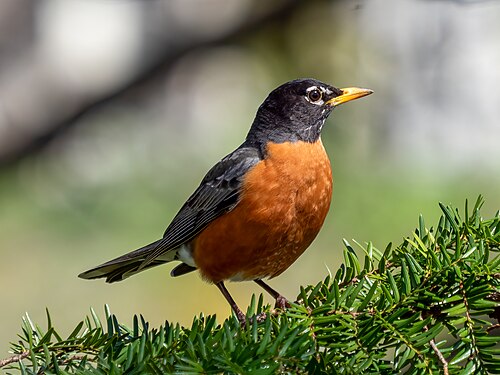
American Robin
Turdus migratorius
A gray-brown thrush with a rusty-orange breast, often seen sprinting and pausing across lawns while hunting worms.
- Medium
- Backyards
- Cities
Keep reading
Sources
- NYC Bird Alliance — Birding Law & Ethics
- Birds Outside My Window — Don’t Play It Again, Sam
- Audubon — Buckle Up, Birders: This Winter Is Looking Finchy
Sources are the pages consulted when this entry was written. How we choose and use sources: sources and identification criteria.