
Pelicans · Pelecanidae
Brown Pelican
Pelecanus occidentalis
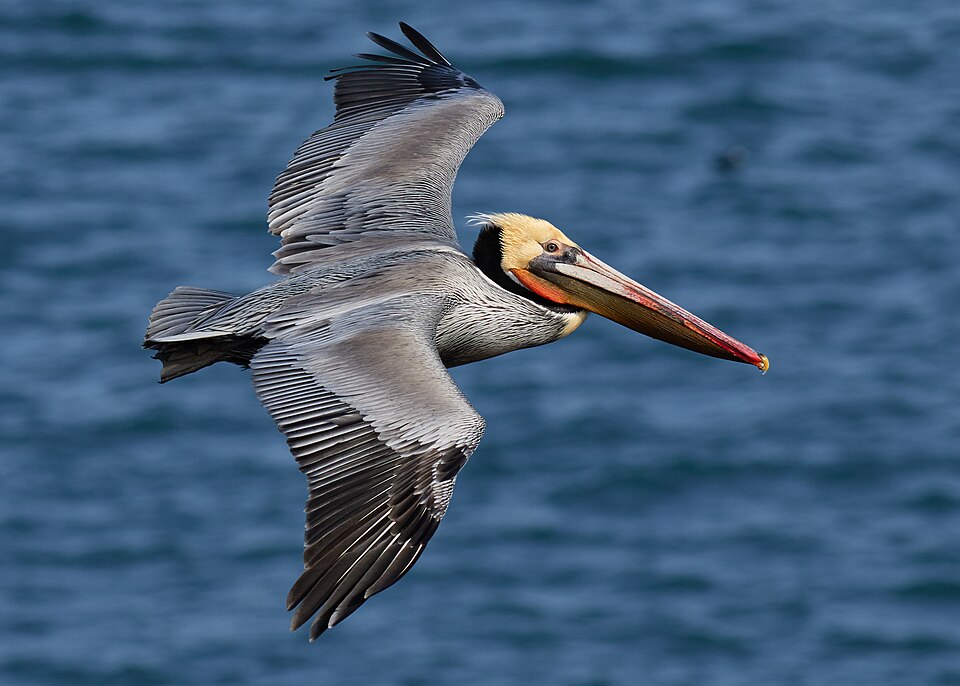
A big, dark coastal seabird that plunges headfirst for fish and glides low over the waves. Its recovery from pesticide losses is a conservation success.
Presence varies. Bird presence and timing change with location, weather, habitat and migration. Treat this page as a starting point, then check recent local sightings (for example on eBird) before you go.
Identification features
- No other US coastal bird has the combination of a huge bill, long neck and a throat pouch.
- Adults are silver-gray above with a dark brown-black belly.
- In nonbreeding plumage the head is white with a yellowish wash on the crown, while breeding adults have a dark reddish-brown hind neck.
- Immature birds are duller, grayish-brown above with a pale belly.
- Flocks fly low over the water in single file, flapping and gliding in unison.
- It is much darker than an American White Pelican.
Size and appearance
A Brown Pelican is a heavy-bodied seabird with long, broad wings and a short tail. The bill is enormous and carries an expandable pouch below it that is used for catching and draining fish. Adults look silvery gray on the back and dark underneath. Seasonal color changes show most on the head and neck: the nonbreeding head is white with a pale yellow crown, while breeding adults develop a rich reddish-brown on the back and sides of the neck. Immature birds are grayish-brown above with a pale whitish belly and take several years to reach full adult plumage. Both sexes look alike, though males are heavier.
Bill: A huge, long bill with a stretchy throat pouch hanging from the lower half.
Habitat
Brown Pelicans are birds of salt water. They are most common in shallow coastal waters, especially sheltered bays, estuaries and along beaches, though they sometimes travel well out to sea. They roost on pilings, jetties, sandbars and rocks and nest on islands, either bare and rocky ones or ones with mangroves or other woody cover, which keep ground predators away. Storm-blown or wandering young birds occasionally turn up on inland freshwater lakes. Piers, harbors and fishing docks draw them because discarded fish scraps and bait are easy to find.
Geographic range
In the US, the Brown Pelican lives mostly along coastlines. It occurs on the Atlantic and Gulf coasts, from Texas and Louisiana around Florida and up the Atlantic coast toward the Mid-Atlantic, and on the Pacific coast, particularly California and further north into the Northwest. Its overall range extends through the Caribbean and parts of Latin America. After breeding, birds disperse northward along both the Atlantic and Pacific coasts, then return to warmer water by winter. A few young birds drift inland in summer, especially in the Southwest. How far north any given year’s birds travel varies.
Seasonal presence
Along the Gulf and southern Atlantic coasts and in southern and central California, Brown Pelicans can usually be found in every season, with local numbers changing through the year. After nesting, flocks and young birds move north along the coasts, which is why summer and fall bring them to places where they are rare in winter, including parts of the Mid-Atlantic and the Pacific Northwest. As the weather cools, they shift back south to warmer waters. Inland sightings in summer are uncommon and usually involve young birds. Timing and distance depend on the year, food supply and coastal weather, so no site is guaranteed.
| Region | Spring | Summer | Fall | Winter |
|---|---|---|---|---|
| Northeast | Not typical | Present | Present | Not typical |
| Southeast | Present | Present | Present | Present |
| Southwest | Present | Present | Present | Present |
| Pacific West | Present | Present | Present | Present |
A dot means the species is regularly present in that region in that season. Dates shift with latitude, elevation, weather and migration, and some regions are only partly covered by the species’ range.
Diet
Brown Pelicans eat fish almost entirely, mostly small schooling species such as menhaden, smelt and anchovies, and a few crustaceans. They locate fish from the air, fold back their wings and plunge headfirst into the water, sometimes from as high as 60 feet. Once the bird surfaces, it tilts the bill to let water drain from the pouch and then lifts the head to swallow the catch. Gulls often hover nearby hoping to snatch a fish. Pelicans occasionally scavenge and may beg around fishing piers, but fish scraps and tossed food can lead to tangled line, hooks and bad habits, so offering food is discouraged.
Behavior
Brown Pelicans are social and spend much of the day flying low over the waves, gliding on a cushion of air just above the surface with a few slow wingbeats between glides. They fish alone or in loose groups and rest in tight clusters on rocks and pilings. Nesting happens in colonies. Both parents incubate the typical clutch of three eggs for about four weeks. Young leave ground nests after roughly five weeks, gather in groups, and take their first flight after about nine to twelve weeks, with parents continuing to feed them afterward. The species usually raises a single brood a year. Colonies are easily disturbed, and flushed adults can leave eggs and chicks exposed to heat and predators. Use a scope or binoculars from a long distance.
Vocalizations
Brown Pelicans are quiet birds for most of the year. Adults make low grunts and croaks around nesting colonies, but away from the colony they are usually silent. Nestlings are noisier, giving hoarse begging calls. On a beach or pier you are more likely to hear the slap of wings, splash of a dive and the sound of gulls and terns than any call from the pelican itself. In practice, identification should rely on shape, size and flight style rather than sound.
Recordings are not hosted on this site. For audio, see the sources below. Please avoid playing recordings to attract birds in the field. See Learning Bird Songs and Calls.
Similar species
- American White Pelican. White Pelicans are larger and almost entirely white with black wing tips, and they feed by dipping rather than by plunge-diving.
- Double-crested Cormorant. Cormorants are much smaller, slimmer and dark, with a slender hooked bill and no huge pouch, and they swim low in the water.
- Northern Gannet. Gannets are white with black wing tips and a pointed bill, and they dive in a streamlined plunge but lack the pouch and heavy build.
Observation tips
- Look for the single-file flight along beaches and piers. Dawn and late afternoon often bring active fishing.
- Keep well back from nesting islands and roosts. Disturbance can make adults leave eggs and chicks exposed, so use binoculars or a scope.
- Do not feed pelicans or leave bait and fish scraps out. Discarded line and hooks can injure them, and being fed can teach birds to approach people.
- If you see a pelican tangled in fishing line, report it to local wildlife authorities or a licensed rehabilitator rather than trying to catch it yourself.
- Watch for dives from 20 to 60 feet up. They are best seen from a pier with the sun behind you.
Always keep your distance, stay on trails and leave nests alone. See How to Observe Birds Responsibly.
Conservation status
IUCN Red List: Least Concern. The IUCN lists the Brown Pelican as Least Concern. In the US, pesticides such as DDT caused steep declines in the mid-20th century, and the species was listed as endangered in 1970. The US Fish and Wildlife Service removed the populations in Alabama, Georgia, Florida and the Atlantic Coast states northward in 1985 and announced removal of the remaining population on November 11, 2009. The USFWS says other federal laws, including the Migratory Bird Treaty Act, still protect the birds, nests and eggs. Status can change, so check the USFWS and IUCN pages.
Status last checked 2026-11-03. Status and trends change, so check the linked sources for the latest. Search the IUCN Red List.
Questions and answers
Is the Brown Pelican still endangered?
Not under the federal Endangered Species Act. After a recovery that followed the 1972 DDT ban, the US Fish and Wildlife Service announced the removal of the last populations from the list in November 2009. Other federal laws, including the Migratory Bird Treaty Act, still protect them.
How do pelicans catch fish?
Brown Pelicans spot fish from the air, fold their wings and plunge headfirst into the water. The throat pouch expands to scoop up fish and water. The bird then tilts its bill to drain the water and swallows the catch.
Related entries
Related birds
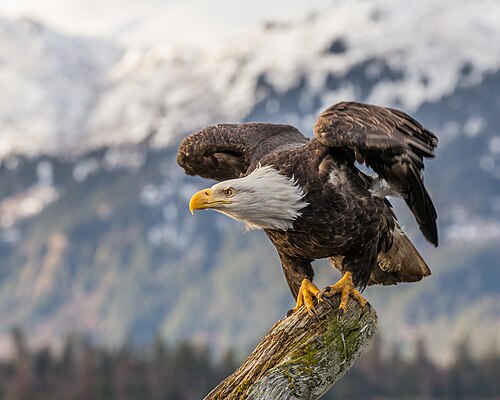
Bald Eagle
Haliaeetus leucocephalus
America’s national bird, a huge dark-brown raptor with a white head and tail that fishes along coasts, rivers and large lakes.
- Very large
- Wetlands
- Coastlines
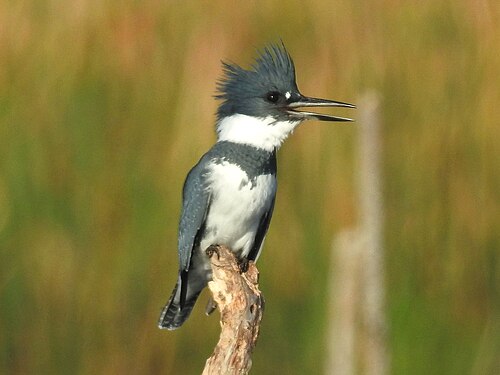
Belted Kingfisher
Megaceryle alcyon
A shaggy-crested, blue-gray waterside bird that rattles along rivers and plunges headfirst for fish.
- Medium
- Wetlands
- Coastlines
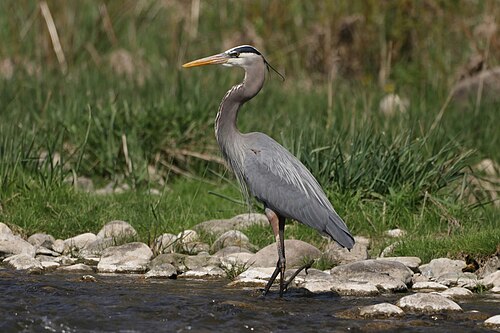
Great Blue Heron
Ardea herodias
North America’s largest heron, a tall gray-blue wader that stands motionless in shallows and strikes with a spear-like bill.
- Very large
- Wetlands
- Coastlines
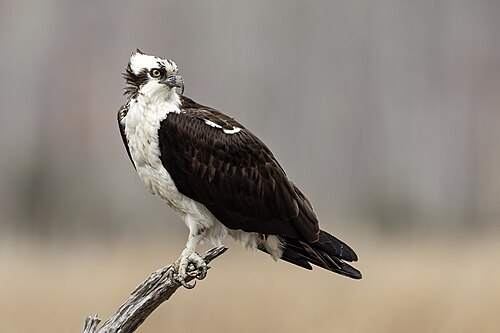
Osprey
Pandion haliaetus
A large fish-eating raptor that hovers over water and plunges feet-first for its catch. Look for its stick nests on poles and platforms.
- Large
- Wetlands
- Coastlines
Related guides
Sources
- Audubon Field Guide — Brown Pelican
- US Fish & Wildlife Service — Brown Pelican Populations Recovered, Removed from Endangered Species List
Sources are the pages consulted when this entry was written. How we choose and use sources: sources and identification criteria.
Further reading (not used as a source for this entry): All About Birds, Cornell Lab of Ornithology.