
Blackbirds, Orioles and Allies · Icteridae
Western Meadowlark
Sturnella neglecta
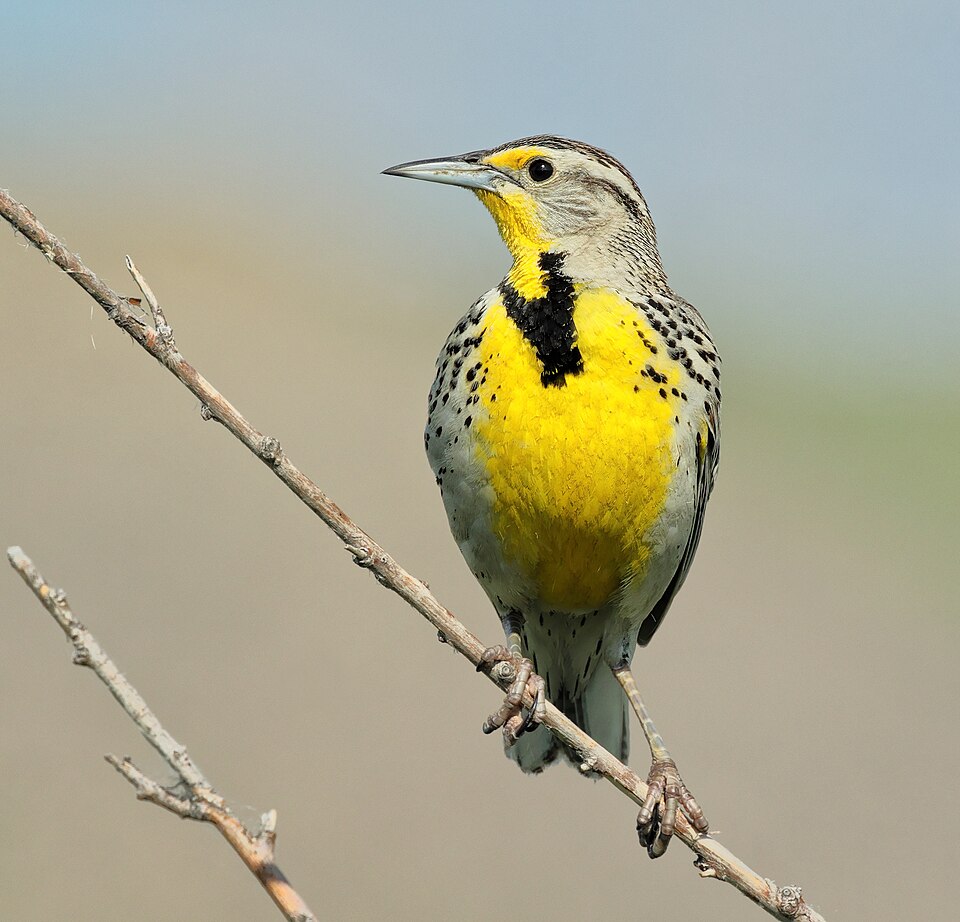
A streaky brown grassland bird with a bright yellow chest and black V, best known for its flute-like, gurgling song from a fence post.
Presence varies. Bird presence and timing change with location, weather, habitat and migration. Treat this page as a starting point, then check recent local sightings (for example on eBird) before you go.
Identification features
- A bright yellow throat and breast carry a bold black V, though the V is partly hidden by buff feather edges in fall.
- The upperparts are streaked brown, buff and black, making the bird nearly invisible in grass.
- Look for white outer tail feathers that flash when it flies or flicks its tail.
- The bill is long and pointed, and the legs are pinkish and sturdy.
- It flies low with rapid wingbeats followed by short glides.
- The call note and song separate it from the Eastern Meadowlark more reliably than plumage.
Size and appearance
This is a chunky, medium-sized songbird with a short tail and a long, sharp bill. The back is a patchwork of brown, black and buff streaks that blends with dry grass. Below, the throat and chest are lemon yellow, crossed by a black V-shaped band. The yellow reaches slightly onto the cheek, which is one clue against its eastern relative. In fall and winter the feather edges turn buffier and the V looks muted. Males and females look much alike, with females slightly smaller. Young birds resemble duller adults, with a paler, less crisp pattern on the breast.
Bill: A long, pointed, slightly stout bill suited to probing soil and grass.
Habitat
Western Meadowlarks live in open country where grass is the main cover. Natural prairies, meadows, pastures and rangeland are the core habitats. Weedy abandoned fields and some cropland also hold nesting birds. Where its range overlaps with the Eastern Meadowlark in the Midwest, the Western tends to favor shorter, drier grass. After nesting it spreads into stubble fields and other farmland, where the loose flocks pick through leftover grain and weed seeds. Tall fence posts, utility wires and small mounds give males places to sing from, so roadsides through grassland are often good places to look.
Geographic range
This is mainly a bird of the western two-thirds of the US and adjacent Canada. Breeding birds occupy the Great Plains, the Great Lakes margins, the Rocky Mountain region, the Southwest, California and the Northwest. In winter many northern breeders move south, so the species spreads through the southern Plains, Texas, the Southwest and California, and a smaller number reach the Southeast. It is mostly absent from the Northeast, and details of how far east it extends in winter are not fully covered here. The Eastern Meadowlark takes over in much of the East.
Seasonal presence
In the northern Plains and Rockies, Western Meadowlarks arrive early in spring, sometimes while snow is still patchy, and males start singing right away. Summer is the breeding season, when territorial males sing from posts. Fall departures come fairly late, and some birds linger well into the cold months. Winter flocks gather in stubble and pastures farther south. In parts of the Southwest, California and the southern Plains the species can be present nearly year-round. Timing shifts with latitude, elevation, drought and snowfall, and in dry western areas summer numbers can depend on spring rain.
| Region | Spring | Summer | Fall | Winter |
|---|---|---|---|---|
| Southeast | Not typical | Not typical | Not typical | Present |
| Midwest | Present | Present | Present | Present |
| Southwest | Present | Present | Present | Present |
| Pacific West | Present | Present | Present | Present |
A dot means the species is regularly present in that region in that season. Dates shift with latitude, elevation, weather and migration, and some regions are only partly covered by the species’ range.
Diet
Western Meadowlarks eat mostly insects through the warm months, including beetles, grasshoppers, crickets, caterpillars and ants, along with spiders, snails and sowbugs. Seeds and waste grain make up roughly a third of the yearly diet, mostly in fall and winter. They forage by walking over the ground and probing the soil with the bill, often opening it to pry apart grass and dirt. The species rarely visits feeders, but now and then it takes cracked grain or seed scattered on open ground in rural settings. Food choices follow what is plentiful locally.
Behavior
A meadowlark spends most of the day on the ground, walking with a steady, deliberate gait and tail flicking. Males perch on a fence post, shrub or low wire to sing and defend a nesting territory, and during courtship they puff the chest, point the bill up, spread the tail and flick the wings. The female builds a domed nest of grass on the ground with a side entrance, tucked under a clump of vegetation. She usually lays about five eggs and incubates them for roughly two weeks. Young leave the nest at around 12 days, before they can fly, and hide in cover while the parents feed them. Many pairs raise two broods in a season. Outside the breeding season, meadowlarks often forage in flocks. Because nests sit in the grass, walking off trails through meadows can crush them without anyone noticing.
Vocalizations
The song is a rich, flute-like series of gurgling and bubbling notes that usually slides downward, and it carries a long way over open country. People often compare it to a musical gurgle ending in a tumble. The most useful call is a dry rattle and a throaty chook or took note. Eastern and Chihuahuan Meadowlarks give a buzzier call and different songs, so listening matters where ranges meet. Males sing most intensely at dawn in spring, but a song may ring out at any time of day. Playing recordings to attract birds should be avoided during nesting.
Recordings are not hosted on this site. For audio, see the sources below. Please avoid playing recordings to attract birds in the field. See Learning Bird Songs and Calls.
Similar species
- Eastern Meadowlark. The two look nearly identical. Voice is the best clue: the Eastern has a clearer, whistled song and a buzzy call, while the Western gurgles and gives a throaty chook.
- Chihuahuan Meadowlark. Found in the Southwest and Mexico, it has more white in the tail and a different, buzzier voice.
- Dickcissel. A much smaller, sparrow-like bird of grasslands that has a smaller black bib rather than a large V and a rufous shoulder patch.
Observation tips
- Scan fence posts, wires and low shrubs along rural roads in spring, then listen for the song before you search for the bird.
- Stay in your car or on the road edge when you can. A car works as a blind and keeps ground nests safe from trampling.
- Do not walk through the grass to get a closer look, and avoid playback of recordings, especially during the breeding season.
- In winter look for flocks in stubble fields and pastures, and check whether any birds have the V and yellow breast showing despite the buff feather edges.
- Use the voice to separate Western from Eastern where their ranges overlap, and note the habitat as well.
Always keep your distance, stay on trails and leave nests alone. See How to Observe Birds Responsibly.
Conservation status
IUCN Red List: Least Concern. The IUCN lists the Western Meadowlark as Least Concern and Audubon calls it widespread and common, but its page also notes survey data pointing to declines in recent decades. Status and trends change, so check the IUCN Red List and current survey summaries for the latest. This guide did not verify specific US legal protections.
Status last checked 2026-11-03. Status and trends change, so check the linked sources for the latest. Search the IUCN Red List.
Questions and answers
How can I tell a Western Meadowlark from an Eastern Meadowlark?
Plumage is very similar, so listen. The Western sings a gurgling, flute-like song and gives a throaty chook, while the Eastern whistles clearer notes and gives a buzzy call. Where ranges overlap, habitat and region help as well.
Where do Western Meadowlarks nest?
They nest on the ground in grass, in a domed nest with a side entrance. Because the nest is so well hidden, avoid walking through meadows in spring and summer, and enjoy the birds from roads and trail edges.
Related entries
Related birds
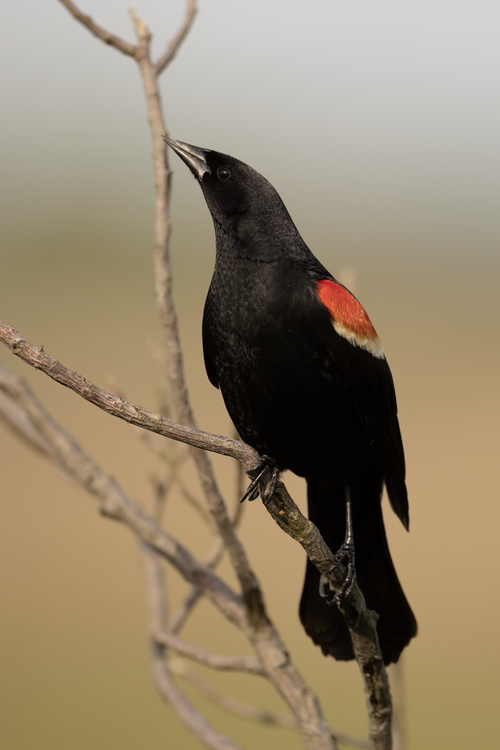
Red-winged Blackbird
Agelaius phoeniceus
A marsh-edge blackbird: males are glossy black with red-and-yellow shoulder patches, females are heavily streaked brown.
- Small
- Wetlands
- Grasslands
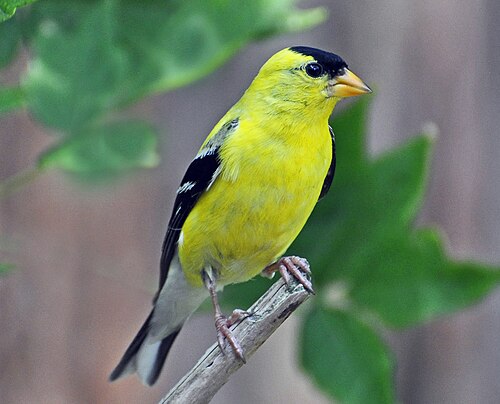
American Goldfinch
Spinus tristis
A small seed-eating finch. Breeding males are bright yellow with a black cap; winter birds turn a muted tan-olive.
- Tiny
- Grasslands
- Backyards
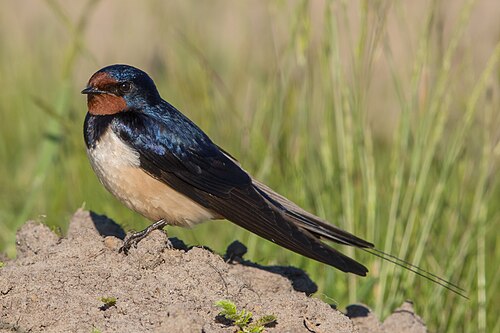
Barn Swallow
Hirundo rustica
A graceful, blue-backed swallow with a rusty throat and a deeply forked tail, often seen skimming over fields and nesting under bridges.
- Small
- Grasslands
- Wetlands
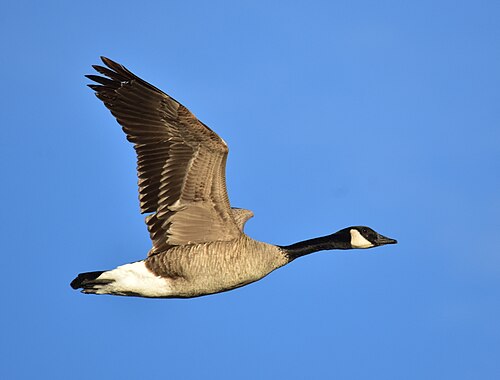
Canada Goose
Branta canadensis
A big brown goose with a black head and neck and a white chinstrap, now common on lakes, golf courses and fields across the US.
- Very large
- Wetlands
- Cities
Related guides
Sources
- Audubon Field Guide — Western Meadowlark
- Wikipedia: Western meadowlark (secondary cross-check of the IUCN category)
Sources are the pages consulted when this entry was written. How we choose and use sources: sources and identification criteria.
Further reading (not used as a source for this entry): All About Birds, Cornell Lab of Ornithology.