
Birding Basics · 8 min read
Choosing Binoculars and Field Gear for Birding
A good pair of binoculars is the one piece of birding equipment worth thinking about carefully. Everything else, from field guides to clothing, can start simple and grow with you. This guide explains what the numbers on binoculars mean, which features matter most, and how to fill out the rest of your kit without overspending.
Decoding the numbers: 8x42 and friends
Every pair of binoculars carries two numbers, such as 8x42. The first is magnification: an 8x pair makes a bird look eight times closer than it appears to your eyes. The second is the diameter of the front lenses, called objective lenses, measured in millimeters. A bigger objective gathers more light, which helps in dim woods or at dawn, but it also adds size and weight.
Audubon’s buying advice recommends 6x, 7x or 8x for birding and says that brightness and field of view matter more than raw power. Its list of suitable sizes includes 6x32, 8x32, 7x35, 8x40, 7x42, 8x42 and 8.5x44. The same guidance warns that ten-power and higher magnify hand shake, can show more heat shimmer, narrow the view and dim the image.
That does not mean 10x is wrong for everyone. Some people hold it steadily and like the extra detail on distant shorebirds or hawks. But for a first pair, something in the 7x to 8x range is easier to aim, easier to find a moving bird with, and more forgiving.
Objective size: bright versus light
Audubon sorts objective lenses roughly into two groups. Full-sized lenses, around 40 to 45 mm, show nearly all the detail your eye can use in all but the poorest light. Midsized lenses, around 30 to 35 mm, are smaller and lighter and give up only a little in dim conditions. Above 42 mm gets heavy for most people to carry all day, and below 30 mm tends to look dim at dusk.
So the choice is a trade. If you bird in shady forests or at first light, a full-sized pair helps. If you walk long distances, travel often or have small hands, a midsized pair may get used more, and the best binoculars are the ones that come along.
Field of view: finding the bird in the first place
Field of view is how wide a slice of the world you see at once. It is often printed as feet at 1,000 yards, or as an angle in degrees. A wide field makes it far easier to find a bird, and to keep a flying one in sight. Audubon says birding binoculars should have an angle of view of at least 6.5 degrees, which equals about 341 feet at 1,000 yards, and gives a conversion: multiply the degrees by 52.5.
Field of view and magnification pull against each other. Higher power usually narrows the view, which is one more reason beginners do well with 8x. Look at the specification sheet when you compare models, because two pairs with the same 8x42 label can differ noticeably.
Close focus, eye relief and the focus knob
Close focus is the nearest distance at which the binoculars can form a sharp image. It matters if you watch feeders, butterflies or nearby warblers. Audubon’s buying article does not give a number, so check the manufacturer’s specification and, if you can, test the pair on something near. Many birders look for models that focus closer than about ten feet, but that is a rule of thumb from retailers and birding guides, not a standard.
Eye relief is how far your eye can sit behind the eyepiece and still see the full image. It matters most if you wear glasses. Audubon says birder-oriented models offer 15 to 20 mm. If you wear glasses, keep the eyecups twisted fully down. If you do not, extend them fully. If you see black edges or rings in the view, set the cups partway.
Finally, consider the focus mechanism. Audubon advises a single center focus knob that turns about one to one-and-a-half times from near to far, because separate focus adjustments on each barrel are too slow for moving birds. Set the diopter ring, which adjusts for differences between your eyes, by focusing with one eye at a time.
Weight, durability and price tiers
Weight is easy to ignore in a store and very obvious after three hours on a trail. Try holding the binoculars up to your eyes for a full minute, then put them on a neck strap or chest harness and walk around. Neck strain is a common reason people stop using a pair. A harness spreads the load across the shoulders.
Prices vary enormously, and I will not rank products here. In rough tiers, entry-level pairs sit at the low end, mid-range pairs cost several times more and often bring better glass, a wider view and tougher build, and premium pairs cost much more again. Audubon’s beginner advice suggests saving toward the range of about $120 to $180 as the point where optics become worth the money, and its binoculars article says that cheap models are often junk. For anything over about $200, it says to expect waterproof, nitrogen-purged construction so the lenses do not fog inside in humid weather.
Skip zoom binoculars and image-stabilized models for a first pair. Audubon notes they are heavy, lose brightness and have a smaller field of view. Test in person if you can: many nature centers, Audubon chapters and outdoor shops let you compare several pairs, and some libraries lend binoculars. Check the return policy if you buy online.
Field guides, apps and checklists
A field guide organizes birds so you can compare them. Printed guides never run out of battery and show similar species side by side. Phone apps are searchable and often include songs. Many birders end up using both. Audubon’s beginner article names the Kaufman Field Guide to Birds of North America as a popular choice for newcomers; the best guide is the one you will open, so look at a few and pick one with clear illustrations or photos and range maps.
Two free apps come up often. Merlin Bird ID, from the Cornell Lab of Ornithology, can suggest species based on a few questions, a photo or recorded sound, and it can download regional bird packs. The Audubon Bird Guide app includes songs, calls and species details, and draws on eBird data to show birds reported near you. Both are tools for suggestions, not final answers, and their accuracy depends on how clear your input is. Download any regional data before you head somewhere with a weak signal.
eBird, also from the Cornell Lab, is both a tool and a database. You log what you see on a checklist, and the records feed research and conservation. A free Cornell account works across eBird and Merlin. Use the species lists for your county to get a sense of what is likely, and keep in mind that the lists reflect when and where other people have looked.
Notebooks and a record-keeping kit
Audubon’s beginner list calls for a waterproof notebook, and with good reason: a damp page is useless. A small, pocket-sized notebook with a pencil or a pen that writes in the rain does the job. Note the date, place, weather, and what you saw. A few sketches help you notice details, even if your drawings are rough.
If you prefer digital notes, use your phone’s notes app or the eBird app, but bring a backup plan for dead batteries and cold fingers. Some birders keep a small card with local species they want to learn, which keeps a walk focused.
Clothing and comfort
Dress for the weather and the habitat. Layers are the most flexible option: a base layer, an insulating layer and a waterproof shell let you adjust as the day warms. Earth tones such as green, brown and gray blend in better than bright colors or white. Wear quiet fabrics, since stiff nylon can swish.
Footwear should suit the terrain. Waterproof boots help in marshes and wet grass, while light trail shoes work in dry parks. A hat with a brim cuts glare and keeps rain off your glasses. In many regions you will want sunscreen, insect protection and long sleeves and pants for ticks. Check local conditions, since insects, snakes and heat vary by region and season.
Carry water and a snack, and tell someone where you are going when you head out alone. In winter and at dawn, gloves that let you operate binoculars help. A small pack keeps things tidy and hands free.
What to skip, and what to add later
You do not need a spotting scope, a camera with a long lens, or a recorder at the start. A spotting scope becomes useful when you want to study distant shorebirds, ducks or hawks. Cameras add a layer of responsibility: if you use one, follow the guidance in How to Observe Birds Responsibly, including distance from nests and avoiding flash.
Once you own gear you trust, the beginner’s guide will help you plan your first walks, and the Bird Finder can help you identify what you spot. For practice, try watching a common species such as the Northern Cardinal or Downy Woodpecker until you know their shapes at a glance.
Frequently asked questions
Is 8x42 or 10x42 better for beginners?
Most beginners find 8x42 easier. It shows a wider view, so finding birds is simpler, and it shakes less in your hands. Audubon recommends 6x to 8x and cautions that higher powers narrow the view. If you have steady hands and like detail, try 10x in a store first.
How much should I spend on binoculars?
Audubon suggests saving toward roughly $120 to $180 as the point where optics start to be worth the cost, and says cheap models are often poor. Prices change, and more money usually buys sharper, wider, tougher binoculars. Try several pairs in person if you can.
Do I need a field guide if I use an app?
Not strictly. Apps like Merlin Bird ID and Audubon’s guide cover many species and include sounds. A printed guide is still handy because it needs no battery or signal and shows similar species side by side. Many birders use both.
Birds mentioned in this guide
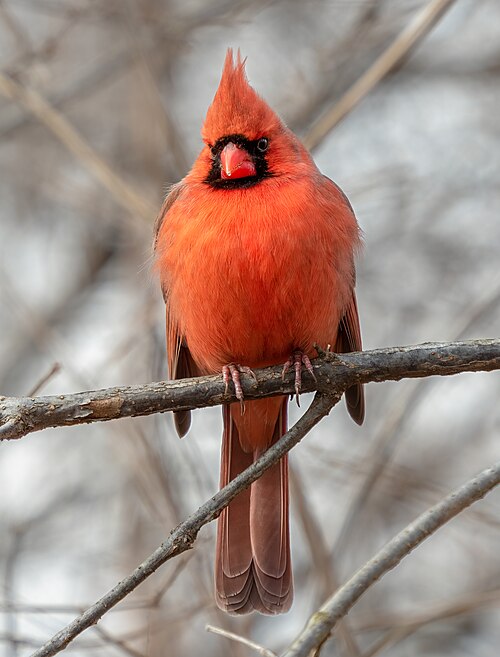
Northern Cardinal
Cardinalis cardinalis
A crested, year-round songbird. The male is brilliant red with a black face; the female is warm tan with red accents.
- Medium
- Backyards
- Forests
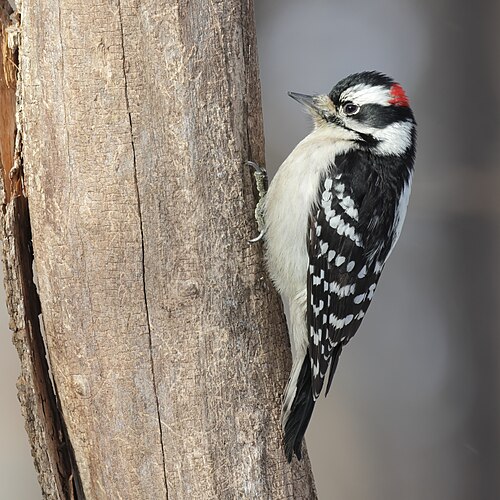
Downy Woodpecker
Dryobates pubescens
The smallest woodpecker in North America, a black-and-white bird with a short bill that visits suet feeders and tiny branches.
- Small
- Forests
- Backyards
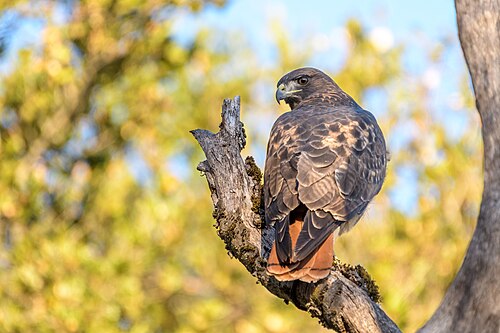
Red-tailed Hawk
Buteo jamaicensis
The most common large hawk in North America, often seen soaring over fields or perched on roadside poles, with a brick-red tail as an adult.
- Large
- Grasslands
- Forests
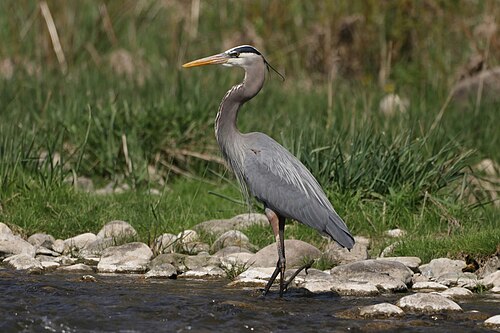
Great Blue Heron
Ardea herodias
North America’s largest heron, a tall gray-blue wader that stands motionless in shallows and strikes with a spear-like bill.
- Very large
- Wetlands
- Coastlines
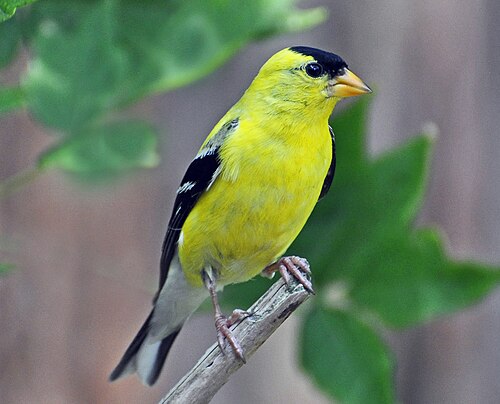
American Goldfinch
Spinus tristis
A small seed-eating finch. Breeding males are bright yellow with a black cap; winter birds turn a muted tan-olive.
- Tiny
- Grasslands
- Backyards
Keep reading
Sources
- Audubon — How To Choose Your Binoculars
- Audubon — How to Start Birding
- eBird Help — Getting started with eBird checklists
- Audubon — Guide to Ethical Bird Photography
Sources are the pages consulted when this entry was written. How we choose and use sources: sources and identification criteria.